Get Full Government Meeting Transcripts, Videos, & Alerts Forever!
Get email alerts on the Legislation Session Roundup topic
No spam. Unsubscribe anytime.
Utah Senate debates specialty-plate revenue, flags and immigration as it clears a slate of bills
Summary
The Utah Senate spent the morning on heated debate over where proceeds from the popular black specialty license plate should go, a divisive proposal to restrict flags on public property and classrooms, and a criminal bill tied to immigration enforcement, then advanced a large group of bills on second and third reading.
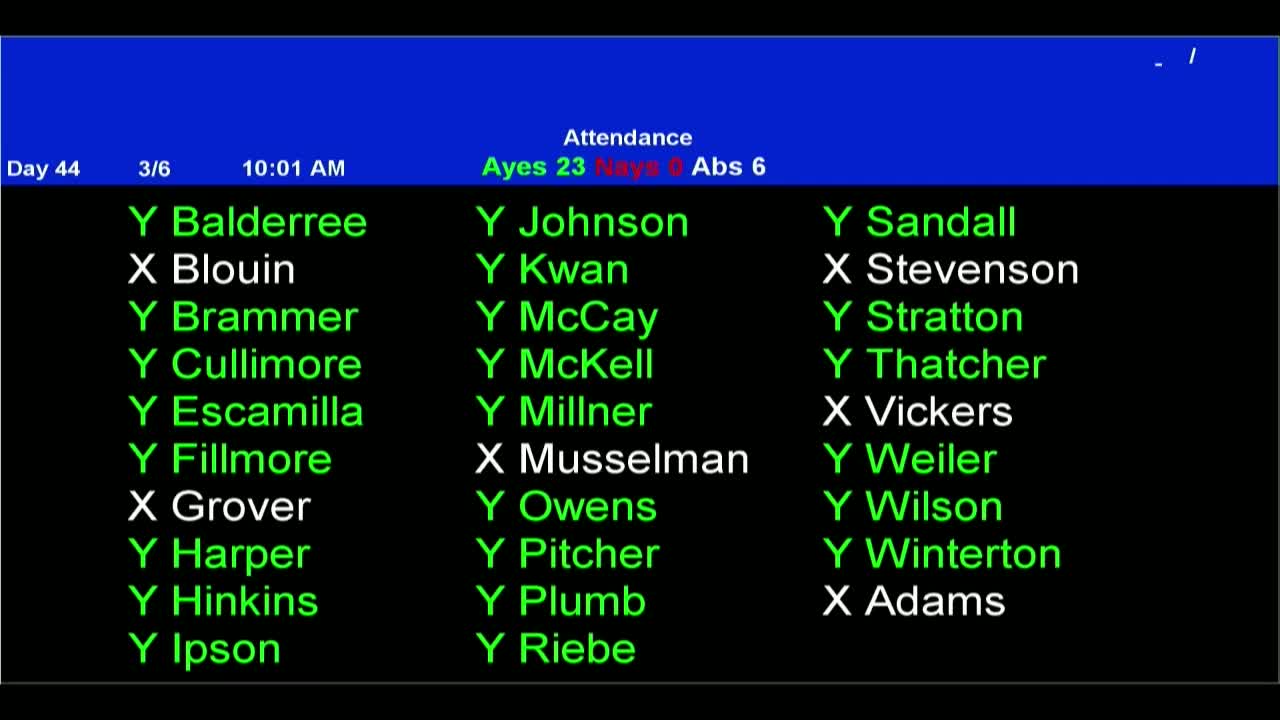
The Utah Senate met in session and debated several high-profile policy questions before approving multiple bills and sending them back to the House. Lawmakers argued over whether windfall proceeds from a popular black specialty license plate should be capped and returned to the general fund, considered limits on flags and other displays at government buildings and in classrooms, and debated a criminal-justice measure that would affect deportation referrals for certain convictions. The Senate then took a series of recorded votes and substituted several bills on the second- and third-reading calendars.
Why it matters: The specialty-plate debate touches state budgeting and funding for the Utah State Historical Society; the flag measure raises free-speech and local-government authority questions; and the criminal/immigration-related bill involves federal immigration consequences that senators said would affect how Utah handles certain convictions. Each item could change who controls money, whose speech is allowed on public property, and how state courts and law enforcement interact with federal immigration authorities.
The specialty plate windfall
Senator Fillmore, the bill sponsor, told colleagues the state did not anticipate the black specialty plate would generate the level of revenue it did and said the bill balances that unexpected windfall with broader state budget priorities. “This is a win-win,” Fillmore said, describing a one-time appropriation of $3.5 million to the Utah State Historical Society while capping future annual distributions to that nonprofit at $300,000 and sweeping excess to the general fund.
Senator Eby opposed the change, calling it a “bait and switch” and saying many people who purchased the plate did so to support the historical society. Senator Vickers and others defended the swap as a fiscal move to let the money compete with other state priorities in the general fund. Senators asked whether the recurring per-plate payment would be $2 ongoing and whether a $300,000 cap applies; Fillmore confirmed the cap and the one-time appropriation in the bill text. Lawmakers also discussed private-brand and corporate plates that the bill would permit; Fillmore said those provisions allow new plate types but do not give their proceeds to corporations.
Flag display and classroom speech proposal
Senator McCain, sponsor of the flag-display bill, described the proposal as an effort to preserve political neutrality on the exterior of government buildings and, in some language, in classrooms. The measure drew sharp debate. Supporters argued government buildings should not be used as a vehicle for the majority’s political message. Opponents said restrictions would curtail legitimate local-government expression and limit free speech. Senator Pitcher offered an amendment to exempt cities and counties from the bill on the grounds that case law recognizes government entities’ own speech rights; the Senate adopted that amendment. Senators drew on past litigation and memorial displays in discussing how courts balance government speech and viewpoint concerns.
Criminal amendments and immigration consequences
Senator McKay sponsored a substitute criminal bill that increases the maximum sentence for certain crimes against persons from 364 to 365 days and directs local law enforcement and courts in how to report immigration status to federal authorities. McKay said the changes narrow the qualifying offenses and were intended to remove incentives for serious offenders to remain in Utah. Opponents—including Senator Escamilla and others—said the bill risks removing due process for lawful noncitizen residents because federal immigration proceedings and detention rules can be triggered by day-count classifications and sentencing maxima. Senator Thatcher and other members of the sentencing commission said federal definitions and practice create complex interactions with state misdemeanor definitions and cautioned the change could accelerate detention for people legally present in the United States; Senator McHale and others urged the Senate to follow the legislative process that led to the current substitute.
Votes at a glance
The Senate took final or disposition votes on a slate of bills. (Tallies below reflect roll-call results recorded on the floor.)
- Third substitute House Bill 372 (Dental Practice Amendments): Motion to pass under suspension of rules carried; 25 yea, 2 nay, 2 absent. Sponsor: Senator McCall. - Second substitute House Bill 4 54 (Local Government Fees Modifications): Passed this body on the floor (result recorded as 14 yea) and sent to the House for further consideration. Sponsor(s): discussed by Senator Brammer on substitution. - Third substitute House Bill 4 91 (Behavioral Health Modifications): Passed; 25 yea, 0 nay, 4 absent. Sponsor: Senator Vickers. - Fourth substitute House Bill 4 44 (Government Data / Data Privacy Amendments): Passed; 26 yea, 0 nay, 3 absent. Sponsor: Senator Cullimore. - Third substitute House Bill 2 56 (Municipal and County Zoning / related amendments as read on the floor): Passed; 27 yea, 1 nay, 1 absent. Sponsor: Senator Vickers. - Third substitute House Bill 191 (High School Credit Amendments): Passed; 17 yea, 10 nay, 2 absent. Sponsor: Senator Fillmore. - Second substitute House Bill 92 (Individual Detention / citizen's arrest amendments): Passed; 24 yea, 0 nay, 5 absent. Sponsor: Senator Wilson. - First substitute House Bill 3 79 (Population Data Amendments): Passed; 23 yea, 0 nay (absent count recorded on the floor). Sponsor: Senator McKell. - First substitute House Bill 2 48 (Veteran Protections Amendments): Passed; 26 yea, 0 nay, 3 absent. Sponsor: Senator Stevenson. - Fourth substitute House Bill 2 26 (Criminal amendments discussed above): Passed; 21 yea, 8 nay, 0 absent. Sponsor: Senator McKay. - Second substitute House Bill 128 (Dangerous Weapon at School Amendments, recodification and clarification): Passed; 25 yea, 0 nay, 4 absent. Sponsor: Senator Musselman.
What’s next
Several items were placed on calendars for further action and a conference committee was appointed on at least one bill the House declined to concur on. The Senate recessed for lunch and scheduled further floor action in the afternoon. For bills returned to the House, the next step is return to the House for the speaker’s signature or further conference if the House refuses to concur.
Ending
Several senators urged decorum during floor debate and a reminder of Senate rule SR2-2-204 (on impugning motives) was distributed. The Senate recessed at the close of the morning session and planned to reconvene later in the day.