Get Full Government Meeting Transcripts, Videos, & Alerts Forever!
Get email alerts on the E Waste Stewardship topic
No spam. Unsubscribe anytime.
Committee recommends passage of broad e‑waste stewardship bill after hours of testimony
Summary
The Environment, Climate, and Legacy Committee voted 5–4 on March 6, 2025 to recommend passage of Senate File 1690 as amended, a statewide electronic‑waste stewardship plan that would require producers to fund collection and recycling and create a single nonprofit stewardship organization.
The Environment, Climate, and Legacy Committee voted 5–4 on March 6, 2025 to recommend passage of Senate File 1690 as amended, a statewide electronic‑waste stewardship bill that would require producers to fund collection, processing and consumer education while establishing a single non‑profit stewardship organization to administer the program.
Supporters told the committee the existing Minnesota electronics stewardship law is out of date, leaving counties and recycling operations to cover rising costs and safety risks from lithium batteries. “Minnesota’s e‑waste contains an estimated $3,100,000,000 worth of valuable metals annually,” Maria Johnson, co‑director of RECAP, told the committee, arguing better collection could create thousands of jobs and make local processors run at full capacity.
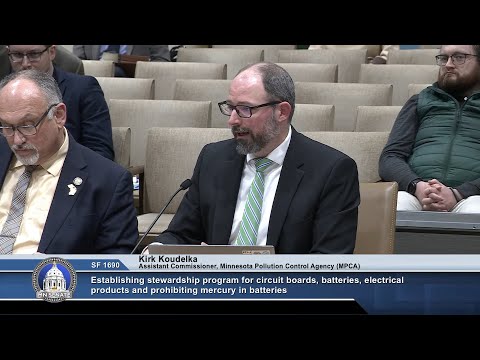
Why it matters: County officials and recyclers said fires from batteries are increasing insurance and operating costs and that current producer programs are not capturing many devices. Kirk Adelka, assistant commissioner with the Minnesota Pollution Control Agency, said the MPCA supports the bill “due to the benefits, in regards to fire safety, economic and environmental and human health benefits,” and told senators manufacturers required under current law still are not meeting collection obligations.
What the bill would do: As amended in committee, SF 1690 would expand the list of covered products to include a broad set of items with batteries, cords or circuit boards; require producers to contract with a single stewardship organization that submits a statewide plan for MPCA approval; set minimum collection convenience standards for counties and communities; and create a reimbursement board to recommend collection and recycling rates to ensure collectors and recyclers are paid for documented costs.
Supporters’ claims and evidence: Hennepin County Commissioner Debbie Goettel and Itasca County Commissioner John Johnson described local costs and fires attributed to lithium batteries, including a transfer‑station fire and rising insurance and maintenance bills. Lucy Milani, director of policy and advocacy at Eureka Recycling, described repeated fires at material‑recovery facilities and said insurance costs have risen sharply. Aaron Klemens of the Minnesota Center for Environmental Advocacy emphasized recovery of critical minerals for the clean‑energy transition and cited low current capture rates.
Industry concerns and opposition: Retailers and manufacturers urged caution. Tim Dunn, Best Buy’s head of environmental sustainability and compliance, said Best Buy operates voluntary recycling programs and opposed the bill as drafted, arguing the proposal “goes well beyond fixing the shortcomings of the current Minnesota law” and would be an unprecedented expansion without a meaningful stakeholder process. Katie Riley of the Consumer Technology Association and representatives from the Minnesota Retailers Association, the Chamber of Commerce, NEMA and trade groups for batteries and appliances also raised concerns about the bill’s scope, a single‑operator stewardship structure, potential costs to small businesses and competition effects.
Process and oversight questions raised in committee: Senators questioned how many collection locations the plan would require (agency staff estimated roughly 200 statewide to meet the convenience standard), who could be a registered collector, and whether a single stewardship organization could set fees while also nominating members of the reimbursement board. Assistant commissioner Kirk Adelka (identified in testimony) said collectors must meet agency performance criteria and that the stewardship plan and fees would be submitted to the MPCA for approval with a public comment period. Committee members also asked about remedies for so‑called “free riders” — producers that do not enroll — and were told the plan includes enforcement tools and a limited private right of action to recover costs from non‑compliant producers.
Vote and next steps: Senator Coolidge moved the committee recommendation to pass SF 1690 as amended; the committee adopted the motion by roll call, 5 in favor and 4 opposed. The recommendation sends the bill to the State and Local Government Committee for further consideration.
Questions left open: Committee members repeatedly pressed for detailed cost estimates, the final composition and powers of the reimbursement board, and whether online sales and small producers would be covered; testifiers and agency staff said many details would be set in the stewardship plan and in future rulemaking and contracts between the stewardship organization and collectors/recyclers.
Votes at a glance: Senate File 1690 (as amended) — Motion to recommend passage and refer to State and Local Government: moved by Senator Coolidge; outcome: recommended to pass; committee tally 5–4 in favor.