Get Full Government Meeting Transcripts, Videos, & Alerts Forever!
Get email alerts on the Land Use Housing topic
No spam. Unsubscribe anytime.
Sedro-Woolley debate centers on ‘shadow platting’ as a tool for gradual infill; staff and former city attorney warn about infrastructure costs
Summary
Planning staff recommended adding a ‘shadow platting’ tool to Sedro-Woolley’s code to allow staged subdivision that still meets the state’s 4-dwelling-units-per-acre density requirement; the council debated whether the approach would help homeowners or shift infrastructure costs to taxpayers.
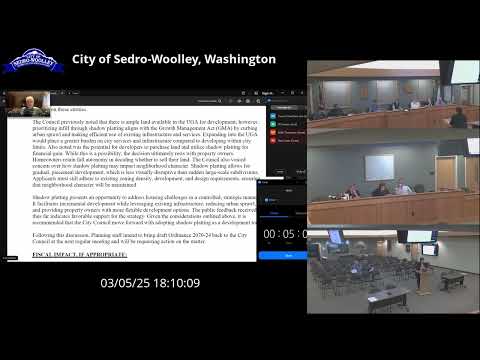
Planning staff presented a proposal to add “shadow platting” to the Sedro-Woolley municipal code as a tool to allow gradual infill while meeting the state’s minimum-density expectations, and council members spent more than an hour debating benefits and risks.
Nicole (planning staff) told the council that staff convened public outreach and that 44 respondents to the housing strategies survey showed 74 percent support for shadow platting (she cautioned the sample was small). She described shadow platting as a way to “allow large lots to be subdivided below the standard density as long as the future development meets 4 units per acre,” enabling staged development that can make small-scale projects financially feasible for property owners.
Nicole said staff recommends moving forward and returning draft ordinance 2000724 for council action at a later regular meeting; she also proposed code edits that would require applicants to undergo SEPA environmental review for the full property and to install sewer infrastructure or meet public-works standards so partial development does not leave infrastructure gaps.
Pat Hayden, a former city attorney and planner in the audience, urged caution. He told the council his experience with similar shadow-planning approaches used by the county produced “pockets” of development on septic tanks and gravel driveways that later proved expensive to bring up to city standards. “The thing about shadow planning is it's an excuse not to do full infrastructure,” Hayden said, warning that allowing development without concurrent utilities shifts the long-term cost of sewer and streets to taxpayers and to future owners who may not be able to afford retrofit connections.
Council members split over the tradeoffs. Several members, including Councilman Burns and Councilman Lavaca, said shadow platting could give homeowners a way to sell or build a single house on large lots without forcing full-scale subdivision and could help the city avoid rezoning more land for high-density apartments. Other members, including Councilwoman Casti and Councilwoman Diamond, worried it could invite the very piecemeal development that makes later infrastructure improvements prohibitively expensive and could be used by developers to avoid building full infrastructure.
Multiple council members asked staff whether the proposed code could be written to require infrastructure up front; Nicole said the code can be made restrictive and could require that the applicant install sewer and other utilities to accommodate full potential buildout. Hayden and others recommended that any shadow-plat authority be coupled with clear SEPA/mitigation rules and administrative discretion so planning staff can deny shadow platting where infrastructure is absent.
A local resident, Paul Heem, described a real case near his farm where a family wanted to sell the house but keep farmland in production; he said a shadow-plat tool could be useful in that circumstance.
No formal vote was taken. Staff will revise draft ordinance language—adding the proposed SEPA and sewer requirements and clarifying administrative review criteria—and return the draft for future council consideration alongside ongoing comprehensive-plan work.