Get Full Government Meeting Transcripts, Videos, & Alerts Forever!
Get email alerts on the State Fair Funding topic
No spam. Unsubscribe anytime.
Hearing on Senate Bill 2009: State fair seeks $2.84 million for exhibitor premiums, security and restrooms
Summary
At an Appropriations - Education and Environment Division hearing, North Dakota State Fair officials asked lawmakers to fund exhibitor premiums and capital improvements, including $1 million for security upgrades and $1.2 million for a new restroom facility; no committee action was taken.
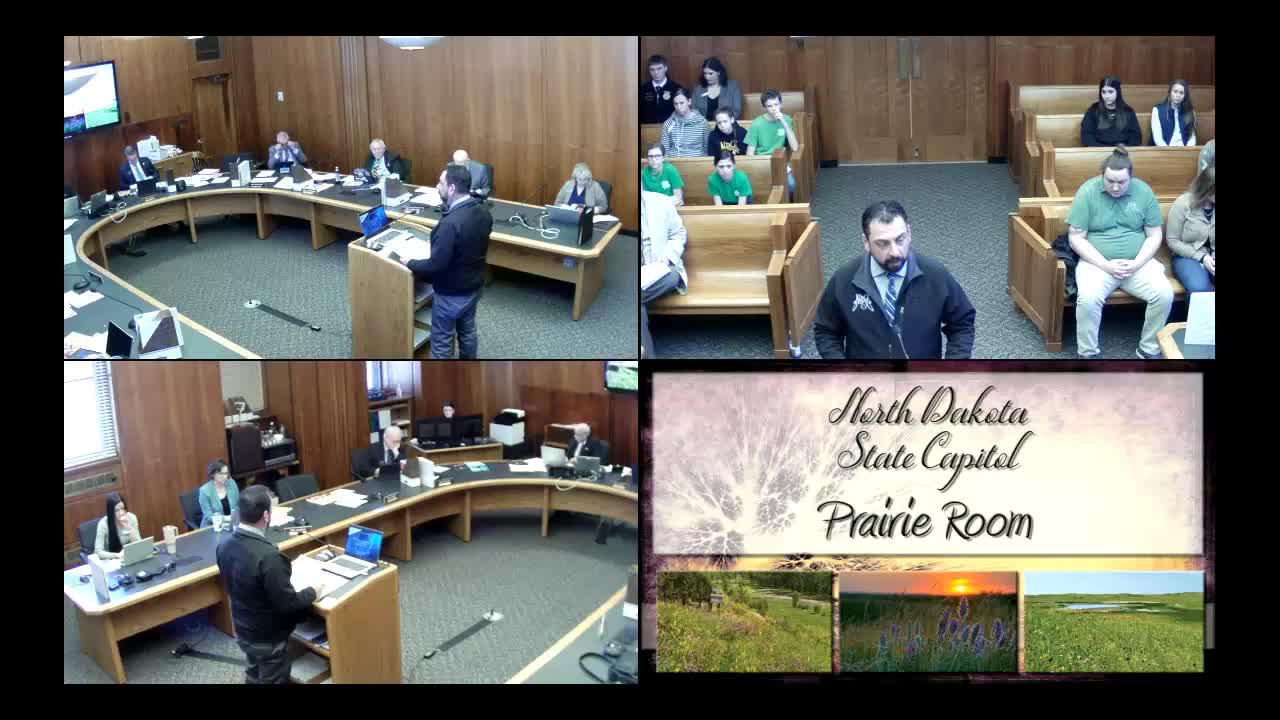
Senate and House appropriations committee members heard testimony on Senate Bill 2009 on Oct. 12, 2025, as North Dakota State Fair officials requested funding for exhibitor premiums and capital improvements including security upgrades and a new restroom facility.
The hearing focused on three funding requests tied to the fair: (1) premium payments for 4‑H, FFA and open‑class exhibitors; (2) a $1,000,000 request to expand security and communications infrastructure at the fairgrounds; and (3) a $1,200,000 request for a new restroom and shower facility in the east camping area. Craig Rudlett, manager of the North Dakota State Fair, and Aaron Atmar, assistant general manager, described attendance, finances and the proposed uses of the requested funds.
"Every dollar from this appropriation is 100% paid out to 4 H FFA open class exhibitors," Craig Rudlett said, describing the proposed premium funding. Rudlett told the committee the fair drew just over 342,000 visitors in 2024 and that the operation runs on a roughly $12,000,000 cash reserve. He said the fair has set aside about $6,000,000 for a planned reroofing of the State Fair Center and has previously invested roughly $800,000 in security cameras.
Aaron Atmar laid out the security portion of the amended bill, which he described as a package of communications and physical‑security improvements intended to help staff, vendors and visitors respond in weather or public‑safety events. Atmar said the request covers a grounds‑wide paging system, upgraded two‑way radios and repeaters to improve communications in large crowds, upgraded and additional high‑megapixel cameras including license‑plate recognition, vehicle‑barrier installations and expanded high‑visibility lighting. "For the safety and security portion of this request, we are seeking $1,000,000," Atmar said.
Atmar also described the restroom project for the east camping area, which would include full bathrooms, showers, a family restroom, and washers and dryers to serve exhibitors, vendors and campers who often stay on site for multiple days. He said camping demand has grown and that First District Health has increased spacing requirements for camper units. The proposed restroom project cost was presented as $1,200,000; Atmar noted that, per a Senate Appropriations amendment in the committee packet, there is a potential cost‑share or matching arrangement that would reduce the state's share ("a 75.25 match not to exceed $900,000," he said, adding uncertainty about the exact wording).
Youth exhibitors and 4‑H/FFA representatives provided extended testimony on the importance of premium checks to allow young people to defray project costs and continue participating. Joe Lindbergh, identified as the 2024–25 North Dakota State Fair reporter, told the committee the bill would allocate $642,833 for premiums to exhibitors and described premiums as reinvestment in future projects and career pathways. Several student witnesses—Samantha Springer, Nathan Springer, Haley McLeod, Noah Prozovsky, Gianna Prozovsky, Emmalyn Herman, Audrey Herman, Bailey (last name redacted) and Sofia Voigt—described how premiums underwrite supplies, motivate participation, and support opportunities that reach local businesses when families travel to the fair.
Committee members asked about timing, procurement and matching. When asked whether security upgrades could be in place for the coming fair, Atmar said some items (cameras, barriers and lighting) could be deployed quickly if funds were available and if the bill included an emergency clause; he said communications upgrades tied to state procurement rules might take longer. Rudlett described insurance limits on headline acts and explained the board keeps a cash reserve partly to cover large contracted acts and other contingencies. The fair employs up to 500 people during the nine‑day event and reported an annual labor cost for on‑site law enforcement of roughly $150,000.
Chairman Nathan closed the hearing without a committee vote; the committee did not take formal action on the bill during this session and indicated the matter would return to appropriations work. Representative Lausser was identified as the committee point person who will follow up with fair officials on details and cost estimates.
The committee adjourned for the day and scheduled to reconvene the next morning on an unrelated budget item. No formal appropriation was adopted at the hearing.