Get Full Government Meeting Transcripts, Videos, & Alerts Forever!
Get email alerts on the Local Tax Policy topic
No spam. Unsubscribe anytime.
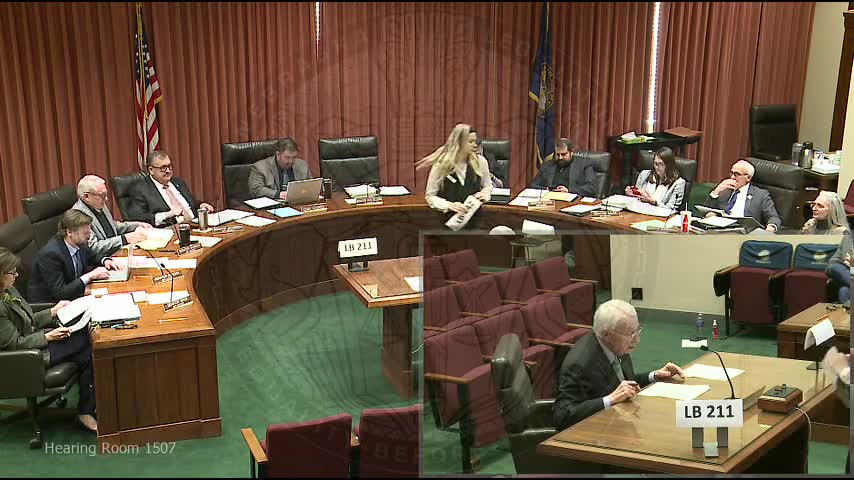
LB211 would give small local governments a 2% growth floor if public‑safety spending is low, proponents tell committee
Summary
Senator Merv Riepe told the Revenue Committee LB211 would provide a minimum growth factor for political subdivisions whose property‑tax‑funded public‑safety spending is under 20 percent of the local property‑tax budget.
Senator Merv Riepe told the Revenue Committee LB211 is a targeted adjustment to the Property Tax Growth Limitation Act intended to help smaller counties and municipalities that cannot make use of the public‑safety exception in LB34. Under LB211, if a political subdivision’s property‑tax‑funded spending on public safety is less than 20% of its total property‑tax‑funded budget, its property‑tax request authority could increase by the greater of 2% or the inflation percentage. If public‑safety spending equals 20% or more, the political subdivision would be governed by the existing LB34 formula (the greater of 0% or the slice index).
John Cannon, executive director of the Nebraska Association of County Officials, testified in support and described county‑level budget patterns. Cannon told the committee that when the fiscal note was recalculated using property‑tax‑funded shares rather than total budget shares, roughly 10 counties would be affected under the proposed 20% threshold — Arthur, Banner (in a five‑year average), Blaine, Boyd, Cedar, Greeley, Hayes, Holt, McPherson, Pawnee and Wheeler were cited in testimony as among the smallest counties whose property‑tax funded public‑safety shares fall below 20% in some analyses. Cannon said the 20% threshold is meant to recognize that many small counties’ budgets are driven by infrastructure rather than public safety.
Lynn Rex of the League of Nebraska Municipalities said the league strongly supports LB211, noting Nebraska has many villages and small municipalities that lack large public‑safety budgets and need some ability to keep pace with inflation or modest growth in costs. Committee members probed whether the 2% floor might create an incentive to alter spending classifications to access the higher growth factor; witnesses rejected that characterization. During questioning Representative Cannon pushed back on a characterization that the bill "defunds the police," calling that "a wholly inaccurate way of putting it."
The committee received proponent letters and opponent letters; the clerk recorded two proponent letters and eight opponent letters in the hearing file. Senators did not take a floor vote during the session; the bill remains in committee while stakeholders continue to offer technical feedback.