Get Full Government Meeting Transcripts, Videos, & Alerts Forever!
Get email alerts on the Insurance Regulation Budget topic
No spam. Unsubscribe anytime.
Insurance commissioner seeks staff and equity funding, supports merging securities into insurance; warns PBM regulation would require more resources
Summary
Insurance Commissioner John Godfried told the Government Operations Division that his department needs four additional FTEs and targeted equity and retirement payouts to handle rising consumer complaints, fraud work and the recently transferred State Fire Marshal functions; he also voiced support for moving securities oversight into the Insurance
John Godfried, North Dakota insurance commissioner, presented the Insurance Department’s budget request and legislative priorities to the Senate Government Operations Division, including staffing requests, salary/equity adjustments, capital needs for the State Fire Marshal, and policy positions on securities consolidation and pharmacy benefit manager (PBM) regulation.
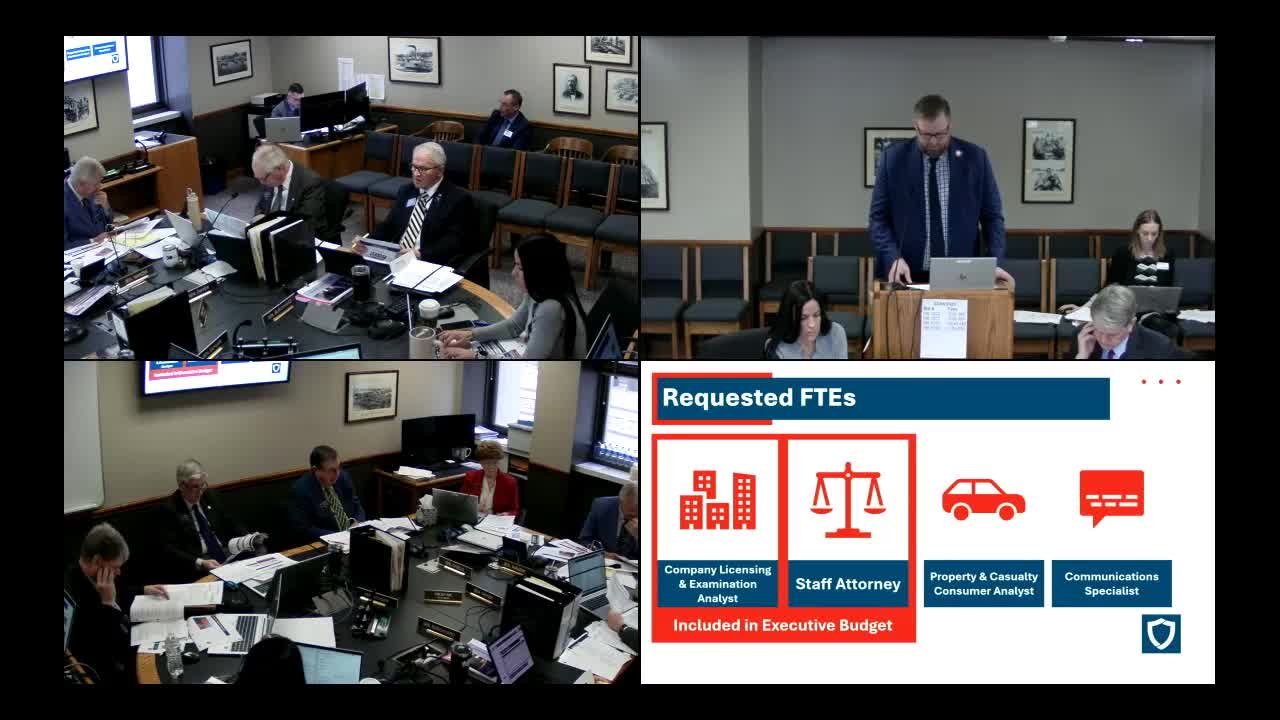
Godfried said the department has added responsibilities since the Fire Marshal’s office transferred in 2023 and that the agency remains fully special‑funded. He asked the committee to approve four new FTEs the department had proposed: an additional attorney (to handle increased legal and fraud workloads and to support the Fire Marshal function), a company licensing and examination analyst (aimed at reducing expensive external consultant spending for insurer examinations), a property and casualty consumer analyst (to address a rising volume of consumer complaints and complex policy disputes), and a communications specialist to expand consumer outreach.
Godfried argued the company‑licensing analyst is a cost‑saving measure: since 2020 the department spent an estimated $458,925 on external exam and IT/actuarial consultants; he said an internal analyst could have reduced those contractor costs materially and would lower future reliance on contractors for planned company examinations. He told senators the four requested FTEs and the department’s 3% salary request would cost about $911,628 in new recurring funds and would raise the agency’s FTE count from 47 to 51.
He also requested targeted non‑recurring and personnel‑related funding: $45,000 for deputy fire marshal salary adjustments, $255,000 in attorney equity adjustments to remain competitive, an estimated $63,250 to cover retirement payouts for two long‑tenured employees, and $20,000 to cover comp‑time and overtime payouts (which Godfried said are difficult to absorb under the state’s pooled FTE funding model). The department also asked for $90,000 in capital assets funding (including $80,000 for a second portable x‑ray imager for the Fire Marshal office and $10,000 in interoperable radios for fraud investigators).
On policy, Godfried said the department supports House bills to modernize some fund flows (House Bill 10 86 and House Bill 11 23 were mentioned) and told the committee he supports transferring the State Bonding Fund and State Fire and Tornado Fund oversight to OMB (House Bills 10 26 and 10 27) because it removes conflicts and aligns risk management with OMB responsibilities.
He also advocated for a merger of the state Securities Department into the Insurance Department (Senate Bill 2,214), telling the committee the change would add regulatory redundancy, legal backfill and shared licensing/producer functions and pointed to 16 other states that have combined securities and insurance regulation. He said the Securities Department had persistent staffing and legal deficits and that costs for outside counsel were unsustainable; the merger, he argued, would improve investor protection and operational oversight.
On pharmacy benefit manager regulation (House Bill 15 84), Godfried warned the committee that well‑crafted PBM regulation would require substantial new resources. He said comparable states that enacted PBM laws used five to seven additional FTEs, and the department would likely see a high complaint volume requiring pharmacist and attorney expertise as well as fraud and company analysts. He told senators he would enforce such laws if passed but urged legislators to attach necessary appropriations rather than passing the mandate without funding.
Committee members questioned whether the department could absorb the Securities Department work without added staff; Godfried said the insurance office has cross‑training, a fraud division with sworn investigators, and internal legal capacity that could provide redundancy but acknowledged a transition plan and possible short‑term budget adjustments would be needed. He emphasized the department’s continued use of special funds rather than general fund dollars and reiterated his request that the committee provide the tools to address the agency’s growing workload and statutory obligations.