Get Full Government Meeting Transcripts, Videos, & Alerts Forever!
Get email alerts on the Property Tax Growth Limitation Act topic
No spam. Unsubscribe anytime.
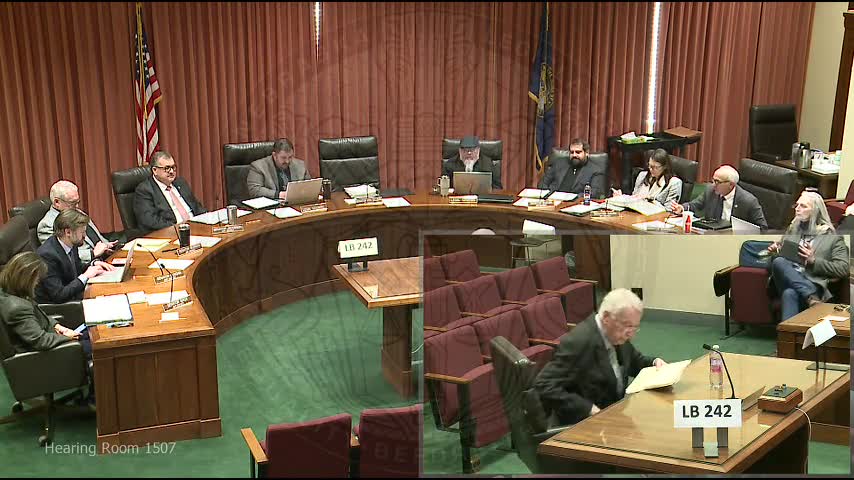
Revenue committee hears LB242 to clarify and fix implementation of LB34 property tax cap
Summary
Senator Merv Riepe and municipal and county representatives told the Revenue Committee LB242 makes technical and operational fixes to the Property Tax Growth Limitation Act (LB34), clarifying growth calculations, transition rules and occupation-tax limits and adding an emergency clause for a July 1, 2025 implementation date.
Senator Merv Riepe introduced LB242 to the Revenue Committee as a package of clarifications and technical changes intended to make the Property Tax Growth Limitation Act (LB34) workable for municipalities and counties ahead of the July 1, 2025 implementation date. "Beginning 07/01/2025, municipalities and counties will be subject to the new property tax cap outlined in the act," Riepe said, and he offered AM 2-73 to clarify how tax-increment financing (TIF) values factor into the growth-value calculation.
Lynn Rex, representing the League of Nebraska Municipalities, described the bill as a budget-procedure priority for local governments, saying, "there is no bill more important than LB 242 because there's nothing more important to a local government than its budget." Rex and other municipal witnesses said the bill aligns definitions across statutes so county assessors and local budget officers do not need to produce inconsistent values for the same parcel under multiple systems.
Nebraska Association of County Officials deputy director Candace Meredith told the committee that when she modeled the LB34 formula in a spreadsheet, a zero percent slice produced an unintended result that "basically the growth percentage would be pretty much wiped out," and said LB242 fixes that so municipalities can capture growth where intended. Meredith and others also described transition language that would allow carryforward of unused restricted‑funds authority into the new property‑tax request authority, capped at 5% of total property taxes levied in 2024.
Other provisions explained to the committee include: amendments to section 13‑5‑18 (lid on restricted funds) to harmonize valuation methods; changes to section 13‑34‑03 to clarify allowable growth and how TIF is counted (AM 2‑73); exceptions in section 13‑34‑04 for some spending categories including substance‑abuse prevention and matching grants; section 13‑34‑05 changes to permit special‑election timing outside a previously narrow window; and a transition mechanism in section 13‑34‑06 to carry forward a limited amount of unused restricted funds.
The bill also removes earlier statutory caps on revenue from local occupation taxes. Mayor Doug Kindig of La Vista said the cap on his city's restaurant tax (described to the committee as a $700,000 cap) would prevent the city from capturing growth tied to tourism and development, and urged removing the cap so cities could rely on occupation taxes instead of raising property taxes. City administrator Jack Cheloha of Ralston (spelling provided in testimony) urged the committee to adopt the AM 2‑73 TIF clarification so cities that currently are at or near levy limits can capture growth when a TIF is completed and the increment becomes available to all taxing jurisdictions.
Committee members asked detailed questions about the public‑safety exception in the growth cap. Senator Tim Kelly and others raised concerns about broadening the public‑safety carve‑out to include behavioral‑health or substance‑abuse programs; proponents said the intent is to allow narrowly defined public‑safety spending to be excluded from the cap when necessary but urged caution in using exceptions.
The hearing concluded with Senator Riepe saying the committee would review the TIF either/or language and that the bill represents cleanup work following passage of LB34. The committee accepted written proponent and opponent exhibits; the clerk recorded four proponent letters and six opponent letters in the official hearing file. No vote occurred during the hearing.