Get Full Government Meeting Transcripts, Videos, & Alerts Forever!
Get email alerts on the Election Administration topic
No spam. Unsubscribe anytime.
Secretary of State outlines technology upgrades, requests shift of election staff to general fund in House Bill 1,002
Summary
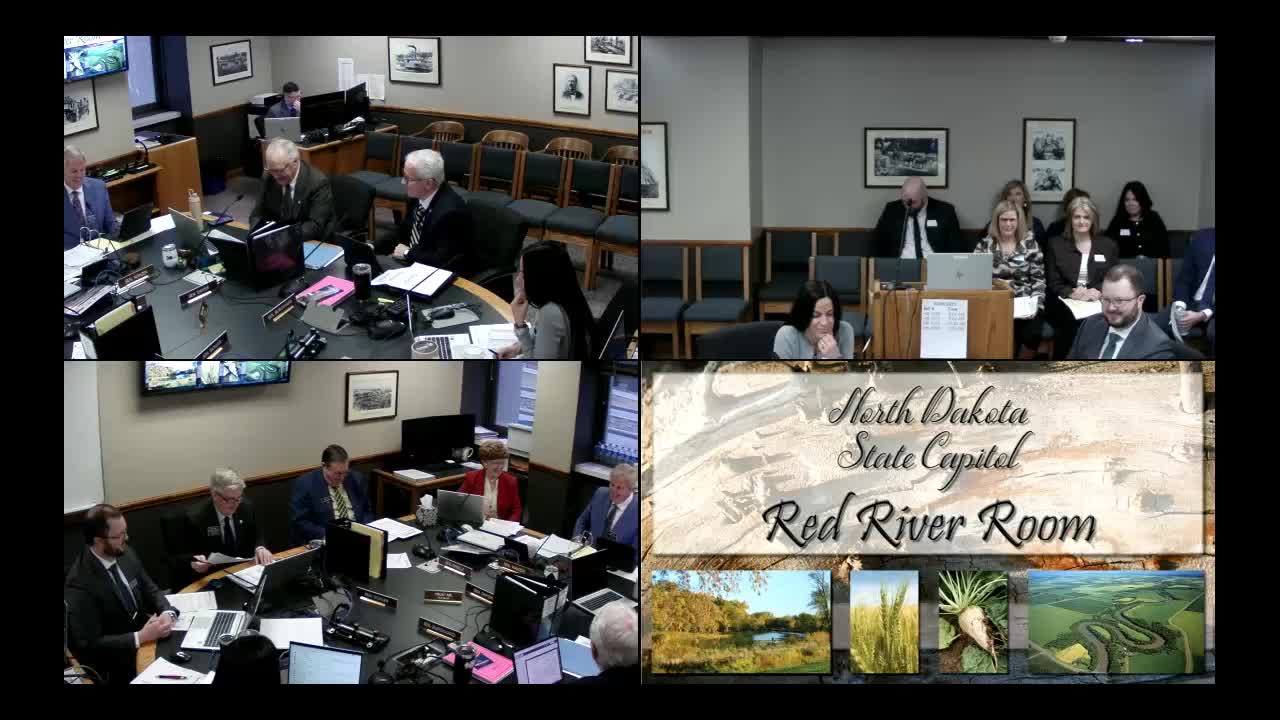
Michael Howe, North Dakota Secretary of State, told the Senate Government Operations Division that House Bill 1,002 would fund continued election administration and a set of technology upgrades ahead of the 2026 elections.
Michael Howe, North Dakota Secretary of State, told the Senate Government Operations Division that House Bill 1,002 would fund continued election administration and a set of technology upgrades ahead of the 2026 elections.
“How office is the starting point we like to say for democracy and transparency,” Howe said as he described the office’s role in elections, business filings and official records. He outlined the bill’s personnel and technology provisions and answered senators’ questions about specific line items.
The bill would reduce the office’s funded FTE count from 35 to 33 in the House version, then move to fund the remaining 33 FTEs with the state general fund rather than federal grants or special funds. Howe said the office sought the change because federal grants that support election staff carry restrictions that can limit those employees’ duties (for example, some federally funded positions cannot work on petition reviews or state-only campaign finance matters). The House version, he said, left 33 general‑funded FTEs in place to permit broader duties for core election staff.
Howe described multiple technology requests in HB 1,002. Among the larger items he cited: $2.8 million from a special information fund (SIF) for poll‑pad and cradle‑point replacements (the “poll pad” is the iPad-like check‑in device used at polling places); $500,000 for a central‑indexing system upgrade (the office’s central indexing was reportedly put into service in 2016 and vendors will no longer support the present version); $650,000 for First Stop (the online business portal); and $200,000 to cover NDIT hosting costs as the office moves off an AS/400 server. Howe said the office expects about 1,100 poll pads and 170 cradle points in the statewide network and that the poll‑pad system’s role is to prevent in‑person double voting by updating the central voter file across sites.
Howe told senators the office also requested ongoing general fund support for positions previously funded by federal grants such as HAVA. He said HAVA award availability has been unreliable and that the office prefers general fund support to avoid limits on staff duties. The bill also includes one‑time funding for a variety of software maintenance and hosting costs and an election security grant authority of $100,000 to help counties improve storage and physical security for election equipment.
Howe summarized smaller recurring lines: $25,000 in grants for tribal ID efforts for voting (split in $5,000 increments per tribe as required by a consent decree related to voter ID), and an $8,000 estimate per statewide petition for postcard/mail costs tied to petition review (additional petition reviews would require emergency commission approvals). He noted existing carry‑forward language for ARPA and SIF monies connected with multi‑year technology projects already underway (First Stop and the new election management/campaign finance system).
Senators asked operational questions: whether poll pads are user‑friendly (Howe said yes and described training and a flip‑chart used to assist poll workers), how quickly check‑in data propagates statewide (Howe said roughly 90 seconds), and how HAVA matching and transfer authority would work in practice (staff explained some funds must be transferred into the election fund to qualify as a state match). Howe also told the committee the office had shifted some public printing responsibilities to Legislative Council, and that counties still print ballots locally.
Howe closed by noting the office’s outreach work during the past biennium and the vendor and hosting cost pressures that drove some of the requested increases.
Looking ahead, he said the office expects First Stop (business portal) to be completed in March 2026 and the election management and campaign finance system to be ready by January 2026 for the 2026 election year.