Get Full Government Meeting Transcripts, Videos, & Alerts Forever!
Get email alerts on the Advanced Nuclear Study topic
No spam. Unsubscribe anytime.
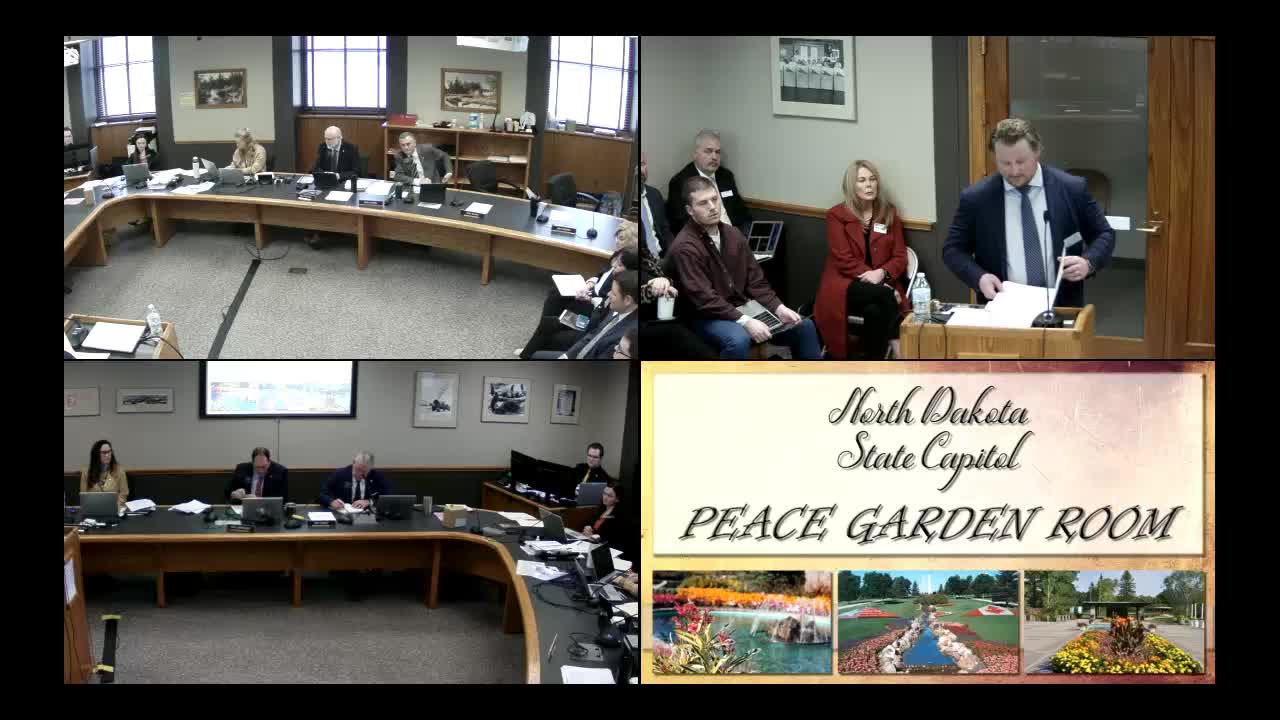
Legislature considers $300,000 study on feasibility of advanced nuclear in North Dakota
Summary
House Bill 10-25 would fund a public interim study—$300,000 appropriation requested—on the feasibility of siting and deploying advanced nuclear generation in North Dakota, with a focus on small modular and microreactors.
Senator David Hogue introduced House Bill 10-25, which would fund an interim study into the feasibility of siting and deploying advanced nuclear generation in North Dakota, including small modular and microreactors. The bill as amended requests an appropriation of $300,000 and invites private-sector contributions; sponsors said the study should evaluate technical, economic and siting considerations and inform long-term policy choices.
"We concluded that it should be a separate study all by itself and not merely part of an interim committee," Senator David Hogue said, explaining the interim committee's recommendation to examine nuclear energy in depth because development timelines for nuclear projects are long and require specialized expertise not currently embedded in state agencies.
Utility and industry witnesses supported the study. Beth Feldman of Xcel Energy said the company has decades of nuclear experience and that a public-private study would allow North Dakota to assess whether advanced nuclear complements the state's energy mix while leveraging existing workforce and infrastructure. Dennis Pathroff, representing the Power Companies of North Dakota, offered member companies' technical support for the study. The Energy and Environmental Research Center (EERC) said the approach mirrors its prior comprehensive lignite planning work and would be appropriate for nuclear evaluation.
State agencies also weighed in on technical issues the study should cover. The Department of Water Resources requested membership on the study committee because nuclear generation can require significant water use (witness cited an illustrative figure of about 407 gallons per megawatt-hour), and the Public Service Commission urged that the study explicitly include permanent or long-term spent-fuel storage options and the regulatory implications of temporary storage approaches.
Senators asked about changes in the bill during amendment: the appropriation was reduced from $500,000 to $300,000 and the study language was amended to include specific consideration of small modular and microreactors. Supporters noted the study does not commit the state to build any facility; it is intended to provide data, public engagement and analysis to inform future decisions.
The committee received supportive testimony from utilities, industry groups, EERC and state water resources staff; the Public Service Commission emphasized the importance of studying spent-fuel disposition. The hearing closed with no committee action taken that day.