Get Full Government Meeting Transcripts, Videos, & Alerts Forever!
Get email alerts on the Education Teacher Certification topic
No spam. Unsubscribe anytime.
Senate committee hears testimony on lowering lifetime teacher license from 30 to 20 years
Summary
Lawmakers and education groups debated House Bill 12 38, which would reduce the years required for a North Dakota lifetime teacher license from 30 to 20, with proponents citing cost and retention benefits and the licensing board urging a 25-year compromise and safeguards for public safety.
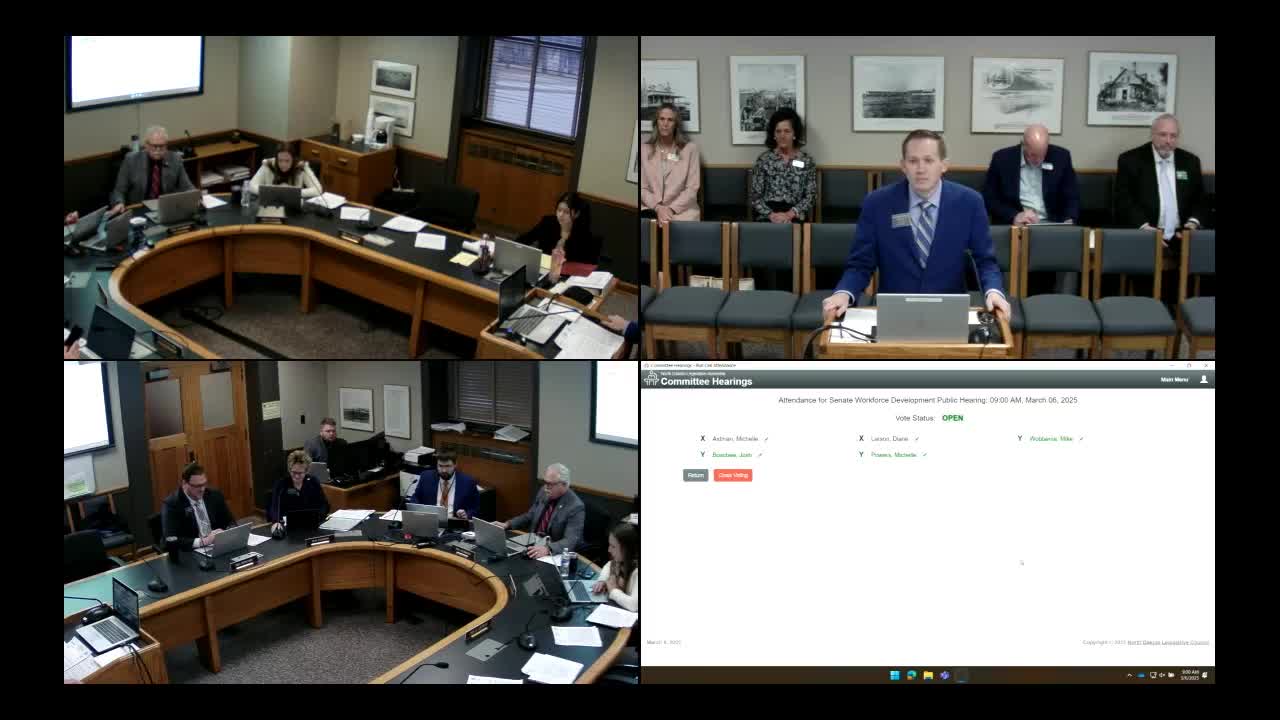
Representative Zach Istaedt, a House sponsor, told the Senate Workforce Development Committee that House Bill 12 38 would reduce the number of years required for a lifetime teacher license from 30 to 20.
The bill’s primary aim, Representative Zach Istaedt, Representative from District 43 in Grand Forks, said, is to “cut a little bit of red tape, a little bit of time and financial costs for our teachers, and provide a modest but meaningful incentive for them to remain in the classroom.”
The measure would mean teachers could avoid two five‑year renewal cycles that currently apply between years 20 and 30. Istaedt said the current per‑renewal license fee is $140 and that continuing education requirements typically force teachers to pay tuition and fees for roughly six semester hours every five years. He estimated the combined cost of fees and coursework over a career before reaching lifetime status can approach $3,000 per teacher. He also said about 2,600 educators have taken a lifetime license in the past 15 years.
Nick Archuleta, president of North Dakota United, testified in favor and said the lifetime license change would be “an opportunity to genuinely appreciate these teachers” and help retain educators who face out‑of‑pocket costs for continuing education. Kevin Hoertz of the North Dakota Council of Educational Leaders, who holds a lifetime certificate, said lifetime certification is a “feel‑good” recognition for long‑service teachers and repeated that district‑level professional development is ongoing and would continue regardless of this change.
Rebecca Pitkin, executive director of the North Dakota Education Standards and Practices Board (ESPB), testified in opposition, saying the ESPB’s board believes continuing evidence of reeducation is needed and that occupational licensing boards commonly require continuing education. Pitkin told the committee the board would accept a 25‑year lifetime benchmark rather than 20, and she described the statute’s origin as tied to retirement benchmarks that historically aligned with teachers’ retirement eligibility.
Istaedt said the bill includes new language authorizing the board to require lifetime license holders who remain employed to report to the board at least every five years, with the bill specifying that reporting should not create additional out‑of‑pocket costs for the teacher. The sponsor and supporters said this addresses ESPB’s public‑safety concerns by preserving a mechanism for boundary‑violation reporting and investigation.
Anne Ellifson of the Department of Public Instruction described the North Dakota Educational Hub, a state‑provided online platform that offers low‑ or no‑cost professional development and can document course completion for licensure renewal. Ellifson said the hub was created in 2021, hosts dozens of courses and can provide transcript documentation even if university credit is not pursued.
No committee action or vote on the bill was recorded during the hearing. Committee members asked whether there is direct evidence that licensing costs cause teachers to leave the profession; Representative Istaedt and several teacher witnesses said there are personal and anecdotal reports but no comprehensive state survey or causal study was presented at the hearing.
The committee closed the hearing after receiving testimony from union, administrator and state agency representatives.