Get Full Government Meeting Transcripts, Videos, & Alerts Forever!
Get email alerts on the Retirement Plan Implementation topic
No spam. Unsubscribe anytime.
Committee advances cleanup bill clarifying defined‑contribution plan eligibility and portability
Summary
House Bill 11‑46 clarifies which state entities may join or offer the new defined‑contribution plan created in last session's House Bill 10‑40, adds portability provisions and expands optional annuity options; the committee recommended due pass with referral to appropriations.
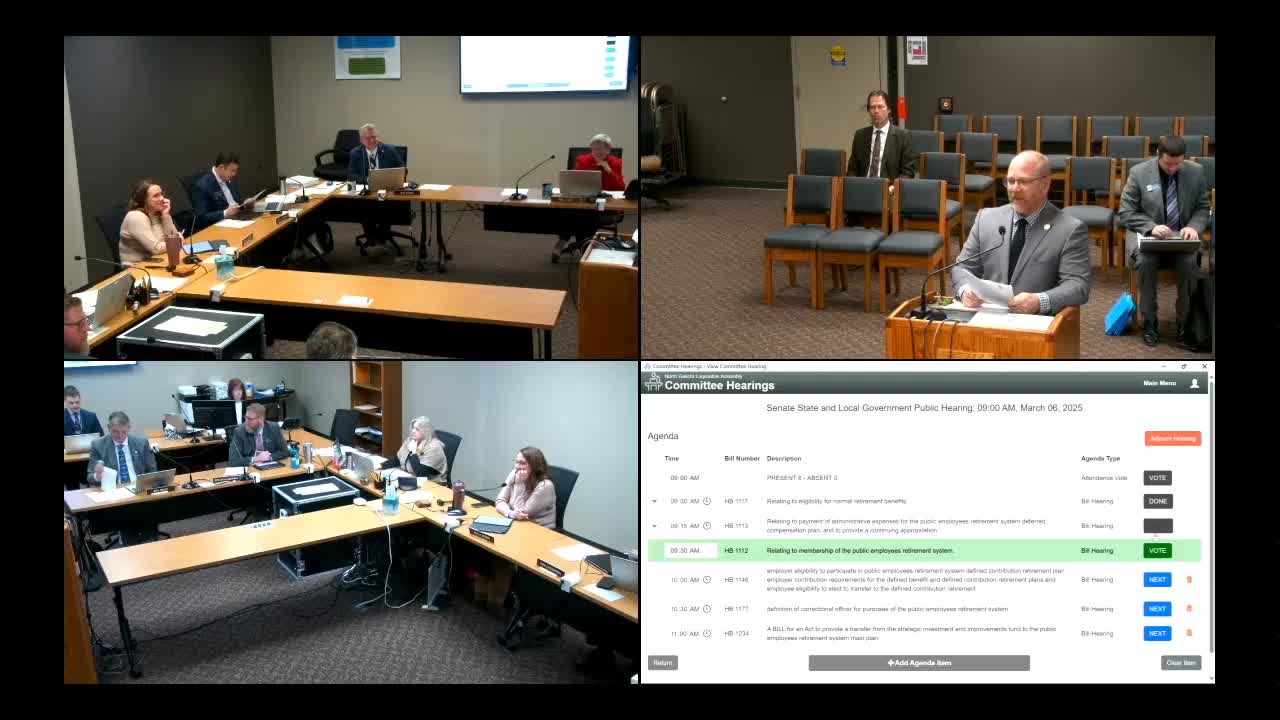
Representative Mike LaFore introduced House Bill 11‑46, explaining the measure consolidates several clarifications after last session's large retirement reform (House Bill 10‑40). He said the bill would allow political subdivisions not currently participating in NDPERS to join the new defined‑contribution (DC) plan, clarify the definition of "state employer" for entities that receive legislative budgetary approval, identify eligible state employees for a limited incentive window, and expand investment solutions to permit in‑plan or out‑of‑plan annuity options.
Derek Holbein of PERS testified in a neutral capacity and described how sections of the bill address implementation gaps the agency found during the rapid transition to DC (PERS completed the conversion faster than most states). Holbein said sections specifying which of roughly 21 entities are not treated as "state governmental units" will prevent unintended ADEC allocations for small employers that do not receive legislative budget approval. He also explained the bill includes retroactive and emergency language tied to an ongoing five‑year incentive window for transfers that is due to expire; PERS said it is holding applications pending clarification.
Committee members asked about the fiscal impacts. Holbein said removing certain entities from the ADEC pool increases the employer contribution rate by about 0.1 percentage point unless a lump‑sum deposit is provided. The fiscal note discussed during hearings noted an actuarially determined employer contribution (ADEC) component of roughly $88 million in a biennium that the sponsor and PERS are seeking to address through lump‑sum funding options.
Senator Wallin moved a due‑pass recommendation with referral to appropriations; Senator Lee seconded. The committee voted aye (6‑0). Representative LaFore volunteered to carry the bill.