Get Full Government Meeting Transcripts, Videos, & Alerts Forever!
Get email alerts on the Public Safety Pensions topic
No spam. Unsubscribe anytime.
Committee recommends expanding public‑safety retirement eligibility to state firefighters
Summary
House Bill 11‑12 would make state‑employed firefighters eligible for the NDPERS public safety defined‑benefit plan. The committee recommended a due pass after testimony from PERS staff, the North Dakota Forest Service and multiple fire‑service organizations.
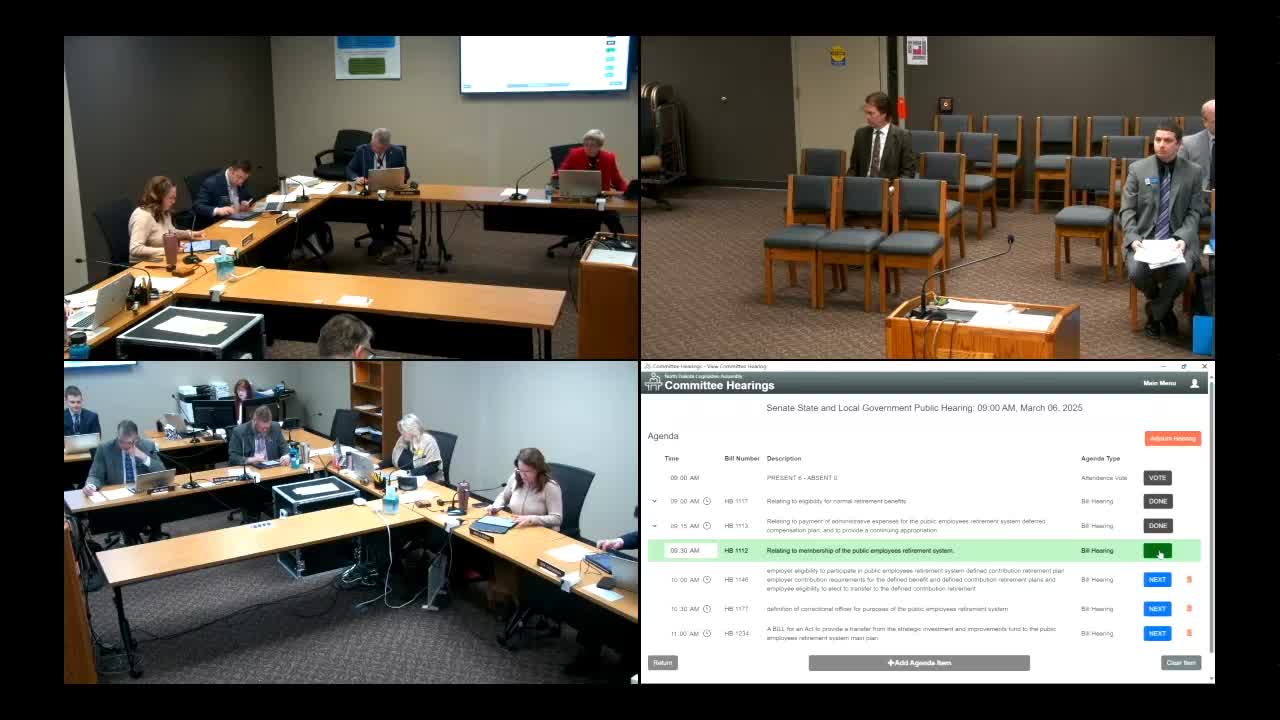
Chair Roars opened the hearing on House Bill 11‑12, "Relating to membership of the Public Employees Retirement System." Derek Holbein, chief operating and financial officer for PERS, presented the bill in a neutral capacity and summarized actuarial and IRS reviews.
Holbein said House Bill 11‑12 would expand the statutory definition of "firefighter" so that eligible state firefighters could join the public‑safety defined‑benefit retirement plan and receive normal retirement at age 55 with three years of service or a combined age‑and‑service of 85. The PERS actuary had estimated four affected individuals based on July 1, 2023 data; Holbein said updated data raised the estimate to six or seven affected employees. He said the change would produce an immaterial impact on the actuarially determined employer contribution rate (ADEC), with an actuarial gain to the main plan of about $39,000 and an actuarial loss to the public safety plan of about $71,000.
Multiple representatives from the North Dakota Forest Service, the North Dakota Fire Chiefs Association, the North Dakota Firefighters Association, and local departments testified in favor. Testimony described the operational role of state firefighters in wildland and structure incidents, their frequent national and interstate deployments, and the physical and long‑term health impacts of wildland firefighting. Ryan Melin, Fire Management Officer for the North Dakota Forest Service, told the committee that NDFS firefighters worked 10,978 hours on fire assignments in 2024 and cited peer‑reviewed estimates presented in testimony that long‑term exposure (five or more years and at least 50 duty days) is associated with an increased mortality risk from lung cancer (up to 43%) and cardiovascular disease (up to 30%).
Supporters argued the bill would remove an inequity between political‑subdivision firefighters (already eligible under local plans) and state employees performing the same hazardous work. Several county and municipal chiefs said the change would improve recruitment and retention for a physically demanding occupation and align benefits with workplace risks. PERS staff confirmed the IRS review found no disqualifying issues.
After closing testimony, Senator Lee moved a due‑pass recommendation; Senator Brownberger seconded. The committee recorded a unanimous 6‑0 vote in favor of due pass. Senator Lee volunteered to carry the bill forward.