Get Full Government Meeting Transcripts, Videos, & Alerts Forever!
Get email alerts on the Optometry Telemedicine topic
No spam. Unsubscribe anytime.
Committee hears bill to require in‑state offices for optometric telemedicine (House Bill 12 67)
Summary
A legislative committee heard testimony on House Bill 12 67, which would update the optometry practice act and require that optometrists offering telemedicine maintain a physical location in North Dakota; supporters say the change protects patients and clarifies outdated law.
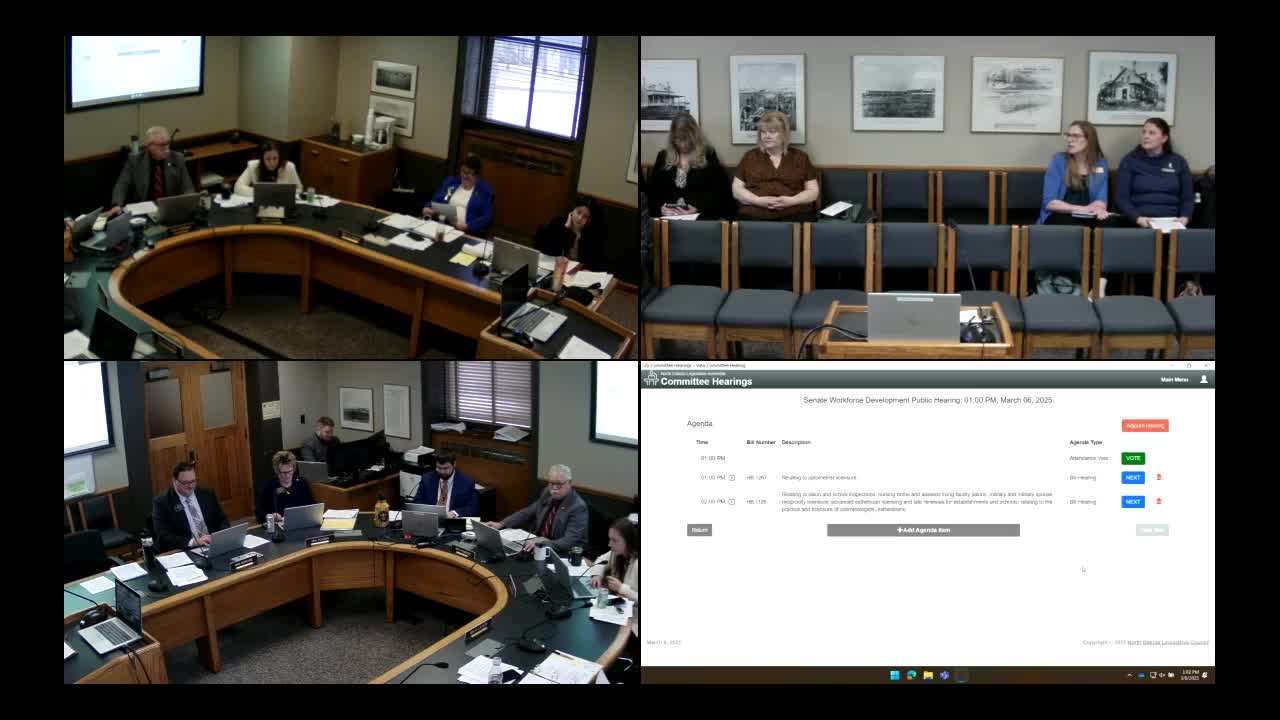
The Workforce Development Committee heard testimony on House Bill 12 67 on optometrist licensure, including new definitions and a provision that would require an optometrist offering telemedicine to maintain a physical practice location in North Dakota.
Supporters told the committee that the bill modernizes the state’s optometry practice act, clarifies board roles and fees, and is intended to protect patients by ensuring a local office is available for follow‑up and complaints.
The bill was introduced to the committee by Terry Hefferts, who said the measure grew from “a couple of years work” with optometrists, the licensing board and other stakeholders. Dr. Tayah Patzmann, executive director of the State Board of Optometry, testified for the board and urged a “vote do pass” on the bill. She told members the statute has not been updated for more than 20 years and that the proposed language would help with licensing, disciplinary actions and patient safety.
A central change in the draft is a telehealth requirement that the initial patient relationship for an optometric telemedicine exam be established through an eye exam carried out by a licensed optometrist with a physical location in the state. “This statement clarifies that to do an examination by telemedicine, the overseeing doctor has to have a physical location in the state of North Dakota,” Patzmann said. She said some distance‑site providers operate in Fargo and Grand Forks but route the patient to a local office for the exam so there is a place for follow‑up or an away‑to investigate complaints.
Dr. Leslie Hellabush, an optometrist and past president of the North Dakota Optometric Association, described how a telemedicine‑assisted exam typically works in practice: a local technician gathers preliminary refractive data and retinal photographs, transmits live slit‑lamp images to a remote optometrist who controls automated equipment such as a phoropter, and then the remote clinician assesses the front and back of the eye from those images. “This is an access bill. We want to provide high quality eye care to our patients with the best and greatest technology out there,” Hellabush said, adding that the bill is intended to prevent low‑quality, low‑cost online providers that offer prescription renewals without a comprehensive exam.
The bill also makes non‑telemedicine edits: replacing the board’s statutory reference to a “secretary” with the executive director to reflect current staffing, adding a fee schedule provision, and updating several definitions of optometric practice. Committee members asked technical and scope questions; Senator Buscey asked about the role optometrists play in identifying systemic conditions during an eye exam, and Hellabush explained how retinal imaging can reveal signs such as changes to blood vessels that prompt coordination with primary care.
No formal committee vote was recorded during the hearing. The committee closed the testimony period after supporters spoke; the chairman recessed the committee for additional business later in the day.
The bill’s proponents said the changes are intended to preserve local accountability and patient safety while allowing modern telemedicine workflows when a local physical site and staff are present.