Get Full Government Meeting Transcripts, Videos, & Alerts Forever!
Get email alerts on the Agriculture Budget Hb1009 topic
No spam. Unsubscribe anytime.
Lawmakers and Ag Commissioner Debate Protein Funding, FTEs and Mitigation Items in Department of Agriculture Budget Hearing
Summary
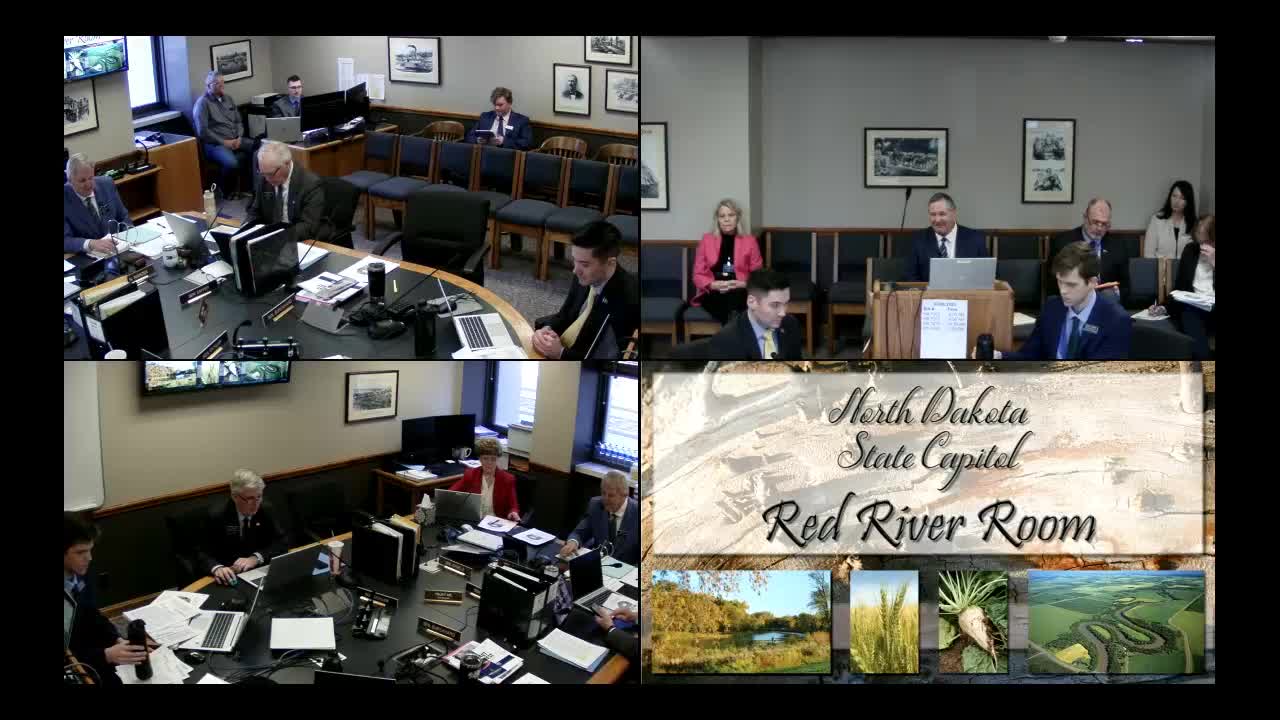
Representative Alisa Mitskog, who represents District 25 (Wahpeton), said during the Government Operations Appropriations Committee hearing on House Bill 1009 that she will prepare a $2 million amendment to buy protein for food pantries across North Dakota.
Representative Alisa Mitskog, who represents District 25 (Wahpeton), said during the Government Operations Appropriations Committee hearing on House Bill 1009 that she will prepare an amendment to add $2 million to the agriculture budget to buy protein for food pantries across North Dakota.
"I'm going to be preparing an amendment...for $2,000,000 for, food pantries across North Dakota for protein meat," Mitskog told committee members, saying local pantries report they get ample nonperishable donations but lack access to meat.
The request follows a $1 million appropriation in the prior biennium that the department used to distribute food through a main distributor, which the commissioner identified as Great Plains. Commissioner Doug Goehring, North Dakota agriculture commissioner, told the committee the program's intent was to increase protein access through farm-to-school and charitable food channels.
Goehring summarized the department's budget and program portfolio and highlighted several optional requests and technical clarifications the department wants the committee to consider. He described ongoing workload in divisions that regulate plant industries, livestock and dairy inspection, pesticide and fertilizer oversight, hemp inspections, and outreach programs such as farm-to-school and Pride of Dakota marketing.
On personnel and operations, the department requested two optional FTEs: one in plant protection to handle increased certification and inspection work (including hemp retail inspections) and one environmental FTE to manage mitigation easement agreements and related contracts. Goehring said the plant FTE request is $214,688 for salaries and operations in the biennium.
The commissioner asked the committee to include explicit language in statute or the department bill to refuse payment of federal "indirect costs" on certain contracts, saying without that language the federal government or contractors sometimes seek 38% to 47% in indirect charges. Goehring said the department wants the legislative body to state it will not pay indirect costs so the department is not forced to accept those charges.
Goehring also asked the committee to include a $250,000 fund transfer for the mitigation program that was inadvertently omitted during House consideration, and he sought $150,000 more for wildlife services to cover increased costs tied to predator control and for operation of a plane the program acquired (including pilot costs).
Committee members pressed for details on several programs. Senators asked about the Royalty Ombudsman program (created in the last session to help royalty owners dispute deductions and payment statements), chronic wasting disease coordination with Game and Fish, and the size of the state's dairy sector; Goehring said the state currently has about 22 dairy farms when combined with processing facilities. He also cited apicultural figures (about 21,000 locations and roughly 843,000 colonies/hives) and registration/licensing counts for commercial feed and fertilizer products.
Several other bills that could affect the department's budget or programs were listed during the hearing, including House Bill 1143 (food distribution and facility grant program), HB1332 (value-added egg facility program), HB1526 (pet food program), HB1551 (bio-stimulants), HB1591 (county fair grant program), and Senate bills addressing farm management programs, ag diversification, low-carbon fuel, value-added milk processing, and grazing grants. Commissioner Goehring also discussed House Bill 1318 (pesticide liability/registration), describing it as statewide legislation affecting manufacturer liability and litigation exposure.
Representative Mitskog's statement that she will file a $2 million amendment was not acted on in the hearing; committee members and the commissioner said staff and agency representatives will be available as the committee drafts and reviews the budget. The committee closed the hearing on House Bill 1009 without a formal vote on any amendment or budget motion.