Get Full Government Meeting Transcripts, Videos, & Alerts Forever!
Get email alerts on the Charitable Gaming topic
No spam. Unsubscribe anytime.
Senator would bar charitable gaming proceeds from political campaigns; raffles and small fundraisers debated
Summary
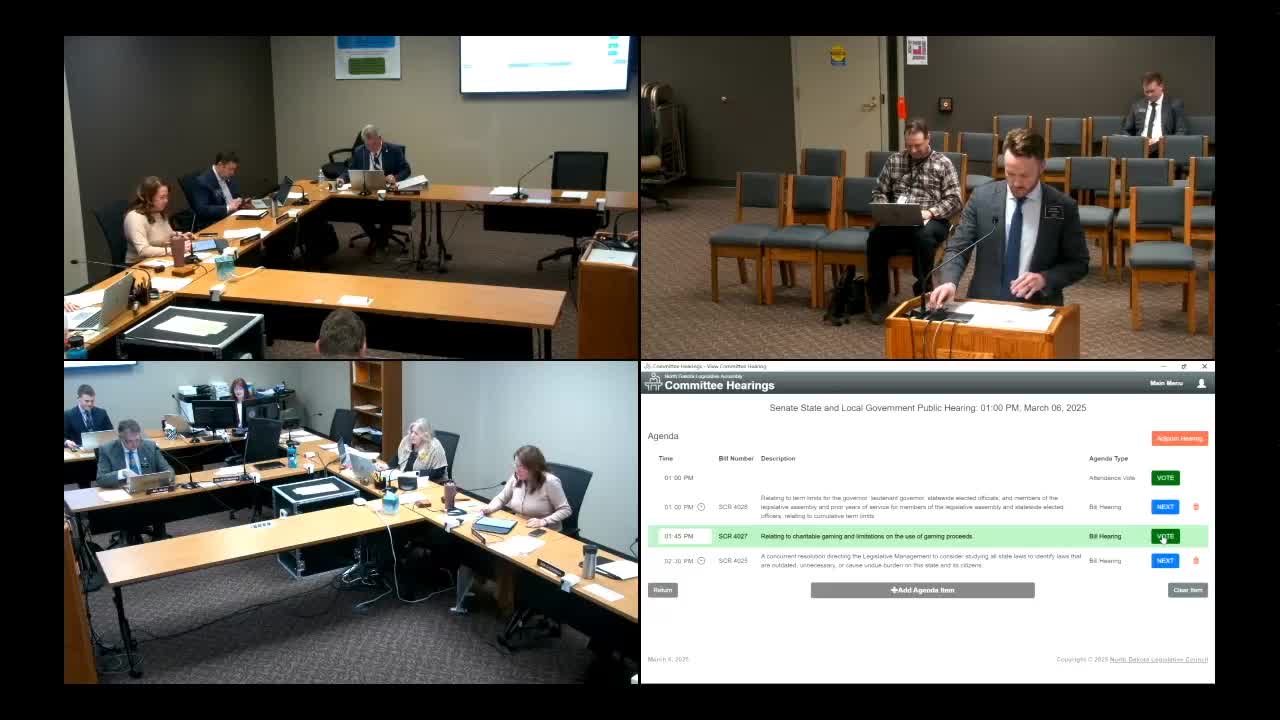
Senator Sean Cleary presented Senate Concurrent Resolution 40 27 to amend the constitution so charitable gaming proceeds cannot be used to support political campaigns or organizations; sponsors and committee members discussed impacts on small raffles and district fundraising.
Senator Sean Cleary introduced Senate Concurrent Resolution 40 27, a proposed constitutional amendment that would prohibit the use of charitable gaming proceeds to finance or influence political campaigns, candidates, ballot measures, or political organizations.
Cleary told the Senate State and Local Government Committee the amendment would add language clarifying that proceeds “may not be used to support, finance, or influence any political campaign, candidate for office, ballot measure, or political organization.” He said charitable gaming in the state has grown and that combining gaming funds with political fundraising complicates oversight.
“Charitable gaming is meant to support nonprofits, not finance political campaigns and political action committees,” Cleary said, adding the change would “promote public trust both in the integrity of charitable gaming and in our campaign finance system.” He asked the committee for a due pass recommendation to place the amendment before voters.
Committee members raised concerns about consequences for small, traditional raffles and district fundraising. Senator Whelan said local party districts and small organizations rely on raffles to raise modest funds, while Senator Castaneda asked whether the amendment could be drafted to draw a clearer line between charitable gaming revenue and campaign finance law.
Cleary said he recognized those concerns and was open to language that would carve out limited raffles; he also said he had asked an adviser to look for wording that might exempt small raffles. He told the committee he was most concerned about larger forms of charitable gaming being used for political purposes and the difficulty of tracking high‑value gaming proceeds.
No committee vote was taken during the hearing. The committee closed the hearing on SCR 40 27; Cleary said he had received in‑kind testimony addressing raffle concerns and would consider amendments to address them.