Get Full Government Meeting Transcripts, Videos, & Alerts Forever!
Get email alerts on the Business Innovation Act topic
No spam. Unsubscribe anytime.
Entrepreneur groups, lenders and university partners push back on proposal to cut Business Innovation Act funding
Summary
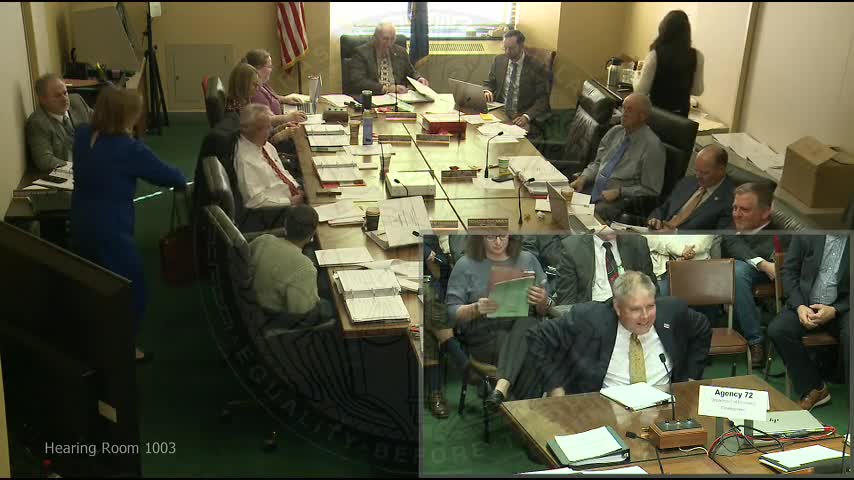
Investors, incubator operators, community lenders and business groups urged the Appropriations Committee not to cut $5 million from the state’s Business Innovation Act, saying the program fuels early-stage capital for agtech, bioscience and small entrepreneurs and draws much larger private follow-on funding.
A proposed $5,000,000 cut to the Business Innovation Act (BIA) drew sustained opposition at the Appropriations Committee hearing as private investors, incubators, rural lenders, and university-affiliated programs said the grants and matching funds are critical to seed-stage startups and community lenders.
What the BIA funds: Witnesses explained that the BIA comprises multiple programs—microenterprise assistance, academic research-and-development matching, prototyping grants, seed investment and matching for SBIR/STTR winners—and helps translate research and early ideas into viable companies. Proponents described how the program complements private capital, university R&D and accelerator programming.
Claims and figures presented: InvestNebraska and research cited by witnesses showed the BIA’s cumulative state investment (since 2011) at roughly $56.8 million and an estimated annual economic impact of about $1.1 billion. BioNebraska said 102 BIA awards have supported bioscience companies for roughly $12.3 million and 23 BIA awards went to ag companies (about $10 million), contributing to roughly 500 high-wage jobs.
Combine, agtech and seed capital: Grit Road Partners and other investors described the Combine and the innovation campus as an ecosystem where companies scale. Grit Road said it has invested in Nebraska agtech companies that used BIA grants and Combine resources to grow; the BIA and the Combine together helped companies raise follow-on capital.
Microenterprise and community-lending: The Center for Rural Affairs and partners (the “microenterprise collaborative”) described the Microenterprise Assistance Program supported through BIA funds: the collaborative reported placing roughly $9.8 million in loans, delivering more than 350 training sessions and 12,000 one-on-one counseling encounters during a recent award period. The Center reported average loan sizes (their portfolio average ~$37,000) and said the collaborative’s work leverages federal and private funds; the collaborative reported a cost per job created of about $677.
Federal SSBCI funds and other resources: DED told the hearing Nebraska has close to $65 million available through the federal State Small Business Credit Initiative (SSBCI) and that the department has already deployed a significant portion; testimony said the state was “well ahead of the curve” on implementing SSBCI. DED also signaled it supports reallocating some smaller-ROI programs and leveraging federal and philanthropic resources rather than keeping all legacy state programs unchanged.
Stakeholder warnings: Investors and industry groups urged that a $5 million reduction would undercut entrepreneurship pipelines, slow agtech and bioscience formation, and reduce the early-stage signaling that attracts private capital. Multiple speakers asked the committee to retain the BIA at its current funding level ($14.7M), citing return-on-investment analysis and a decade-plus track record of results.
Bottom line: The hearing showed broad cross-sector opposition to the proposed BIA cut, with witnesses arguing the program leverages state dollars into far larger private and federal investment, especially for agtech and bioscience startups.