Get Full Government Meeting Transcripts, Videos, & Alerts Forever!
Get email alerts on the Term Limits topic
No spam. Unsubscribe anytime.
Senator proposes 3-term limit, says appointments should not count toward term limits
Summary
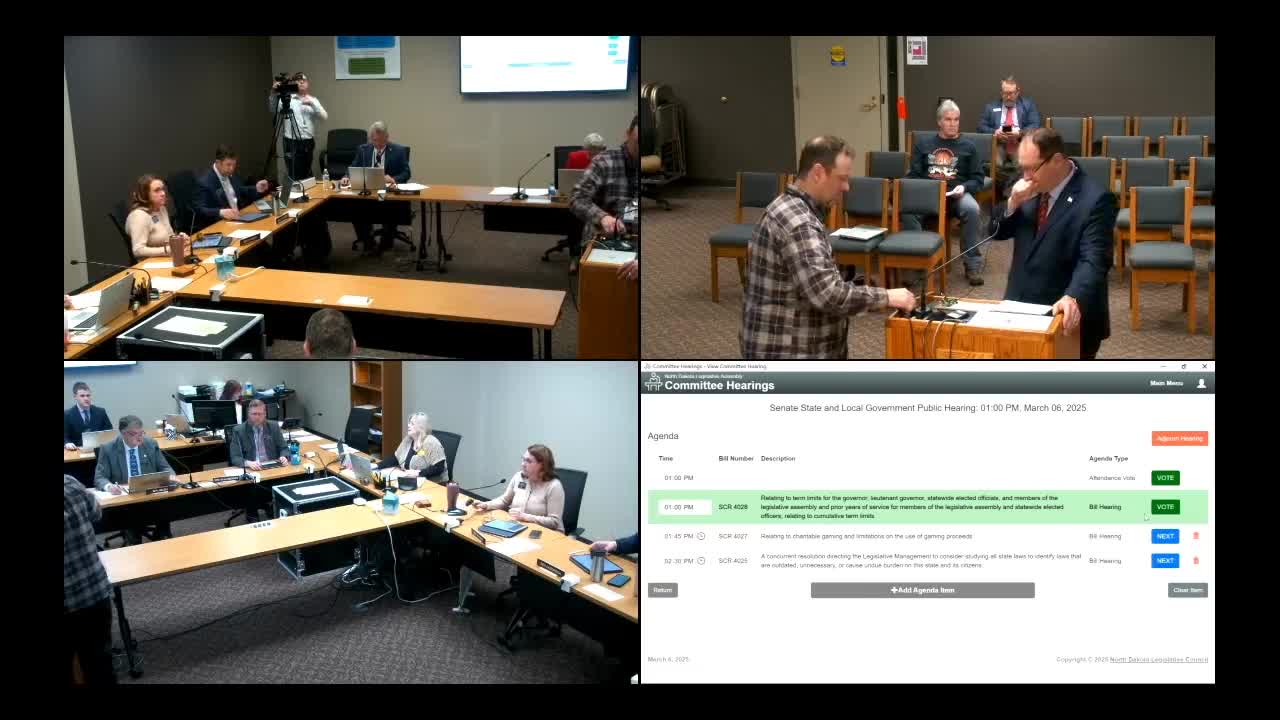
Senator Justin Gerhardt introduced Senate Concurrent Resolution 4,028 to ask voters whether statewide offices (except governor and lieutenant governor) should be subject to three elected terms and to specify that appointments to fill vacancies would not count toward those limits.
Senator Justin Gerhardt introduced Senate Concurrent Resolution 4,028 to ask voters whether statewide offices (except governor and lieutenant governor) should be subject to three elected terms and to specify that appointments to fill vacancies would not count toward those limits.
Gerhardt told the Senate State and Local Government Committee the resolution “proposes term limits of 3 elected terms for all statewide offices, except the Governor and Lieutenant Governor,” and that it would “make clear that appointments to fill vacancies don't count against these limits.”
The proposal stems in part from Gerhardt’s own experience as an appointee. He said he was appointed in October 2023 to complete a predecessor’s term and was subsequently elected to a full term, and that under current law he would be “termed out after serving just over 5 years and in only 2 regular legislative sessions.” He argued North Dakota’s citizen‑legislature schedule—about 80 days every two years—means legislators need more time to gain experience.
“Governing takes time to learn,” Gerhardt said. “Addressing appointments and increasing to 3 terms strikes a better balance—long enough to get good at a job but not so long that anyone becomes entrenched.” He also said the resolution would expand the question to statewide officials voters did not directly consider in 2022.
Committee members asked questions about the resolution’s effects on the balance between branches and on the ballot mechanics. Senator Bromberg asked why the proposal treats the governor and lieutenant governor differently; Gerhardt replied he was “open to discussion” but left those offices at two terms to preserve existing expectations for the chief executive. Senator Lee raised concerns that expanding term limits could remove choices from voters and suggested the change might strengthen the executive branch relative to others.
Gerhardt acknowledged edge cases the resolution did not yet address, including how two‑year election cycles created by redistricting would count toward term totals and whether lifetime‑limit versus a reset after a hiatus should apply. He said an amendment could be drafted to address two‑year elected terms and that the current draft would impose lifetime limits rather than a reset after a multi‑year break.
During public testimony, Kevin Herman of Beulah opposed the resolution, saying it “circumvents the wishes of North Dakota voters in the 2022 general election, Measure 1,” and citing Article 15, Section 4 of the state constitution, which he read to restrict the legislature’s authority to change the term‑limit language approved by voters. Herman told the committee the resolution would effectively allow legislators to “get back their legislative power over the citizens of North Dakota.”
The committee closed the hearing on SCR 4,028 without a recorded vote; Gerhardt asked for a due pass recommendation.
The measure will return to the committee record for further consideration; no committee action was recorded at the hearing.