Get Full Government Meeting Transcripts, Videos, & Alerts Forever!
Get email alerts on the Rural Workforce Housing topic
No spam. Unsubscribe anytime.
Sen. Bob Hallstrom urges $25M-a-year boost for Rural Workforce Housing Fund to meet unmet demand
Summary
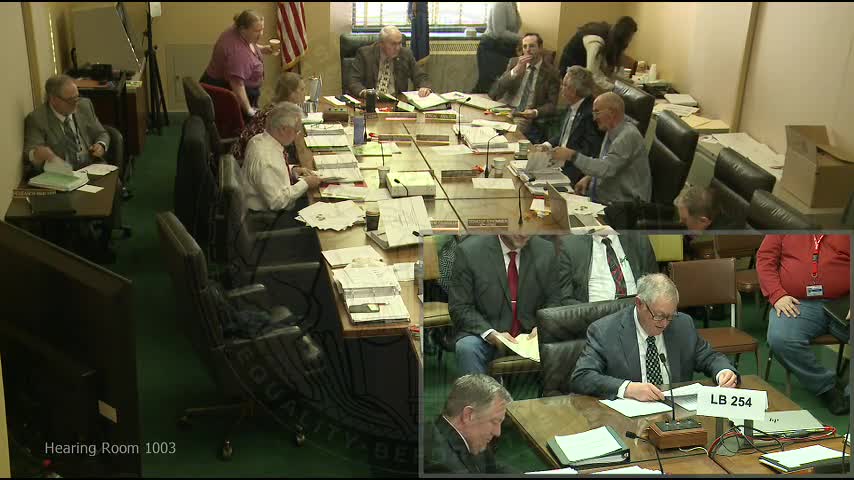
Sen. Bob Hallstrom introduced LB254, a bill that would appropriate $25,000,000 to the Rural Workforce Housing Fund in each of the next two fiscal years, saying: “The lack of workforce housing across our state is a barrier to job growth, community development, and worker recruitment, and retention.”
Sen. Bob Hallstrom introduced LB254, a bill that would appropriate $25,000,000 to the Rural Workforce Housing Fund in each of the next two fiscal years, saying: “The lack of workforce housing across our state is a barrier to job growth, community development, and worker recruitment, and retention.”
That funding, Hallstrom said, is targeted at housing projects in counties with populations under 100,000 and is designed to help communities fund new owner-occupied homes (with maximums set in statute) and rental units that meet workforce needs.
Why it matters: proponents told the committee the program leverages matching funds and local philanthropic support and helps communities that otherwise cannot cover gaps between construction costs and appraised values. Department of Economic Development records and testifiers showed strong demand: for the most recent round DED received 19 applications requesting about $28.6 million for $12.5 million available, with applicants proposing roughly $9.2 million in local matches.
What proponents said: witnesses from across the state described rapid local results. Dan Mauk, executive director of the Nebraska City Area Economic Development Corporation, said his organization has built and sold workforce houses before completion and that the subsidy “seeded” larger subdivisions and private investment. Emma Craig of the Nebraska Investment Finance Authority reiterated statewide data showing builders cite rising costs and limited capital stacks as top barriers; she urged a recurring funding stream. Janelle Seim of Aurora described using two $1 million awards plus local capital to establish a $3.5 million revolving fund that drove construction of dozens of for-sale and rental units and added roughly $15 million to the local tax base without using TIF.
Local match and project rules: the bill would continue the program’s community-driven model. The committee heard that matching requirements have been reduced over time to help small towns—originally a dollar-for-dollar match, then 50¢ on the dollar, and most recently 25¢ on the dollar—so smaller communities can assemble projects. Hallstrom told the committee that modification increased the number of viable applications.
Program history and pipeline: proponents reviewed prior state investments: an initial $7 million infusion followed by larger appropriations (about $10 million in 2020, $30 million in 2022 and $12.5 million in 2024, some of which was later applied to active projects). Hallstrom said the early rounds produced about 1,400 housing units from the first two infusions and noted unmet demand remains.
Opposition/neutral: no opponents appeared at the hearing. Several testifiers recommended the Legislature consider also funding the Middle-Income Workforce Housing Fund and keeping support recurring rather than one-time.
Bottom line: supporters argued LB254 is a high-leverage economic development investment that helps rural communities recruit and retain workers and unlock private and philanthropic dollars for housing projects. The bill was introduced and heard; no committee vote was recorded at the hearing.