Get Full Government Meeting Transcripts, Videos, & Alerts Forever!
Get email alerts on the Transportation Highways topic
No spam. Unsubscribe anytime.
Sen. Ballard seeks $15 million to advance Lincoln East Beltway planning
Summary
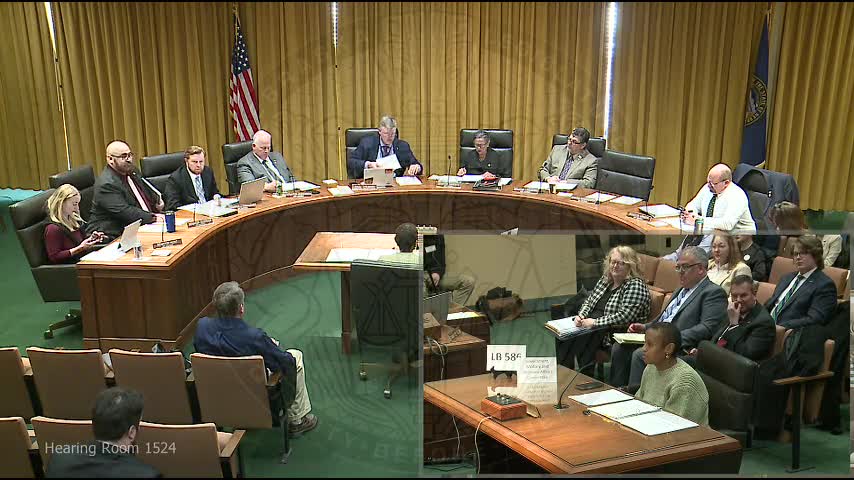
Sen. Beau Ballard, chairing the bill’s introduction, told the Transportation and Telecommunications Committee that LB619 would appropriate $15,000,000 to cities of the primary class and their counties to support construction and infrastructure connecting state and national highways.
Sen. Beau Ballard, chairing the bill’s introduction, told the Transportation and Telecommunications Committee that LB619 would appropriate $15,000,000 to cities of the primary class and their counties to support construction and infrastructure connecting state and national highways. "LB 619 appropriates $15,000,000 in grants to cities of the primary class and their respective counties to support the construction and infrastructure connecting the state and national highways," Ballard said.
The bill’s supporters framed the appropriation as funding needed to update environmental and corridor work and to position the project for federal grants. Pam Dingman, Lancaster County engineer, told the committee the East Beltway corridor was first defined by interlocal agreement in 1995 and that the Federal Highway Administration approved a final study in 2002. She said local partners have already purchased several tracts and conducted traffic studies showing crash history and future capacity needs. "The updated project estimate is a staggering 5,510,000," Dingman said in testimony supplied to the committee.
David Carey, director of the Lincoln‑Lancaster County Planning Department, described the Beltway as the eastern link in a multi‑decade plan to complete a freeway loop around Lincoln, saying, "The East Beltway will connect Interstate 80 on the North to near Waverly to Highway 2 on the South at the interchange with the now constructed South Beltway." Carey said the corridor has formal corridor protection and that local governments have been coordinating to reserve alignment segments.
Local business and civic groups also testified in support, saying the project would relieve congestion and support regional economic growth. Bruce Boyer, a registered lobbyist for the Lincoln Chamber of Commerce, and Carter Thiel of the Lincoln Independent Business Association emphasized safety and long‑term economic development as reasons for state participation.
Committee members asked about details the appropriation would buy. Ballard said the $15 million would be used to "dust off" prior environmental and preliminary engineering studies required for federal matching and grant applications; he said that money would be a direct state appropriation and would not be a mandated local match.
No formal action or vote on LB619 was recorded during the hearing. Ballard closed by reiterating the project’s regional importance and by inviting further questions from the committee.
The hearing record includes local traffic counts, the 1996 corridor study and FHWA approval, prior land purchases, and the most recent local cost estimate provided to the committee’s exhibit packet.