Get Full Government Meeting Transcripts, Videos, & Alerts Forever!
Get email alerts on the Medicaid Pharmacy topic
No spam. Unsubscribe anytime.
Committee advances bill barring prior authorization for certain antipsychotics after fiscal debate
Summary
House Bill 610, which would prohibit prior authorization for certain emergency uses of schizophrenia and bipolar medications in Medicaid, passed the committee. The Department of Public Health and Human Services disputed the fiscal estimate and said loss of supplemental rebates and shifts in utilization drive costs in the fiscal note.
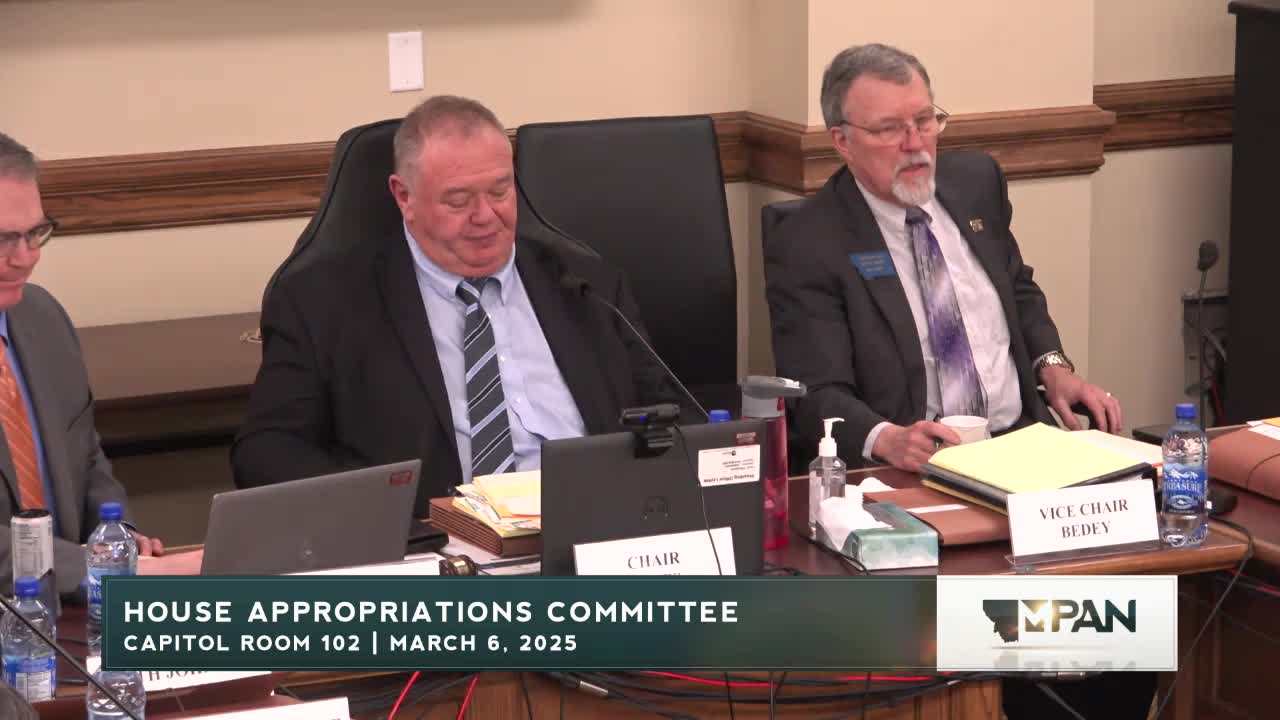
House Bill 610, a bill to restrict prior authorization requirements for antipsychotic medications used for schizophrenia and bipolar disorder in Medicaid, moved out of the House Appropriations Committee following extended testimony and a 20-3 recorded vote in favor.
The sponsor described the bill as narrowly targeted emergency use language and urged collaboration with the department on fiscal estimates. Industry representative Chris Averill, testifying for Alkermes, said the fiscal note understates the number of claims that the current prior‑authorization process denies and that a useful comparison is Colorado’s experience, which showed several million dollars of state fiscal impact. Averill urged a do‑pass vote.
Medicaid officials disputed some assumptions in the sponsor’s rebuttal. Gene Hermanson, Medicaid chief financial manager, and Katie Hawkins, who oversees the pharmacy benefit, explained the fiscal methodology used in the fiscal note: the department used current script counts as a baseline, applied Medicaid drug rebate assumptions (they cited roughly 23% rebates for certain brand drugs and about 13% for generics), and modeled changes in utilization based on a comparator state (Michigan) and the loss of supplemental rebate arrangements tied to a preferred drug list. Hermanson said one large driver in the department’s estimate is the loss of supplemental rebates — the fiscal note models roughly $2.5 million per year from supplemental rebate changes — and the department’s vendor independently produced a similar estimate.
Proponents argued there are societal costs when people with severe mental illness cannot access medication quickly, including ER visits, hospitalizations and incarceration; proponents asked the committee to consider those downstream costs alongside the department’s fiscal modeling.
After debate Representative Jones moved a due‑pass motion. The committee held a roll‑call vote that recorded 20 yes and 3 no; the clerk announced the bill passed the committee and will proceed in the legislative process.
Votes at a glance: House Bill 610 — moved due pass by Representative Jones; committee vote 20 yes, 3 no; outcome: passed out of committee.