Get Full Government Meeting Transcripts, Videos, & Alerts Forever!
Get email alerts on the Trust Lands Water Court topic
No spam. Unsubscribe anytime.
House committee backs bill to sell landlocked state trust parcels, debate focuses on fiscal trade-offs
Summary
House Bill 676, which would change how the state handles water-court duties and require sale of certain landlocked state trust parcels to lessees, advanced from the House Appropriations Committee on a 12-11 roll-call vote.
House Bill 676, which would change how the state handles water-court duties and require sale of certain landlocked state trust parcels to lessees, advanced from the House Appropriations Committee on a 12-11 roll-call vote after more than two hours of testimony and questioning.
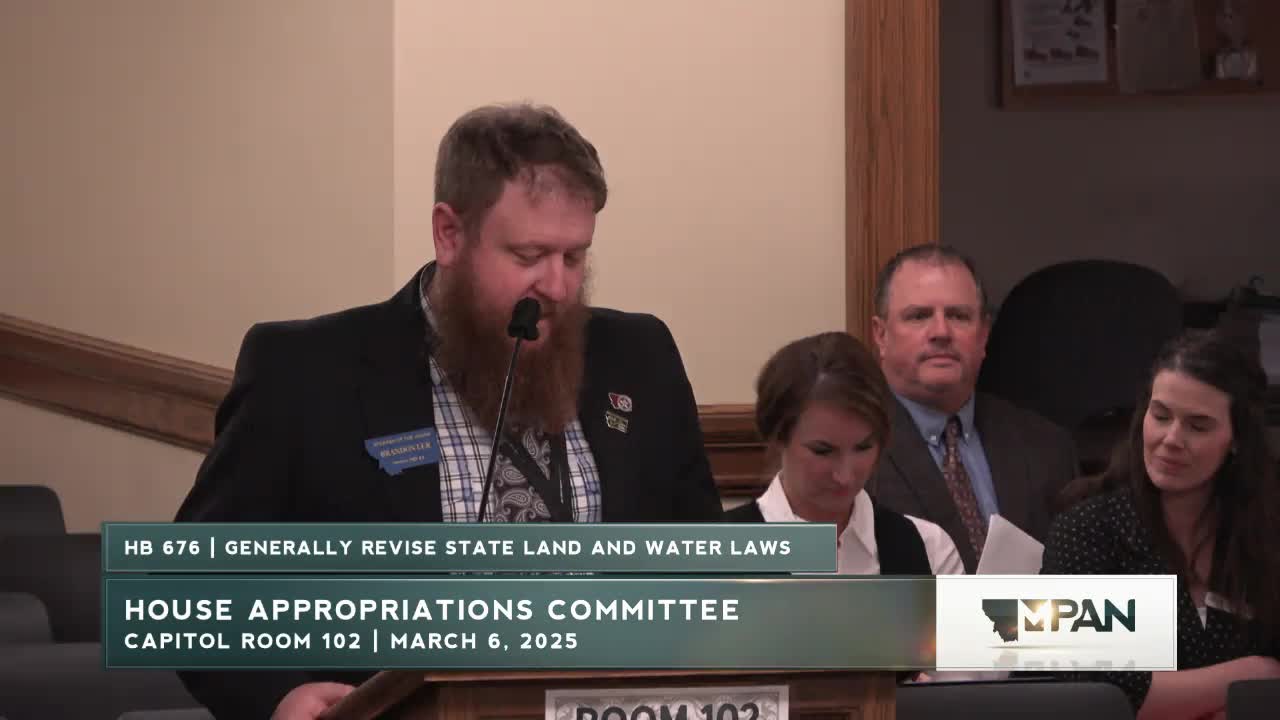
The bill’s sponsor, Brandon Leer, told the panel the measure would rework aspects of the state water court and clarify procedures for the Land Board to sell landlocked trust parcels that have private water leases. He said the measure’s fiscal implications were the central subject for the committee.
Supporters including Jocelyn Cahill of the Senior Ag Water Rights Alliance argued the fiscal note omitted significant potential revenue from parcel sales. Cahill said the state has about 5,000,000 acres of trust land and that, based on past Department of State Lands valuations, selling a portion of landlocked parcels could generate hundreds of millions of dollars one-time and ongoing property‑tax revenue thereafter.
Opponents raised legal, fiscal and technical concerns. Clayton Elliott of Charter Unlimited and Marcus Strange of the Property and Environment Research Center asked the committee to delay the bill, citing technical problems in how the bill treats adjudication work and appropriations for the water-rights process. Ellie Brighton, representing the Montana Stockgrowers Association, said the fiscal note assumes significant start-up costs (the note projects about $1,600,000 annually to process sales) and warned that required sales to lessees could reduce ongoing leasing revenue by an estimated $5 million to $7 million per year under assumptions in the fiscal note.
Informational witnesses from state agencies provided context but also underscored uncertainty. Sean Thomas, Division Administrator for Forestry and Trust Lands, said the fiscal note assumes about 1,250,000 acres of trust land lack legal access (landlocked or isolated) and modeled sales at 40 parcels (sections) per year with a transaction cost assumption of roughly $20,000 per sale. Anna Pakenham Stevenson, Water Resources Division Administrator at DNRC, said the bill anticipates compressing many water‑court tasks into a five‑year period and that the water court’s average production would need to rise sharply; she and DNRC staff said the fiscal note is unclear about how unresolved adjudications would be handled if the water court’s authority changes.
Committee members pressed both the sponsor and agency witnesses on valuation, marketability and how sale proceeds would be treated. Representative Gillette asked where sale proceeds would go; the sponsor said proceeds from permanent dispositions of trust land would go to the permanent fund for beneficiaries, principally K‑12 schools. Several members noted the bill’s language requires the Land Board to sell isolated parcels “shall sell,” and asked which agency would manage the sales; DNRC described using its existing land‑banking sales process as a modeling baseline.
Supporters and some committee members emphasized that sales would be limited to lessees who hold the relevant water right for the parcel. Opponents said captive sales to lessees may make determining a fair market value difficult in the absence of a competitive sale.
After debate Representative Jones moved a due‑pass motion. Roll-call votes recorded in the committee transcript show 12 yes and 11 no; those voting yes included Vice Chair Beatty, Representatives Alves, Barker, Falk, Patrick, Fox, Gillette, DeCastro, Nave, Schillinger, Walsh and Chair Jones. The committee clerk announced the motion passed and the bill will continue through the legislative process.
The committee record shows continuing uncertainty: DNRC and witnesses highlighted the difficulty of accurately valuing a broad portfolio of isolated parcels without a parcel‑by‑parcel title and access review, and the fiscal note labels sale revenue and resulting interest earnings as indeterminable without further work.
If the bill proceeds, members said they expect more drafting changes, particularly to clarify timelines for water‑court work, the sales process and the disposition of proceeds. The sponsor said he is open to working on those items in the Senate.
Votes at a glance: House Bill 676 — moved due pass by Representative Jones; committee vote 12 yes, 11 no; outcome: passed out of committee.