Get Full Government Meeting Transcripts, Videos, & Alerts Forever!
Get email alerts on the Ethics Commission Assessment topic
No spam. Unsubscribe anytime.
LOFT report: Ethics Commission focused on campaign finance; recommends audits, new filing system and case management
Summary
A Legislative Oversight Committee presentation of a LOFT operational assessment found Oklahoma's Ethics Commission concentrates most of its resources on campaign finance reporting and recommends audits, a new records system, clearer revenue accounting and expanded training for political subdivisions.
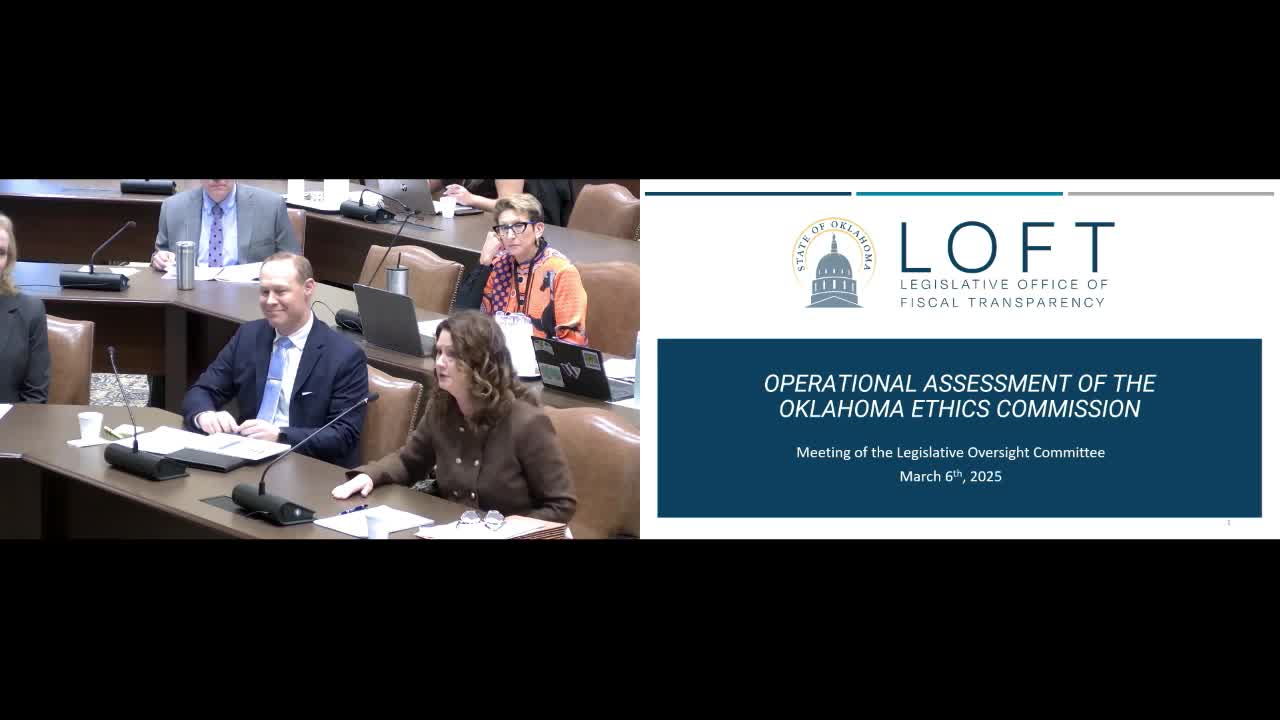
A Legislative Oversight Committee hearing on March 6 reviewed a LOFT (Legislative Office of Fiscal Transparency) operational assessment that found the Oklahoma Ethics Commission devotes the bulk of its enforcement effort to campaign finance reporting and needs improved records systems, clearer revenue accounting and a more proactive audit-and-training strategy.
LOFT Director Bertram presented the review and told the committee, “Today, we're presenting the operational assessment,” outlining four findings that encompass the commission's work, record keeping, mission alignment and opportunities to realign operations. The report recommended a new case management system, a risk‑based audit schedule, an annual report and a public-facing library of guidance and training materials.
The report said campaign finance complaints make up the largest share of the commission's workload. LOFT found that from 2014 through 2024 most enforcement activity, complaints and settlements related to campaign finance (Rule 2), while conflicts-of-interest complaints — the rule most directly tied to the commission's constitutional mission — represented a much smaller portion of settled cases. LOFT analysts concluded that many settlements arise from late or mistaken filings rather than substantive misconduct.
Leanne Bruce Boone, executive director of the Ethics Commission, introduced her staff and said the agency has begun to shift toward “strong customer service and presence,” adding the commission is working to increase proactive assistance for filers and to expand educational offerings.
LOFT also flagged gaps in the commission's financial record keeping. The auditors found discrepancies between fee-revenue spreadsheets provided by the commission and state accounting reports, and LOFT said the agency did not maintain consistent, accessible documentation in several cases. LOFT recommended clearer public reporting of revenues, use of revolving funds and an annual report detailing complaints, resolutions, trainings, audits and advisory opinions.
The committee heard detailed budget and fund figures during the presentation: LOFT reported the commission has historically received about $700,000 in annual appropriations and collects about $280,000 in fees and fines on average, giving the agency roughly $1,000,000 in available annual revenue. LOFT said the commission’s FY25 appropriation request totaled $2,360,000 and that the legislature provided one‑time funding of $1,350,000, including $1.2 million earmarked to replace the Guardian online filing system and $150,000 for a political‑subdivision enforcement fund. LOFT reported the ethics commission’s collective revolving funds held over $2,000,000 as of December 2024.
Committee members asked how revolving funds may be used. LOFT explained the commission has three revolving funds: a “200” fund with an annual deposit limit of $150,000 (but not a balance cap), a “211” fund with a $200,000 deposit limit that is restricted to IT expenditures, and a “212” fund that currently holds replacement funds for the Guardian system. The commission's leaders said the 200 fund primarily holds registration fees and could be used for one‑time needs, while recurring operating expenses should rely primarily on appropriations.
On information technology, LOFT documented the commission’s transition from the Guardian system (built under a prior contract) to a new vendor, RFD Inc. LOFT said RFD's statement of work estimated a possible five‑year cost up to $2.7 million if all performance benchmarks are met (about $2.6 million if benchmarks are not met). The commission told the committee it selected a vendor in part because it would allow the state to own the system source code and reduce long‑term software‑as‑a‑service costs. LOFT recommended the commission implement a robust case management system to prevent lost cases and better track staff time and outcomes.
LOFT urged the commission to adopt a risk‑based audit schedule, suggesting audits run on a two‑year cycle aligned with general election cycles and focusing on winning campaigns then losing campaigns in reverse order. LOFT argued that targeted audits would more reliably catch substantive campaign finance violations and reduce the number of technical‑error settlements.
The commission’s executive director said the agency has increased trainings and expects to expand virtual offerings; LOFT and commission staff both said restoring staff capacity and clarifying revenue use would enable more routine audits and political‑subdivision enforcement. LOFT also recommended statutory and administrative changes the legislature may consider, including limiting retrospective reviews across election cycles except for fraud and requiring campaign banking records post‑election (LOFT listed its full set of recommendations in the report).
During committee comment, members raised concerns about past staff turnover and inconsistent recordkeeping. Senator Goodwin asked whether the commission had rectified revenue accounting discrepancies; commission leadership said they were working with the state accounting office (OMES) to reconcile records and had reduced the commission’s reliance on outside legal counsel by hiring internal counsel and partnering with the attorney general’s office.
The hearing concluded with LOFT staff noting they will follow up in about a year to document the commission’s response to the recommendations. The committee also approved the meeting minutes by roll call during the session; the motion carried in accordance with joint rule 9.6.
The report and LOFT materials — including revenue exhibits, the Guardian/RFD contract discussion and LOFT’s recommendations — were made available to the committee and are referenced in the agency’s LOFT report.