Get Full Government Meeting Transcripts, Videos, & Alerts Forever!
Get email alerts on the Grants Funding topic
No spam. Unsubscribe anytime.
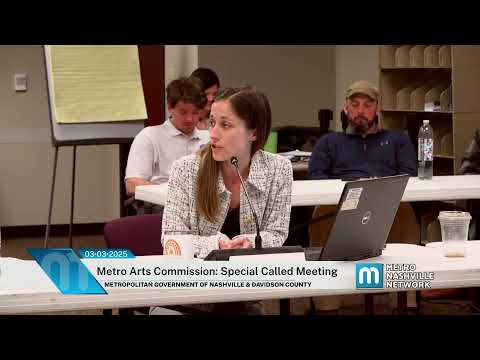
Metro Arts Commission approves operating and THRIVE grants totaling roughly $1.96 million for FY25
Summary
The Metro Arts Commission voted to award 92 operating grants totaling $1,957,920 and to fund 75 THRIVE project grants after staff explained the funding formulas and commissioners handled multiple recusals for conflicts of interest.
The Metro Arts Commission on a series of recorded votes approved funding recommendations for the FY25 operating and THRIVE grant cycles, awarding a total of $1,957,920 for 92 operating grantees and approving 75 THRIVE project grants.
Commissioners moved the grants-and-funding portion to the start of the agenda and then reviewed conflict-of-interest rules before voting. Tessa, a staff member, explained that Metro code 2.22202 requires commissioners to disclose conflicts when a family member, board member, fiscal agent or close contact could gain or lose financially or appearance-of-impartiality concerns exist. "If you know that you cannot vote impartially, you should recuse yourself and identify that as a conflict of interest," Tessa told the commission.
Why it matters: The awards restart grant payments after the commission’s review and are the main spending decisions Metro Arts made at the meeting. Staff said contracting will begin after award notices and estimated Metro’s contract-signature process will take about four to six weeks, meaning grantees should expect contracts within that window.
What the commission approved and how it was calculated
Interim Executive Director Ashley Gottschelder presented the operating-grants funding formula: organizations are grouped by budget-size category (micro through large); the “full funding” amount is calculated as 25% of an organization’s reported revenue; those full-funding amounts are summed and then scaled to the available operating budget (60% of the overall grant budget). Ashley said the operating budget available for this cycle was $1,900,000 and the resulting scale factor produced award amounts that sum to $1,957,920 across 92 operating grantees.
For THRIVE project grants, staff said the policy is to fund approved projects at 75% of the requested amount, then allocate remaining funds in rank order and finally redistribute any leftover funds evenly among eligible awardees without exceeding original requests. Staff told the commission there were 75 projects recommended for funding; award sizes ranged from approximately $4,000 to the amount requested.
Votes at a glance
- Operating grants: Motion to approve recommended operating grantees (92 organizations; total approved $1,957,920). Outcome: approved. (Group motions and a set of pulled, individual votes recorded during the meeting; several commissioners recused on specific grantees.) - THRIVE grants: Motion to approve the list of 75 THRIVE projects (individual applicants and projects with named fiscal agents). Outcome: approved.
Key named approvals highlighted during roll call
The commission recorded group approvals and multiple individual roll-call votes. Among the large organizations funded were Cheekwood Estate and Gardens; Nashville Ballet; Nashville Opera; Nashville Symphony Association; National Museum of African American Music; Country Music Hall of Fame; Frist Art Museum; and Tennessee Performing Arts Center. Mid-size, medium, small and micro category grantees were approved in a mix of group motions and individually pulled votes. For THRIVE, staff read the number and the applicant/fiscal agent pairs and the commission approved them (examples include projects using fiscal agents such as The Forge, North Nashville Arts Coalition, Belcourt Theater, International Black Film Festival, Global Education Center and others).
Conflict disclosures and recusal practice
Commissioners repeatedly disclosed conflicts. The chair and staff instructed commissioners to identify conflicts on forms filed with staff and to mark the packet so staff could pull items from group votes. The commission used the procedure that any grantee with identified conflicts would be removed from a category vote and considered separately so the remaining commissioners could vote on the rest of a category. Tessa explained that if a grantee might produce a monetary gain to a commissioner or a close relation or if the public would perceive partiality, that should be disclosed and the commissioner should recuse.
Process and timeline
Ashley told the commission that award notices would be emailed to applicants (awardees and non-awardees) and that contracting would then begin; she estimated contracts would take roughly four to six weeks to complete through Metro. The commission also said it had brought on extra contract help because of staff capacity constraints to expedite the contracting phase.
Ending
After the final THRIVE approvals, staff confirmed that notices would go out the week of the meeting and the contracting phase would start. The commission then moved on to other agenda items.