Get Full Government Meeting Transcripts, Videos, & Alerts Forever!
Get email alerts on the Zoning Code Clarification topic
No spam. Unsubscribe anytime.
Zoning board chair asks planning board to clarify mandatory water‑hookup rule and village setback standard
Summary
Suzanne Ryan, chair of the Wolfeboro Zoning Board of Adjustment, asked the Planning Board on March 4 to clarify or remove a vague mandatory water‑hookup provision (Section 175‑83) and to revisit a 30‑foot maximum front setback in the village residential district (Section 175‑70) because both, she said, create practical conflicts for applicants.
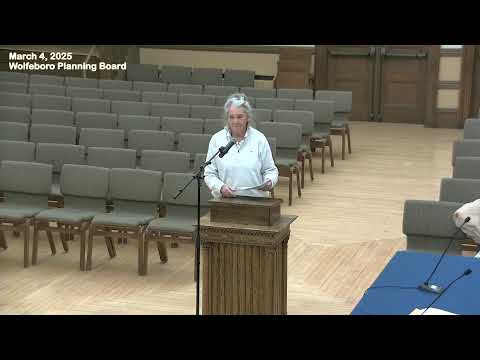
At the March 4 Wolfeboro Planning Board meeting, Suzanne Ryan, chair of the Zoning Board of Adjustment, urged the planning board to address two zoning/code items that the ZBA says cause confusion for applicants: a mandatory water‑hookup requirement and a 30‑foot maximum front setback in the village residential district.
Ryan said the mandatory water‑hookup language in Section 175‑83 is currently vague — the code requires a water hookup but no longer specifies a clear distance or threshold for triggering that requirement. “You used to have a dimension in there,” Ryan told the planning board, and she asked the planning board to either better define the rule or remove it, advising that the town attorney be consulted to confirm whether it belongs in zoning or should be handled as non‑zoning policy.
Ryan also raised concerns about a village residential rule (cited in discussion as a 30‑foot maximum front setback in Section 175‑70) that she said can be difficult to apply in practice, notably where sewer lines, steep terrain or other site constraints prevent a building being placed near the roadway. She described cases in which meeting the numeric setback requirement would force an otherwise reasonable redevelopment into an impractical location and asked the planning board to reconsider the standard or clarify how it should be measured (edge of road, centerline, sidewalk, etc.).
Ryan provided the planning board with ZBA case totals to show the board’s workload and record: she said the ZBA’s 2022 record included eight approvals and one denied variance, 2023 had four approvals and two denials, and 2024 (to date) included nine approvals and four denials (numbers as reported to the planning board). She asked that, where applications require review by both boards, the scheduling sequence be coordinated so the planning board can benefit from the ZBA’s notice of decision for any subsequent planning review.
The planning board acknowledged the request and said it would consider the items for the board work plan and consult planning staff and counsel as needed. No formal code changes were proposed at the meeting; the matter was presented as a recommendation for the planning board’s work program and future ordinance/code review.