Get AI Briefings, Transcripts & Alerts on Local & National Government Meetings — Forever.
Committee gives mixed recommendation to bills clarifying "acting in concert" and contiguous-lot rules
Loading...
Summary
The committee gave House Bill 2090 a do-pass recommendation and House Bill 2094 a do-pass recommendation after debate about agricultural and rural exceptions, wildfire risk and water protections.
Two related bills that clarify subdivision and lot-splitting rules drew debate before the committee and were reported do pass.
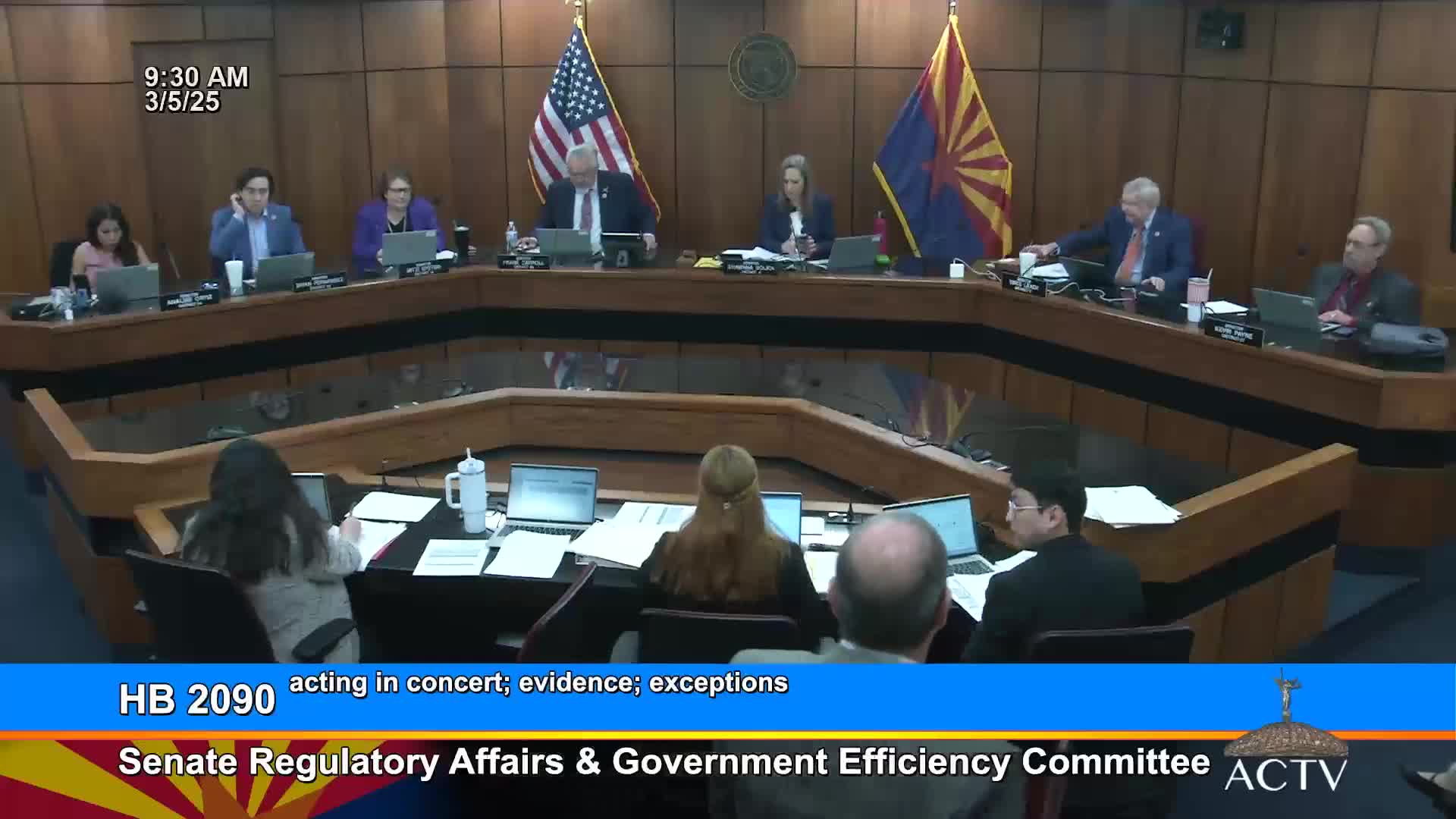
House Bill 2090 limits to a 10-year period the violation of acting in concert to unlawfully divide land to avoid subdivision laws, and adds exemptions for well-share agreements, road maintenance agreements and, in counties with population under 500,000, use of the same contractor or registered design professional. Tom Farley of the Arizona Association of Realtors testified in support, saying the bill "clarifies existing law about the 10 years" and recognizes practical arrangements in rural Arizona.
HB 2090 drew pushback from one senator who said the bill "tilts the winds of justice in favor of whoever is trying to do the development instead of whoever is looking out for our water," and another senator voted nay. The committee recorded a 4-3 vote in favor (four ayes, three nays).
House Bill 2094 modifies the definition of "contiguous" for subdivision requirements to include lots separated by a private road and to exclude public roads or highways accepted by a political subdivision. The Arizona Association of Realtors supported HB 2094 as returning statutory language to an earlier standard and targeting attempts to circumvent subdivision laws. HB 2094 was reported do pass on a 4-3 roll call.
Both measures are intended to clarify state subdivision rules and address rural practices; committee discussion highlighted concerns about water protection, enforcement and the potential to favor developers in certain factual patterns.