Get Full Government Meeting Transcripts, Videos, & Alerts Forever!
Get email alerts on the Business Personal Property topic
No spam. Unsubscribe anytime.
House panel advances SB1069 to raise business personal property exemption to $500,000; vote 5-4
Summary
The House Ways and Means Committee returned Senate Bill 1069 with a due‑pass recommendation after testimony for and against raising the business personal property exemption to $500,000; sponsors estimate a roughly $800,000 general fund impact and debate focused on effects for small businesses versus large corporations
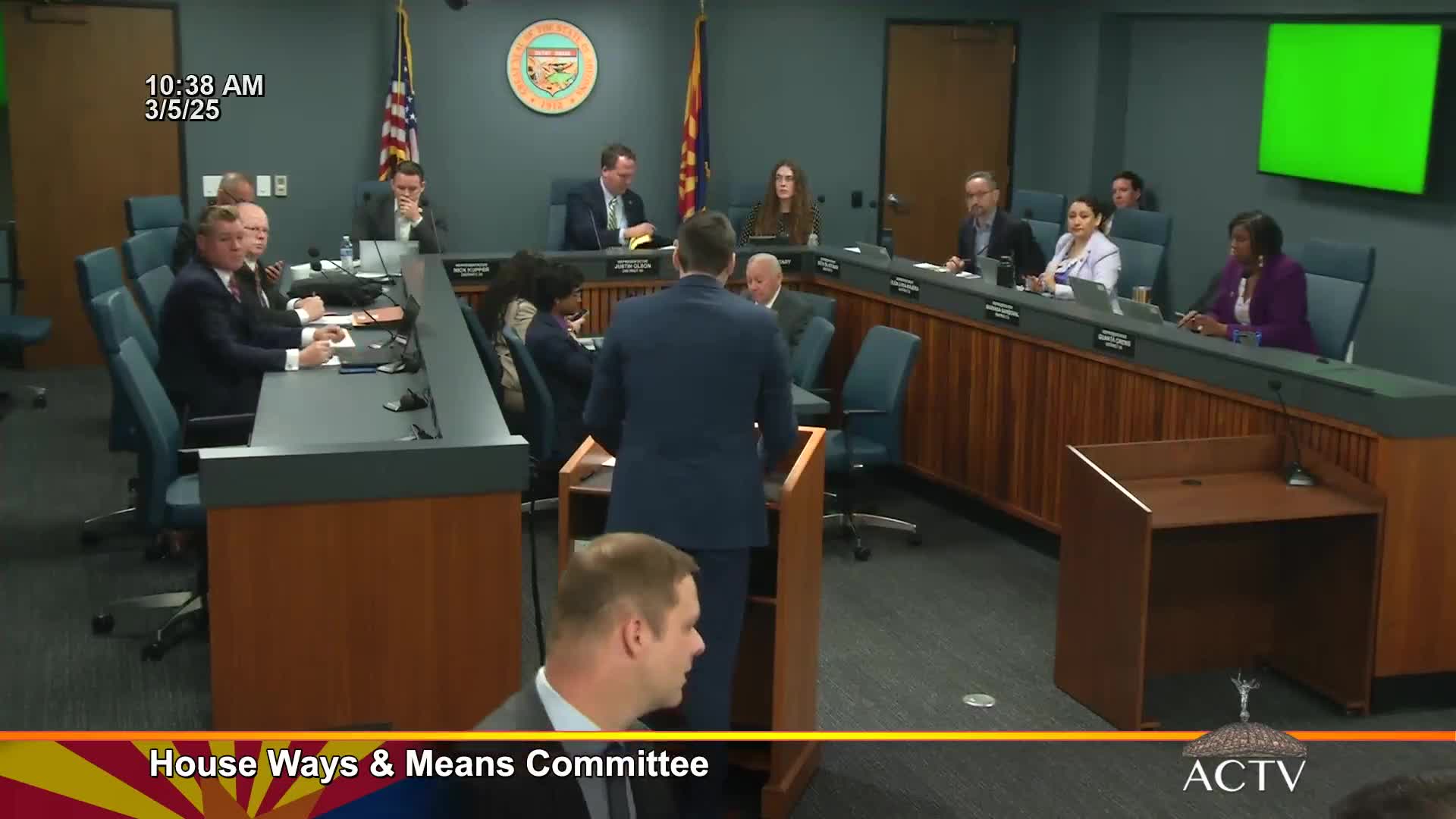
The House Ways and Means Committee voted 5‑4 to return Senate Bill 1069 with a due‑pass recommendation after hearing sponsor remarks and competing testimony for and against increasing the business personal property exemption to $500,000.
Senator Michelle Mesnard (bill sponsor) told the committee the measure is a modest step toward relief for small businesses. "While I would love to eliminate the entire business personal property tax because it is double taxation," Mesnard said, she described SB1069 as "a modest step" intended to reduce administrative burden and the effective double tax on small businesses. The staff explanation before the committee said the bill would be effective Jan. 1, 2026.
Why it matters: The bill would raise the exemption that applies to business personal property — furniture, fixtures and equipment reported to county assessors — shifting the exemption floor from the current inflation‑indexed level (discussed in testimony as approximately $270,000) to $500,000. Supporters said the change eases compliance burdens for many small firms; opponents said it would extend a benefit that could disproportionately help large firms and reduce state revenues.
Support and opposition - In support: Kevin McCarthy, president of the Arizona Tax Research Association, said the change provides administrative relief and equity for taxpayers and counties and argued that constitutionally mandated uniformity limits targeted carve-outs. Chad Heinrich of the National Federation of Independent Business told the committee the exemption will reduce tax complexity for small businesses and relieve administrative cost. - In opposition: Blake Lister of Opportunity Arizona testified the bill extends tax exemptions to businesses and called it "another tax handout for the riches," urging either a targeted amendment to favor small farmers and small businesses or a no vote. Mark Ashley, a resident who identified himself as a retired public servant, also opposed the bill as written, saying he feared larger dealers would capture the benefit.
Cost and effective date Staff and witnesses placed the general fund impact at roughly $800,000. The staff explanation before the committee listed the bill’s effective date as Jan. 1, 2026.
Committee motion and vote Vice Chair Cover moved that SB1069 be returned with a due‑pass recommendation. The committee recorded the following votes: Representative Carter — aye; Representative Dwayne — aye; Representative Taylor — aye; Vice Chair Cover — aye; Chairman Olsen — aye; Representative Robin — nay; Representative Cruz — nay; Representative Luna Najera — nay; Representative Sandoval — nay. The motion passed 5‑4.
Closing statements Sponsor Mesnard said the measure primarily benefits smaller taxpayers by raising the exemption floor and that a full repeal of business personal property tax is constrained by constitutional and broader property tax considerations. Opponents urged either targeting the exemption to smaller businesses or preserving revenue for public services.
Ending: The committee returned SB1069 with a due‑pass recommendation and will forward the bill to the next stage of the legislative process.