Get Full Government Meeting Transcripts, Videos, & Alerts Forever!
Get email alerts on the Higher Education Workforce topic
No spam. Unsubscribe anytime.
Private postsecondary leaders pitch workforce training, teacher pathways amid Arizona shortages
Summary
Leaders from Grand Canyon University and private postsecondary schools told the Senate Education Committee they are expanding programs to supply nurses, technicians and teachers to Arizona employers and urged inclusion in the state's Teachers Academy program.
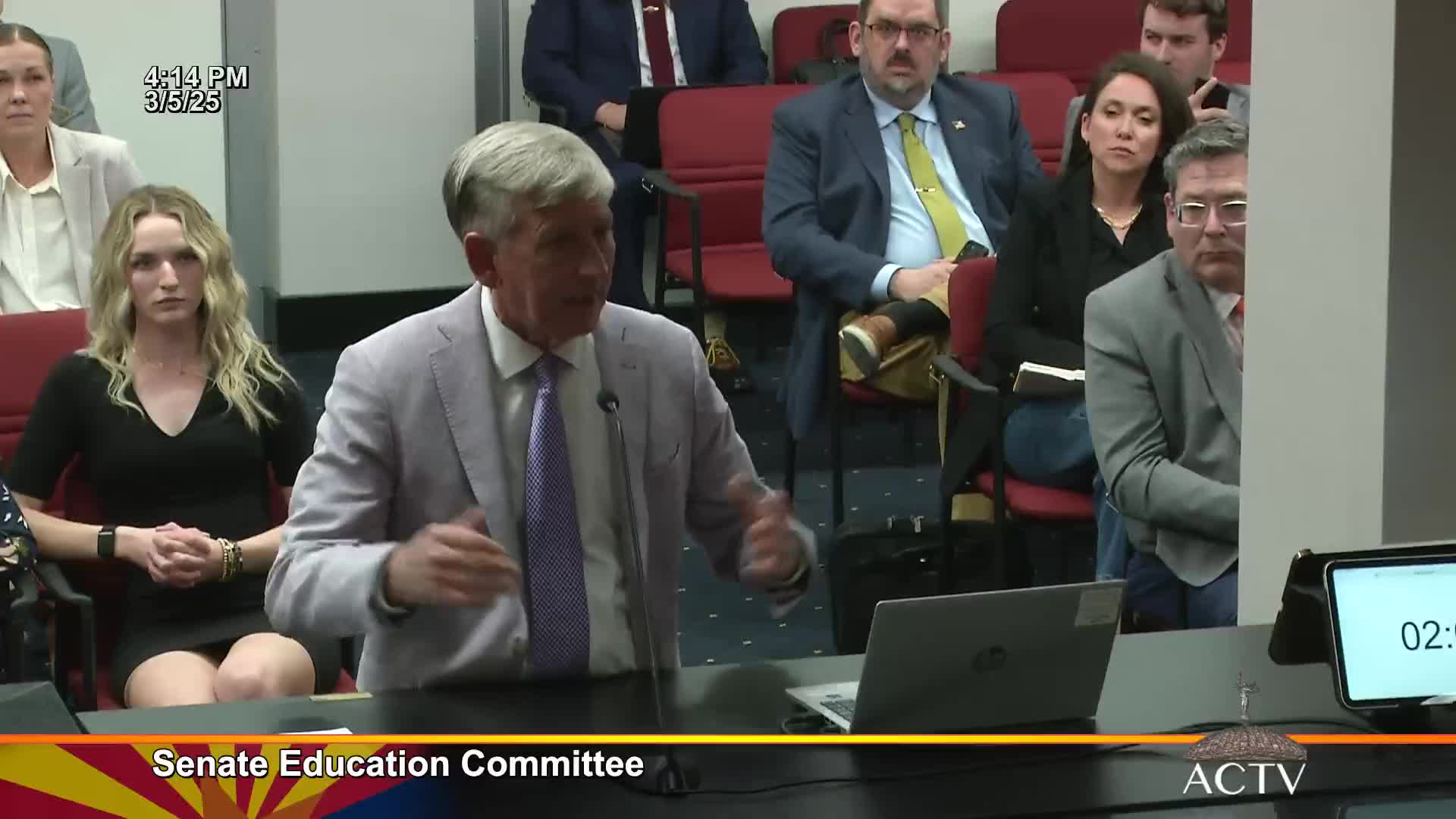
Grand Canyon University President Brian Mueller and representatives of Arizona's private postsecondary sector addressed the Senate Education Committee on Feb. 19, describing expanded campuses and certificate programs intended to feed state labor needs, and urging lawmakers to include private institutions in the Teachers Academy scholarship program.
Mueller said Grand Canyon University (GCU) has grown from roughly 900 on-campus students 16 years ago to 25,000 this year and is planning growth to more than 40,000 over the next decade. "We haven't raised tuition in 16 years," Mueller told the committee. "The average student now pays less tuition than the average state university student, and our students take out on average less debt than the average state university student." He added that just under 100,000 students study online with GCU and that about 20,000 of those students are in Arizona.
Why it matters: Committee members heard private colleges portray themselves as a low-cost, rapidly scalable source of trained workers for nursing, skilled trades and teacher preparation at a time Arizona districts report staffing shortages.
In his presentation, Mueller described four "platforms": a large residential campus, extensive online programs, a network of small local campuses focused on trades and nursing, and short-term pre-apprenticeship and manufacturing programs tied to local employers. He said GCU is producing nurses and preparing technicians for chip manufacturing and other trades; "Not every student needs a 4 year degree," Mueller said, arguing for alternative career pathways.
Kevin LaMountain, executive director of the Arizona State Board for Private Postsecondary Education, described the state's oversight role for nonpublic postsecondary institutions. He said the board licenses 237 institutions serving roughly 336,277 students across 3,150 programs and maintains a Student Tuition Recovery Fund to protect students if an institution closes. "These schools are out there doing great work'and it doesn't cost the state of Arizona any money," LaMountain told the committee.
Representatives of private-school associations and institutions elaborated on workforce programs. Stacy Nottingham of Bryan University and Andrea Snow of Ancora described partnerships with health-care and construction employers to train nursing assistants, machinists and other in-demand occupations. Dr. Emily Pottinger, associate dean at GCU's College of Education, told the committee GCU has graduated about 100,000 educators since 1961 and highlighted accelerated and "earn while you learn" programs intended to place candidates in classrooms quickly.
Committee discussion turned to House Bill 2018, which would allow private, degree-granting institutions that offer teacher-preparation programs to participate in the state Teachers Academy and make them eligible for fund distributions capped at the average in-state tuition and fees charged by Arizona public universities. Representative Matt Gress, sponsor of HB2018, said the bill includes a $10 million appropriation to the Teachers Academy fund to address current unmet demand.
Supporters at the hearing said HB2018 would expand the teacher pipeline and level the playing field for students attending private institutions. Opponents raised concerns about diverting limited public dollars before the state has met unmet need at public universities. Testimony from Dr. Emily Pottinger and GCU President Mueller emphasized financial barriers facing teacher candidates and argued the expansion would increase the number of teachers entering Arizona classrooms.
Ending: Committee members completed presentations and moved to consider multiple bills on the agenda. The Teachers Academy proposal was debated later in the session; the committee gave HB2018 a due-pass recommendation by recorded vote (see "Votes at a glance").