Get Full Government Meeting Transcripts, Videos, & Alerts Forever!
Get email alerts on the Municipal Finance topic
No spam. Unsubscribe anytime.
Emeryville amends midyear budget, moves redevelopment residuals to shore up general fund
Summary
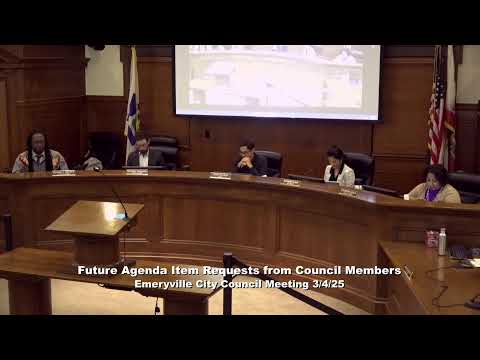
Emeryville City Council on March 4 approved a package of midyear budget adjustments and policy changes designed to reduce a structural deficit and increase the city’s short-term fiscal flexibility.
Emeryville City Council on March 4 approved a package of midyear budget adjustments and policy changes designed to reduce a structural deficit and increase the city’s short-term fiscal flexibility.
The council adopted an eight-point strategy recommended by the Budget and Governance Committee and vetted by the Budget Advisory Committee that reallocates the city’s residual redevelopment property tax revenues to the general fund, merges the economic uncertainty and disaster reserves, sets a 20% target for the unassigned general fund balance and assigns $3.3 million for a pending Social Security settlement, among other actions.
"In this 5-year projection the city is projecting a deficit in the general fund for all five years," Brian Mora, finance consultant with Regional Government Services, told the council during a presentation that outlined the city’s revenue shortfalls and reserve positions. Mora detailed that current-year revenue shortfalls included a $5.1 million decline from estimates and that last year’s adopted budget had moved from an originally projected $5.2 million deficit to a $7.2 million final shortfall largely because of a settlement with the IRS.
Why it matters: City staff and advisory committees warned the council that Emeryville faces a recurring structural gap driven by volatile development-related fees, declining key revenues and rising costs. The measures passed on March 4 are intended to (1) provide immediate budgetary breathing room with ongoing revenue reallocation, (2) create clearer reserve rules and (3) earmark money now for a known settlement to avoid future surprise draws on operating funds.
What the council approved: The principal elements the council accepted are: reallocating all residual redevelopment property tax receipts (currently about $6.4 million annually) to the general fund rather than splitting them across funds; transferring $7 million into the unassigned general fund balance (a $5 million draw from the merged reserve and $2 million from capital fund surplus) to reach a 20% working-capital target; merging the economic uncertainty and disaster reserves to reduce policy confusion and improve flexibility; and formally assigning $3.3 million from reserves to cover a pending Social Security settlement. The council also endorsed continuing audits and revenue-recovery work (sales tax, utility user tax and business license audits) and asked staff to update cost allocation and fee studies.
The presentation showed the effect of the package would reduce the current-year deficit from an $8.7 million shortfall to about $5.5 million and raise the general fund unassigned balance to roughly $11.5 million (about 20% of annual expenditures in the model presented). The combined reserve would remain near the council’s target, albeit with a somewhat lower percentage after the transfers.
Council discussion and next steps: Council members pressed staff on the reserve target and on options to close the remaining multi-year gap. Council member Preyforce noted Emeryville’s reserve target is higher than many comparable cities and asked whether the council could set a lower percentage; staff answered the target is council-determined and that merging the reserves would clarify how the 50% target is applied. Council members and the budget committees stressed the importance of avoiding repeated use of vacant positions to balance the budget.
Staff said next steps include presenting detailed midyear adjustments for all funds at the March 18 meeting, updating the two-year budget and five-year forecast, and returning with more detailed analysis and outreach on possible revenue measures for a November 2026 ballot (if the council chooses to pursue local measures).
Council action: The council voted to adopt the Budget and Governance Committee recommendations (motion and second on the floor; roll call vote recorded: unanimous approval). The motion formalizes the eight recommended items and directs staff to implement the reserve and transfer changes and to continue audits and fee/cost allocation work.
Context and caveats: The council-approved transfer plan relies in part on one-time transfers and reserve draws; staff and advisory committees noted that sustaining the general fund at the 20% unassigned target likely will require additional measures (expenditure reductions, continued revenue recovery work, or new local revenues) in the coming budget cycles. Mora also noted the city’s general fund relies unusually heavily on fees and charges, which vary significantly with development activity and make long-term forecasting more difficult.
Looking ahead: Staff will return with the formal midyear adjustment ordinance and more detailed fund-level changes at the March 18 meeting and continue work on the full two-year budget for 2025–27.