Get Full Government Meeting Transcripts, Videos, & Alerts Forever!
Get email alerts on the K 12 Curriculum topic
No spam. Unsubscribe anytime.
Little Miami presents science-of-reading-aligned ELA pilots; board hears six-year cost and state subsidy
Summary
District staff summarized a year-long pilot of new English-language-arts curriculum aligned to the science of reading, recommended Benchmark Advance (K–5) and Into Literature (6–8), and presented six-year cost estimates and a state reimbursement amount.
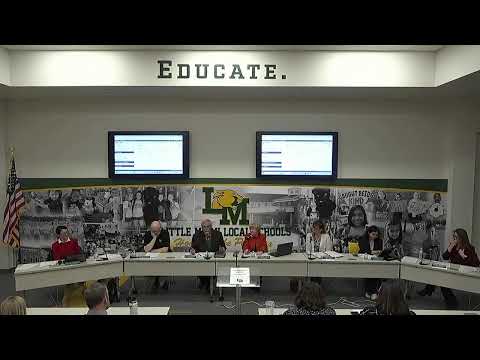
Jen Horvath, a district staff member working on curriculum, told the Little Miami Local School District Board of Education at its March 4 meeting that the district conducted a year-long pilot and recommends new ELA materials that align with the state’s science-of-reading mandate.
Horvath said the review began in 2023 after the Ohio Department of Education guidance that followed House Bill 33 and that the district used pilot teachers, building administrators and a literacy council to evaluate usability, alignment, student engagement, rigor and program modifications.
The district leadership recommended Benchmark Advance for kindergarten through fifth grade and Into Literature for grades six through eight. Horvath described the main technical reasons for the selections: Benchmark Advance’s vertically aligned, content-based units that build background knowledge and vocabulary across K–5; and Into Literature’s differentiated small-group tools and an embedded writing feedback tool called Writable for middle grades.
Horvath said Benchmark Advance would be purchased under a six-year contract for $544,009.98; the state would contribute $258,791.16, reducing the district’s six‑year cost to $286,207.42. She said Into Literature would cost $331,984.91 and that class sets of longer-read materials associated with that program would total about $335,362.61. Horvath said portions of consumable workbooks could be funded from student fees when appropriate.
Board members and staff discussed the procurement process, the state’s list of approved programs and professional development. Horvath said the state requires pathways training on the science of reading for educators from preschool through 12th grade; the district has been offering a professional-development series, a Schoology group for shared research and a book study.
Board members who spoke praised the diligence of the pilot process and the involvement of teachers and parents. One board member asked about prior curriculum adoption dates; Horvath said the district last adopted K–5 materials in 2013.
Horvath described implementation steps the district plans if materials are approved: finalize scope and sequence with pilot teachers, schedule vendor-led training (the vendors provide multiple training sessions), distribute teacher materials before summer and continue local coaching led by pilot teachers and the literacy coach.
No formal vote on adopting the new ELA materials was recorded in the March 4 meeting minutes; the presentation served as the board briefing and request for future board approval.