Get Full Government Meeting Transcripts, Videos, & Alerts Forever!
Get email alerts on the Mortgage Lending Discrimination topic
No spam. Unsubscribe anytime.
Senate banking hearing spotlights racial disparities in mortgage lending and public-banking proposals
Summary
A New York State Senate hearing assembled state regulators, the attorney general's office, industry groups and community organizations to examine racial disparities in mortgage lending, DFS enforcement and proposals including CRA expansion and public banks.
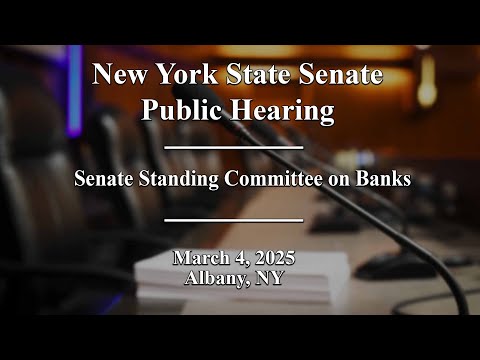
At a public hearing of the New York State Senate Banking Committee, state regulators, the attorney general's office, industry representatives and community groups presented competing explanations and proposals to address racial disparities in mortgage lending and access to credit across New York.
The hearing opened with Chair State Senator James Sanders Jr. framing the issue as central to the American dream: "If we are saying that that is not happening for a portion of the population, then that my friends is a very much attack on the idea of America." He and Senator Jabari Brisport said they convened the session to assess whether discrimination persists in mortgage origination and servicing and to consider remedies including public banking.
Why it matters: testimony and published analyses offered consistent evidence of lending disparities, while the Department of Financial Services and banking trade groups urged careful interpretation of public data and described ongoing regulatory and industry efforts. The Attorney General's Civil Rights Bureau summarized a 2023 office report showing persistent, statewide racial gaps at multiple stages of mortgage origination and refinancing. The Department of Financial Services described examinations, consent orders and a proposed regulation to expand the state's Community Reinvestment Act (CRA) to nonbank mortgage lenders. Advocacy groups called for stronger remedies including public banks and greater funding for community lenders; mortgage bankers and the New York Bankers Association pointed to underwriting constraints, secondary-market rules and limits of public HMDA data.
DFS role and findings: Samantha Darche, deputy superintendent of the Consumer Examination Unit at the New York State Department of Financial Services, told the committee that DFS supervises roughly 3,000 financial institutions and uses Community Reinvestment Act and fair-lending exams to detect discrimination. "Equity is 1 of our agencies guiding values," Darche said, and she described four agency reports since 2021 that, at an aggregate level, show racial disparities in mortgage origination across regions. Darche said DFS negotiated consent orders with some nonbank mortgage lenders requiring subsidized financing in majority-minority neighborhoods, marketing changes, enhanced training and additional compliance audits. She also noted DFS's second annual minority mortgage lending report released in November 2024 and urged stakeholders to submit comments on proposed CRA rules for nonbank mortgage lenders before the public-comment deadline (April 7, as stated during testimony).
Attorney general's findings and recommendations: Assistant Attorney General James Alyaga and a senior official from the attorney general's Economic Justice team summarized the office's October 2023 report, "Racial Disparities in Home Ownership," saying disparities appear at every step of the lending pipeline. Their presentation cited statewide household ownership rates (67% for white households versus 34% for households of color in Census data), higher denial rates for Black (23%) and Latino (20%) applicants compared with White applicants (14%), and an average 38% higher probability of denial for applicants of color after statistical controls. The office also estimated roughly $170 million in additional interest paid by Black and Latino borrowers on 30-year conventional loans originated 2018—2021, and $37 million in extra costs and fees. The attorney general's office recommended expanding New York's consumer-protection law to prohibit unfair or abusive acts (S.105/A.5287), strengthening the New York State Human Rights Law to address disparate impact, expanding down-payment and refinancing subsidies, and authorizing public banking (S.1992/A.6268 in testimony).
Advocates' stance and public-banking proposals: New Economy Project, New York Communities for Change, the Community Service Society and other community groups testified that discrimination exists in mortgage markets and called for structural remedies. "Is there discrimination in the New York home mortgage banking industry? The answer unequivocally is yes," Andy Morrison of the New Economy Project told the committee. Witnesses urged passage of the New York Public Banking Act, expanded capital for community development financial institutions (CDFIs) and targeted subsidies for first-generation homebuyers and home-repair financing.
Industry witnesses and data limits: Sherry Echols of the New York Mortgage Bankers Association and Claire Cusack of the New York Bankers Association urged caution in interpreting public HMDA data and emphasized underwriting constraints driven by secondary-market requirements. Echols described operational factors that affect approval and pricing (credit history gaps, debt-to-income calculations, appraisal and property-tax disparities, and secondary-market loan-level price adjustments) and emphasized that many independent mortgage banks must originate loans that can be sold to Fannie Mae, Freddie Mac, FHA, VA or USDA investors. Cusack noted the extensive federal and state regulatory framework (CRA, ECOA, the Fair Housing Act, HMDA and DFS oversight) and argued that DFS's statewide reports provide more comprehensive analysis than narrower studies in New York City.
Areas of convergence and outstanding questions: Witnesses converged on several points: racial disparities in lending outcomes are measurable; nonbank mortgage lenders have grown in market share (DFS testimony noted nonbank share rising to a majority by 2022); and data and enforcement gaps exist for nonbank originators. Questions remained about how much observed disparities are driven by underwriting variables omitted from public HMDA data (credit score, loan-to-value, some pricing factors) versus unexplained differences that could reflect discriminatory policies or practices. Senators and panelists discussed accelerating CRA oversight of nonbank lenders, bolstering DFS and AG enforcement capacity, and whether public banking or stronger subsidies should be pursued.
What comes next: DFS urged stakeholders to submit public comments on proposed CRA regulations for nonbank mortgage lenders; the department said those regulations would provide structure for future examinations. Several panelists asked the legislature to increase enforcement resources for fair-lending investigations and to consider statutory changes the attorney general and advocates recommended. Advocates asked the Senate and Assembly to move on public-banking legislation and to expand targeted down-payment and refinancing supports. Industry representatives offered to continue technical collaboration on underwriting, alternative-credit measures and regulatory design.
The hearing provided a detailed record of competing evidence and policy proposals rather than immediate statutory action. Lawmakers and regulators signaled intent to press the pace on oversight and to explore new tools, while community groups urged more rapid, structural change to close gaps in credit access and pricing.