Get Full Government Meeting Transcripts, Videos, & Alerts Forever!
Get email alerts on the Police Buffer Zone topic
No spam. Unsubscribe anytime.
Committee approves 25-foot buffer for officers during investigations
Summary
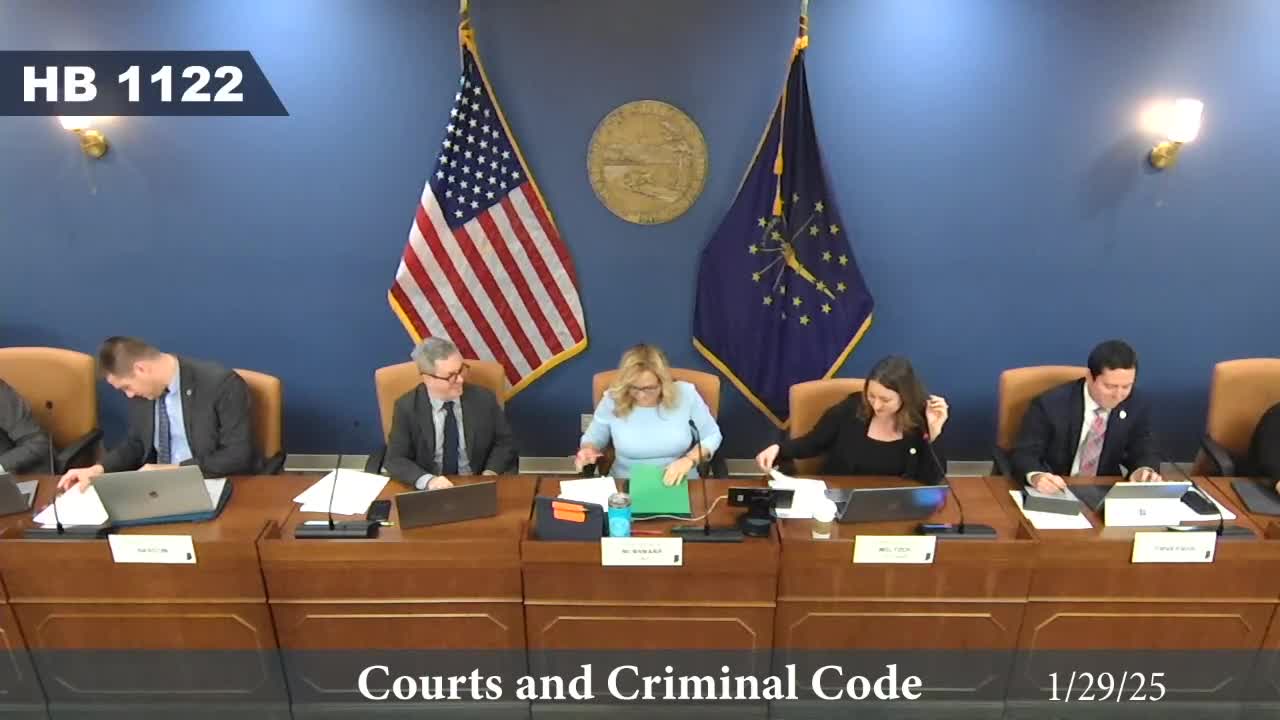
The House Courts and Criminal Code Committee advanced House Bill 1122 on a 10-3 vote to reinstate a statutory standard directing people to keep 25 feet from law enforcement conducting investigations, after a federal appellate injunction found prior language too vague.
The House Courts and Criminal Code Committee voted 10-3 to pass House Bill 1122, a measure that would require people to stay 25 feet away from law enforcement while officers are conducting an investigation and to make clearer the standard officers must use before ordering someone to move.
The measure, introduced by Chairwoman McNamara, aims to address vagueness the Seventh Circuit identified in litigation that blocked enforcement of the earlier 2023 law and to provide a clearer standard for officers when asking bystanders to step back.
Chairwoman McNamara said the bill “seeks to satisfy 1 of the injunction recommendations that there was no order for law enforcement to tell people to get back,” and that the change is meant to resolve the court’s concerns about vagueness. “The intention of this bill is to protect not only law enforcement, but also people that you're engaged in the situation with,” she said.
Sergeant Mark Saltzman of the Evansville Police Department testified in support, describing the prior law’s short period of enforcement and its local effectiveness. Saltzman said the law “went into effect in July of 20 23 and remained in effect until there were a couple of court cases that went to the Seventh Circuit Court of Appeals.” He told the committee that, during the time it was enforceable in Evansville, “it was extremely effective” and that public compliance generally followed when officers gave an order to step back.
Chris Daley of the ACLU of Indiana said the organization was neutral on the bill but supported tightening the standard. “We do think this is obviously a good-faith effort to bring the law into compliance with constitutional requirements,” Daley said, adding that the ACLU remains concerned that “25 feet is too great a distance” and that the provision could be abused; the organization said it will monitor use and litigate where it sees unconstitutional enforcement.
Kyle Pruitt, chief of police in Plainfield and government relations chair for the Indiana Association of Chiefs of Police, told the committee the distance is not large in practical terms and argued safety and evidence-preservation concerns support the buffer. “I think if you look laterally one side or the other, I'm approximately 25 feet from either wall. We're not talking a great distance…this very simple iPhone can capture video and audio from that sort of distance,” Pruitt said, and added officers sometimes need space to avoid exposing evidence or decedents to public view.
Representative Matt Pierce and other members asked about scenarios where the buffer could extend into private property, such as a porch or inside a house; McNamara acknowledged it is “virtually impossible to do every single scenario that a law enforcement officer finds themselves in” and that the bill cannot enumerate every factual permutation.
The committee recorded three recorded no votes — Representatives Pierce, Shackleford and Bauer — and ten yes votes. House Bill 1122 now moves to the full House.