Get Full Government Meeting Transcripts, Videos, & Alerts Forever!
Get email alerts on the Presumption Of Death topic
No spam. Unsubscribe anytime.
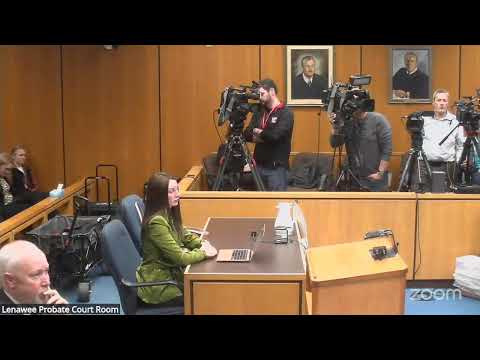
Probate court orders Skelton brothers presumed dead but declines to find father guilty of murder
Summary
Lenawee County Probate & Juvenile Court granted in part a petition to declare three missing Skelton brothers deceased under Michigan statute but denied the request to find their father, John Skelton, murdered, saying the evidence did not meet the clear-and-convincing standard.
A judge in Lenawee County Probate & Juvenile Court granted in part a petition to declare three brothers who vanished more than a decade ago presumed dead, but declined to find by clear and convincing evidence that their father, John Skelton, murdered them.
The court’s written opinion, read aloud at the hearing, said: "After review of the evidence, testimony, and current law, the petition is granted in part and denied in part." The judge cited Michigan Compiled Laws (MCL) 700.1209(2) in explaining the legal standard for a declaration of death after an extended unexplained absence.
The petition, brought by Tanya Zuber (petitioner), asked the court to find that the children died on the night of their disappearance rather than waiting for the presumption period to lapse. The judge said the petitioner produced five witnesses at a one-day trial, including three law-enforcement officers, the petitioner, and a cold-case researcher.
"This order settles the matter raised by Tanya Zuber's petition," the judge read, and then described the court’s analysis of the testimony and records offered in support. The court concluded that, while the statutory presumption of death applied, the record did not contain clear and convincing proof that John Skelton murdered the children.
Law-enforcement witnesses described investigative work but, according to the judge, much of their testimony relied on multiple layers of hearsay and on reports or recollections that were not supported by underlying documents offered into evidence. Chief Larry Weeks, formerly of the Morenci Police Department, testified about on-scene observations including a home he described as in "disarray," and that a fellow officer had removed a "noose." FBI agent Corey Barris testified he observed the residence and described it as "destroyed." Michigan State Police Detective Jeremy Brewer presented a multi-piece timeline and described years of investigative effort but the judge noted supporting documents for that timeline were not provided to the court for verification.
Cold-case researcher Kelly Hodges testified she ran roughly 20 database searches, including facial-recognition and age-progression checks, and reported she found "no proof of life after 11/25/2010." Tanya Zuber testified she had for years held out hope the boys were alive but said she no longer believed that was the case.
On the question of whether the court could make an earlier finding that the children were killed on the night of their disappearance, the judge wrote that such a determination requires proof by the higher "clear and convincing" standard. "The presentation of evidence, however, does not present clear and convincing evidence that John Skelton murdered these children," the judge said.
As a result of the ruling, the court ordered that the three brothers — identified in the hearing record as Alexander William Skelton, (as transcribed) Ryan Andrew Skelton, and Tanner Lucas Skelton — be presumed deceased in accordance with the cited provisions of MCL 700.1200 et seq. The court emphasized the decision does not resolve the underlying criminal questions; it addressed only the civil statutory presumption and declined to make a finding of murder.
The judge acknowledged the "terrible and longstanding impact on the community" and offered condolences to family and community members but said the court must follow the law and the applicable evidentiary standard. The hearing concluded with the court reading its order and asking if there were questions.
Votes at a glance: This was a judicial order rather than a multi-member vote; the court announced a single written ruling: petition granted in part (declaration/presumption of death) and denied in part (no finding that John Skelton murdered the children).