Get Full Government Meeting Transcripts, Videos, & Alerts Forever!
Get email alerts on the School Funding Referendum topic
No spam. Unsubscribe anytime.
Racine Unified superintendent asks voters to approve $190 million referendum to shore up school budget
Summary
Superintendent Lauren Gajewski told a March town-hall that a non-recurring $190 million, five-year referendum on the April 1 ballot is designed to preserve current programs and staff amid state funding shortfalls and rising costs.
Lauren Gajewski, superintendent of Racine Unified School District, told a town-hall audience the district is asking voters to approve a non‑recurring $190,000,000 referendum spread over five years to cover growing budget shortfalls and preserve current programs.
“This is it, right, plain and simple in front, is $190,000,000 over the next 5 years. This is a non reoccurring referendum,” Gajewski said, adding the measure is meant to sustain recent academic gains while preventing further staff and program cuts.
Nut graf: The referendum, which appears on the April 1 ballot, is the district’s response to a long-running gap between state funding and inflation that officials say has produced multi‑year deficits. Gajewski said the district faces roughly $24 million to $34 million in shortfalls in coming years and that a failed referendum would force deeper staffing cuts, larger class sizes and program reductions.
Gajewski framed the ask as a maintenance of current services rather than an expansion of programs. She listed the referendum’s intended uses as sustaining early-literacy instruction, keeping school safety systems and staff, preserving youth-apprenticeship and dual-credit opportunities, and maintaining compensation levels needed to attract and keep teachers. She said the district’s enrollment is about 15,500 students and described recent gains including improved graduation rates and state report-card scores.
She cited several budget figures during the presentation: a $34,000,000 deficit found in her first year, vacancy savings of about $4,000,000 from unfilled positions last year, a forecast of roughly $24,000,000 deficit for the next year, and projected deficits across five years that she summarized as about $24 million, $30 million, $35 million, $42 million and $45 million. Gajewski said the district estimates the referendum would raise about $26 million in its first year and that the staggered yearly amounts are designed to produce an approximately level tax impact year to year.
“The impact would be approximately $35 increase on your property taxes per $100,000 of your property value,” Gajewski said. She offered the numerical example that a $200,000 home would see about a $70 increase in the first year.
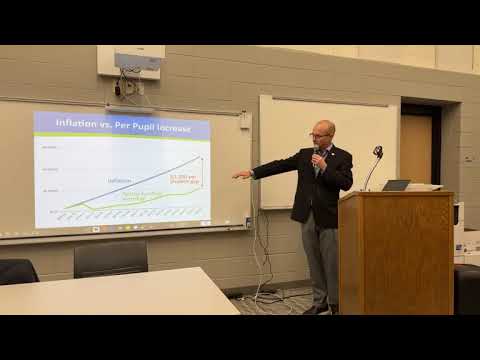
Gajewski attributed the long-term gap to the state funding formula, saying that in about 2009 the state “decoupled public school funding with inflation,” which she called a major cause of a roughly $50,000,000 revenue loss since that change. She also referenced Act 20, a state initiative tied to reading instruction requirements and funding that she said included $50,000,000 for districts but that the money had not been delivered to schools.
On safety, Gajewski said the district uses a screening system at entrances and funds staff who work to “reregulate students” and head off serious incidents. She said those systems have a purchase and upkeep cost and that losing referendum funds would force reductions in safety staff and equipment. She referred to the entrance screening as the Evolv system.
During a question-and-answer segment, Gajewski emphasized that the referendum is intended to maintain current staffing and services rather than add new ones. When asked what specific cuts might occur if the referendum fails, she said principals would have to staff buildings with smaller budgets, which could mean larger class sizes, fewer course options, reduced extracurricular availability and lower compensation that could increase staff turnover. She said the district already had reduced staff and closed some schools during previous budget adjustments.
Community organizers and students also spoke at the event. Andrew Ellison, campaigning director for the Vote Yes for Our Kids campaign committee, described local outreach efforts and asked for volunteers for door‑knocking, phone banks and yard‑sign distribution. “We’ve been out walking the last couple months, setting up, getting out in the community, talking with folks about the campaign,” Ellison said.
Students who attend district academies described program benefits. Jayden George, a student ambassador from Racine Case High School, said the academy’s youth-apprenticeship and dual-credit opportunities gave him workplace experience and college credits. “I learned how to write grants. I write newsletters. I help with the Facebook pages,” Jayden said, describing certifications and off‑campus partnerships he credited to district programming.
The superintendent and other speakers repeatedly framed the referendum as a stopgap while the state addresses long-term funding, and as a way to preserve gains the district has made in early literacy and college- and career-ready programs. Gajewski urged voters to view the measure as an investment to preserve recent progress.
Ending: The district encouraged attendees to ask questions, view a building tour after the presentation, and contact the superintendent’s office or the Vote Yes for Our Kids campaign for more information. The town-hall was livestreamed on the district’s Facebook page and included a later building tour for attendees.