Get Full Government Meeting Transcripts, Videos, & Alerts Forever!
Get email alerts on the Capital Improvements topic
No spam. Unsubscribe anytime.
Sewell Homestead advisory board prioritizes repairs, asks for financial transparency and schedules site visit
Summary
At its inaugural advisory meeting, members and public speakers reviewed an initial capital plan for the Sewell Homestead Education Center, flagged deferred maintenance and volunteer declines, and asked staff for detailed treasurer reports before a site visit set for late March.
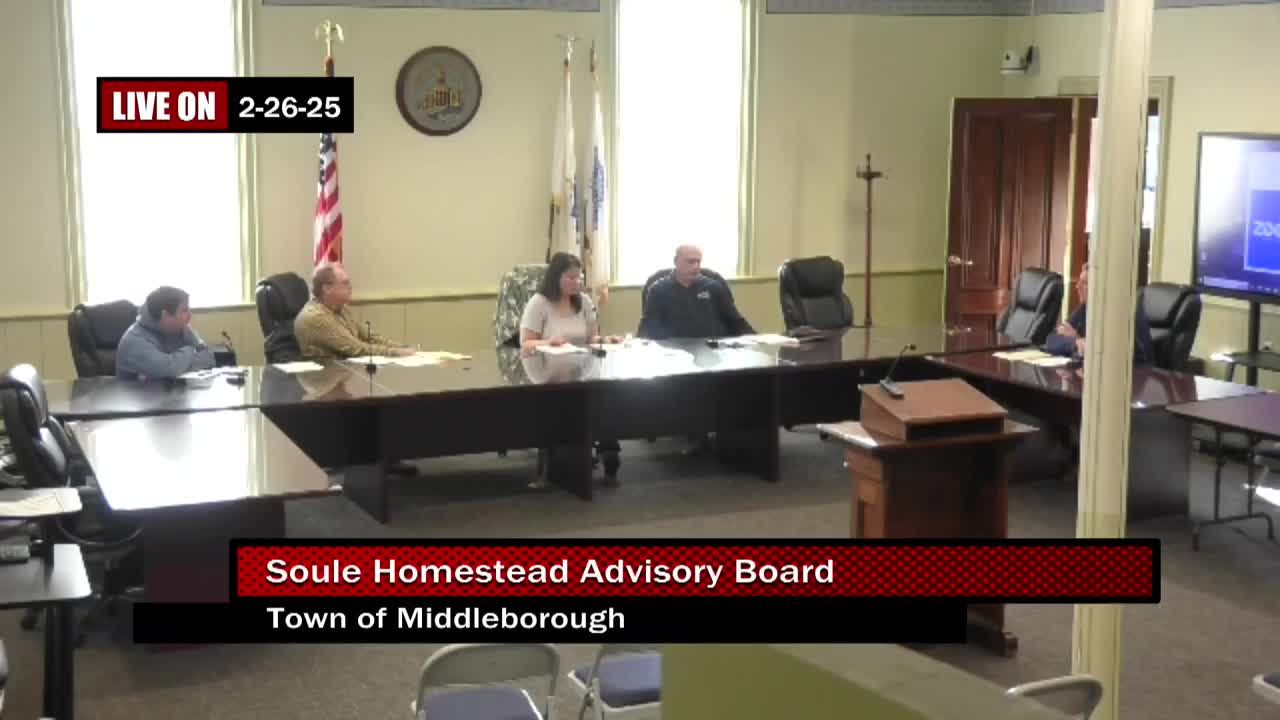
Theresa Farley, Select Board member and the Town of Middleborough’s representative to the Sewell Homestead Advisory Board, opened the new advisory board meeting by placing a capital plan at the top of the group’s agenda and asking members to help prioritize needed repairs and funding options.
The discussion centered on immediate building repairs, funding constraints, and a decline in volunteers and community groups using the Homestead. The board agreed to request detailed financial reports from the Homestead’s treasurer and to conduct a site visit at the Homestead in late March to review urgent maintenance needs in person.
Why this matters: The Town of Middleborough owns the Homestead’s buildings and holds a lease with the Sewell Homestead Education Center that, board members and public speakers said, obligates the tenant to provide free or low-cost programming to residents. Members and commenters told the advisory board that sizable deferred maintenance and limited staff capacity threaten the center’s ability to meet both program and property responsibilities without clearer town support or outside funding.
Members and roles: Farley chaired the meeting as the Select Board appointee. Jay (identified in the meeting as the town’s ex officio representative) opened the session and turned the meeting over to Farley. Advisory members who introduced themselves included Neil Rosenthal (at-large advisory member and former Select Board member), David Kramer (vice president of the Sewell Homestead board and long-time volunteer), and Nathan Demers (who has served on both the Select Board and the Homestead board). Several members of the public made substantive comments, including Tia Quinn (resident/commenter) and Carrie (a former Homestead board member and neighboring farm owner). The treasurer, Nancy, was referenced repeatedly as the person who will provide financial reports.
Capital and maintenance needs: Advisory members summarized recent and planned repairs. Kramer said the Homestead used roughly $25,000 from Community Preservation Committee (CPC) funding to start siding work on the farmhouse and that a Pierce trustee contributed about $9,000 toward the farmhouse siding. The east classroom had both window replacement and roof repairs funded or earmarked; those projects were prioritized because funds were expiring. Kramer listed other immediate items: finishing siding and trim work on the farmhouse and east classroom, repairing a chicken coop (materials previously estimated at about $5,000), and installing gutters across several buildings. He estimated the Homestead’s total gutter needs at roughly 1,000 feet and cited a ballpark price near $15,000 for that work.
Finances and staffing: Speakers said the Homestead operates with about “two and a half” staff positions (about 100 employee hours per week) and relies on programming and rentals for income. Kramer said the Homestead once ran eight or nine weeks of summer camps that produced only about $100 net in one year; after a modest rate increase the following year the Homestead netted about $7,000 from camps. The board discussed fundraising and grant options, including CPC and other grant-writing support the town could help coordinate. Farley asked the Homestead to provide a year-end treasurer’s report (the Homestead’s fiscal year was stated in the meeting as Dec. 31) and for regular monthly treasurer reports to be shared with the advisory committee so members could better understand revenue sources, program margins and expenditures.
Transparency and confidentiality: The advisory board and Homestead representatives agreed that financial documents that come before the advisory group are public records, but that confidential items could be redacted before distribution. Farley offered to meet with treasurer Nancy and with Jay to determine what is appropriate to share, redact any legitimately confidential details, and then publish the rest to the committee.
Volunteer and programming concerns: Multiple public commenters and advisory members said volunteers and long-standing community groups — for example 4‑H, Boy Scouts, quilting and fiber arts groups and other community users — have reduced their involvement or were no longer allowed to meet at the Homestead. Tia Quinn, a member of the public, told the board there is a simple budget spreadsheet that once accompanied the annual report and that the Homestead should make such breakdowns available to explain programming and community-use decisions. Carrie, a former Homestead board member, said a large share of the Homestead’s revenue comes from rental income (house tenant rents) and that the organization’s mix of landlord responsibilities, farm leases and educational programming creates misaligned priorities that the advisory board can help resolve.
Lease, APR and town responsibilities: Board members and commenters repeatedly referenced the lease requirement for free and low-cost programming to town residents and noted the property is subject to an Agricultural Preservation Restriction (APR) and related state rules. One speaker recalled negotiating APR terms and said haying had been accepted previously as an agricultural use under the APR. Advisory members emphasized the town’s ownership of the buildings and the need to clarify which capital repairs fall to the town and which fall to the Homestead under the lease.
Next steps and logistics: Members requested that the Homestead send the year-end treasurer’s statement and monthly treasurer reports to the advisory committee (committee distribution will be via the Homestead advisory group email). Farley said she would provide a sample capital-plan spreadsheet that committee members could fill in and prioritize; Kramer offered to walk the committee through the Homestead’s most urgent building issues. The group agreed to a site visit and meeting at the Homestead in late March (the board discussed a late‑March date and agreed to confirm the exact day by email). Farley and Jay said they would meet with the treasurer in advance to identify any confidential material that should be redacted before public distribution.
Formal actions: The meeting closed with a motion to adjourn that was seconded and approved by voice vote.
The advisory board indicated it will reconvene after the site visit to consider a prioritized capital plan, grant opportunities and options to restore community-use arrangements that meet the lease’s free/low-cost programming requirement.