Get Full Government Meeting Transcripts, Videos, & Alerts Forever!
Get email alerts on the Land Use Zoning topic
No spam. Unsubscribe anytime.
Easley planning commission hears draft Unified Development Ordinance; discussion centers on tree rules, consolidation and review process
Summary
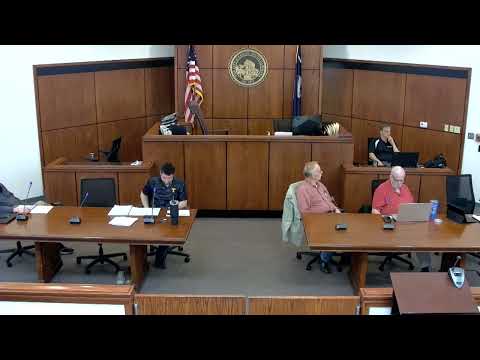
A consultant for the City of Easley presented a draft Unified Development Ordinance (UDO) to the Planning Commission on Oct. 7, and commissioners deferred formal action to a future meeting after extensive questions and public comment about tree-preservation rules, consolidated zoning tables and implementation details.
A consultant for the City of Easley presented a draft Unified Development Ordinance (UDO) to the Planning Commission on Oct. 7, and commissioners deferred formal action to a future meeting after extensive questions and public comment about tree-preservation rules, consolidated zoning tables and implementation details.
Rico Gianni, senior planning associate with MRB Group, told the Planning Commission the UDO combines the existing zoning ordinance and land development regulations into one document and reorganizes standards into consolidated tables for permitted uses and dimensional standards. "The most significant change that you'll see in this document is the tree preservation standard," Gianni said during the presentation.
The draft also proposes a revived architectural review board, a standing internal review group called an Area Coordination Committee, clarified development-review procedures and new buffer and tree-mitigation requirements. Gianni said the document preserves existing zoning districts but reorganizes regulatory text into consolidated, easier-to-read tables so administrators and applicants can find requirements in one place.
Why it matters: commissioners and residents said the changes are substantial enough that the city needs an annotated, side-by-side comparison of the draft against the current ordinance and land development regulations before voting. Several commissioners asked staff to provide comparisons in sections so the commission and the public can verify whether wording is new, rephrased or removed.
Key points from the presentation and discussion
- Tree preservation and mitigation: The draft establishes a general tree-coverage requirement, a tree-survey submittal requirement for larger developments, replacement or mitigation calculations tied to tree diameter-at-breast-height (DBH), and an option for a fee-in-lieu to a city tree fund. Gianni described a framework in which an existing large tree could be replaced by planting credits or by payment into a tree fund if credits cannot reasonably be achieved on-site. "If it's not feasible due to site constraints ... they will pay a payment to the city, into the city's tree fund," Gianni said. He also said street trees and preserved trees could count toward required tree coverage.
- Nonconformities and thresholds: The draft includes thresholds for determining when alterations to nonconforming structures trigger improved site requirements (Gianni cited a common 50% threshold tied to appraised value and building-permit cost reporting). "If you exceed a 50% of its appraised value ... you would be required to say, OK, you gotta invest, like, 5% of those dollars to install some trees," he said.
- Consolidation of standards: The consultant reorganized many spread-out provisions—definitions, permitted uses, dimensional standards and development-review steps—into consolidated tables and appendices. Gianni used a cookbook analogy to describe reorganizing disparate text into thematic sections and tables to ease administration and public use.
- Buffers, parking and parking alternatives: The draft defines three buffer types (visual; visual-plus-acoustic; visual-plus-acoustic-plus-separation) with required composition, and adds flexibility for parking through shared-parking analyses, reduced required spaces based on site conditions, and fee-in-lieu of parking in some downtown or core-commercial circumstances.
Public comment and specific concerns
Several residents spoke during the public-comment period and raised detailed questions about how the draft would be implemented and enforced.
- A long public comment (speaker identified in discussion as Pat, resident) asked who would perform tree surveys, how small residential tree removals would be handled and whether bonding requirements for subdivisions expose the city to risk. The commenter said: "You say things like do a tree survey. But you don't say who needs to do the tree survey." The speaker urged clarity on who reviews tree surveys and what fees or fines would apply for small backyard removals.
- Justin Alexander (resident) asked the commission to "consider an exemption for small residential lots" so homeowners would not need a permit for routine backyard tree removal, and said he would submit typos and suggested edits via the spreadsheet process staff proposed.
- Dennis Gallagher (resident) warned that large developers might pay fees in lieu of on-site improvements and urged the commission to watch for unequal outcomes: "I've seen it in the past ... it doesn't work well because some people, developers, are able to pay a large fee to pretty much get what they want." He also asked for clarity on enforcement responsibilities.
- Donna Rainey (resident) requested page numbers and raised technical questions about floor-area-ratio and impervious-cover calculations and how the draft treats campgrounds and farm-animal rules.
Staff direction and next steps
Commissioners asked staff to provide more granular review materials. Gianni and city staff agreed to explore producing an annotated, side-by-side comparison (or an online, cursor-over comparison) mapping new UDO sections to current ordinance language and the existing land-development regulations. Gianni recommended a process for submitting written corrections: a spreadsheet that lists section references and suggested edits, which he will consolidate and use to prepare revised drafts.
Formal action: The Planning Commission moved and seconded a motion to defer consideration of the UDO draft to a later meeting. The commission voted by voice to defer; the chair called the motion approved. No ordinance or text amendments were adopted at the Oct. 7 meeting.
What remains unresolved
Commissioners and residents repeatedly asked for specific clarifications and edits staff should supply in future meetings, including: - A side-by-side or annotated comparison showing where current language is unchanged, reorganized, reworded or omitted. - Clear definitions of when and by whom tree surveys and arborist reports must be prepared and reviewed, and an explicit exemption or administrative path for single-family residential tree removals. - Explicit assignment of responsibility for maintenance and ownership when open space or alleys are dedicated, and requirements for HOA documentation where dedications are not to the city. - Clear references for technical studies (traffic-impact studies, arborist reports) showing the professional qualifications required for submittals.
The commission did not set a new vote date at the meeting; staff indicated they would work to provide sectioned comparisons and accept spreadsheeted comments from commissioners and the public before the next hearing.
Ending
No final action was taken on the UDO at the Oct. 7 meeting; commissioners deferred the item after public comment and a request for more detailed, annotated materials. City staff and the MRB Group consultant will provide further documentation for review and accept written correction requests in a spreadsheet format ahead of the next meeting.