Get Full Government Meeting Transcripts, Videos, & Alerts Forever!
Get email alerts on the Budget Public Hearing topic
No spam. Unsubscribe anytime.
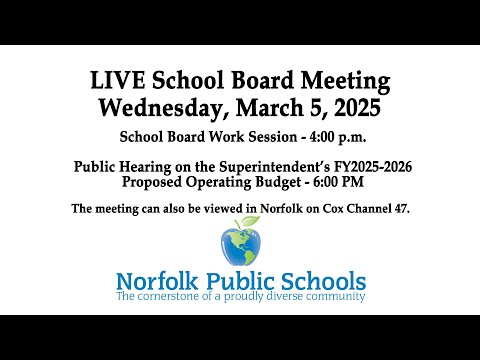
Public hearing on superintendent’s FY26 budget draws appeals for facilities repairs, before-and-after care and staff pay
Summary
At a public hearing on the superintendent’s FY26 operating budget, community speakers urged investment in school repairs, before-and-after care at Jaycox, pay and hours for wellness assistants, music education, and more equitable facility funding across neighborhoods.
Norfolk Public Schools held a public hearing on March 18 on the superintendent’s proposed fiscal year 2025–26 operating budget. Chief Financial Officer Miss Spivey summarized the proposal, which she said totals about $772.9 million across funds and includes a $450.2 million general fund, staff compensation adjustments (an average 4.5% COLA and step increases, higher starting teacher pay) and continued capital investment including the Maury High School rebuild.
Speakers at the public hearing — 15 individuals who had signed up in advance — raised a range of local concerns and requests:
- Facilities and maintenance: Parents and PTA representatives urged more urgent repairs at older buildings. A parent of students at Oceanaire Elementary described deteriorating caulking, ceiling tiles and roofing repairs and said the condition affected a child with respiratory allergies; she cited research linking school facility condition to student outcomes and teacher retention and asked the board to prioritize maintenance funding.
- Ghent and Maury process: Several Ghent parents and neighborhood residents said they support the Maury rebuild overall but expressed alarm that schematic plans would reduce the usable play area in front of Ghent and asked for continued, direct involvement in site decisions. Speakers asked for greater outreach and clearer, accessible channels for community input beyond the meetings already held.
- Jaycox before-and-after care (ELC focus): Multiple speakers representing parents, local organizers and community groups urged a dedicated, universally accessible before-and-after-school care program at Jaycox Elementary (an ELC school). Speakers said the school’s 9:00 a.m. start time and local workforce patterns leave many families with childcare gaps; they asked the board to include a budget line (speakers suggested figures and a pilot funding level and indicated a potential $600,000 startup as a community estimate) to contract a provider that can operate before and after school for all grades, including pre-K.
- Wellness assistants and part-time clinic staff: Wellness assistants and clinic staff asked that part-time positions be converted to full‑time roles, or receive wage and hour protections, so they are not regularly unpaid on holidays or snow days while carrying clinic responsibilities every school day.
- Music education and arts: A parent and an alumnus asked the board to increase support for music and arts programs across elementary, middle and high schools and to ensure instruments, staffing and performance opportunities are funded at every school.
- Pedestrian and bicycle safety / Safe Routes to School: A member of the Bicycle and Pedestrian Advisory Commission urged reinvestment in Safe Routes programming and school field trips to regional safety curricula, and asked the division to support applications that can unlock matching funds for cross‑agency pedestrian-safety programs.
Several speakers thanked the division for existing supports (tutoring, ELC pilots) while asking for expansion and more equitable distribution across neighborhoods. CFO Spivey and other administrators said the FY26 proposal increases starting pay for teachers to $60,088, continues program funding for early-literacy tutors and includes major capital projects in the capital improvement fund; she noted city council review and finalization of the budget will follow the school board’s adoption schedule.
What this means: The budget hearing surfaced strong neighborhood-level requests that could translate to specific budget amendments or addenda as the board finalizes a proposed operating budget and forwards it to the City of Norfolk. Board members and administration will weigh requests against revenue and capital constraints during the upcoming adoption process; some requests (lifting part-time wellness assistants to full time or launching a universally funded before/after program) would require recurring operating funding or targeted grant/partnerships to sustain.