Get Full Government Meeting Transcripts, Videos, & Alerts Forever!
Get email alerts on the Water Rights topic
No spam. Unsubscribe anytime.
Committee of the Whole debates bill on state lands and water rights; sponsors, attorneys and ag groups voice concerns
Summary
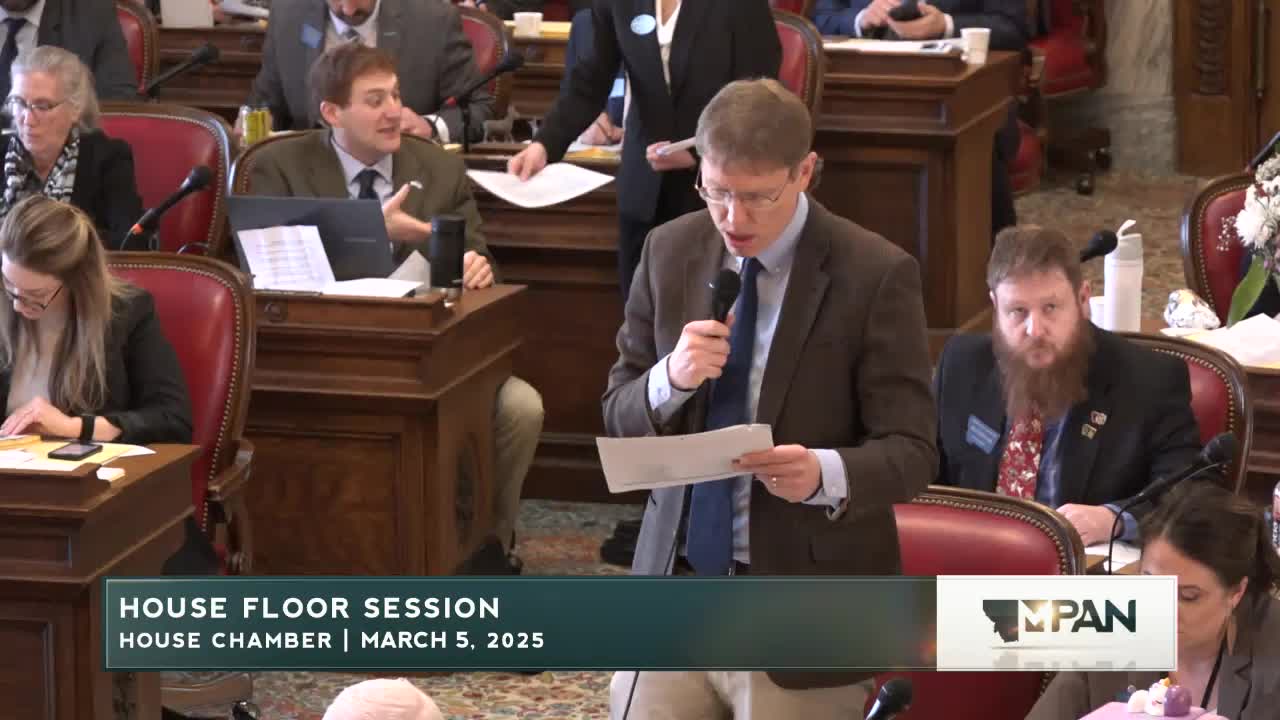
House Bill 676, introduced by Representative Lear, received detailed debate in the House Committee of the Whole on March 4, 2025, over provisions that would change how water rights tied to state lands are treated and set a target date related to the Water Court’s adjudication duty.
House Bill 676, introduced by Representative Lear, received detailed debate in the House Committee of the Whole on March 4, 2025. The bill, as read into the record, would generally revise laws related to state lands and water rights, including language described in the transcript as eliminating “the water court duty to adjudicate water rights on 07/01/2031,” prohibiting the Board of Land Commissioners from obtaining a private water right that is used on state lands, and requiring the sale of isolated parcels with water rights in certain circumstances.
The bill’s sponsor, Representative Lear, said the measure would protect agricultural lessees who invest in wells and other improvements on or near state trust land, and would “put the power back in the producer’s hands,” urging committee members to recommend passage. Representative Lear also characterized the proposal as setting a clear timeline for concluding the Water Court’s adjudication process while preserving the Legislature’s ability to revisit the date in future sessions.
Opponents pressed constitutional and practical concerns. Representative Griffith said the Montana Constitution vests water ownership in the state and warned that the bill attempts to “get around” constitutional principles; Griffith stated, “The water is owned by the state.” Griffith cited a Montana Supreme Court case (described in the discussion) and said the measure could be unconstitutional and that the Water Court is performing necessary work that should not be ended arbitrarily.
Representative Konauer asked members to vote no and said the bill’s approach to the Water Court should be handled through bills considered in the Legislature’s natural resources or interim water policy process rather than in a vehicle that did not come through natural resources. Konauer said, “We shouldn't be doing it in this bill that did not come to our natural resources committee,” and warned that the proposal could reduce the value and use of state trust lands if future lessees cannot use water associated with a parcel.
Other members, including Representative Clacken and Representative France, described experiences and stakeholder input. Clacken recounted local drought conditions and expressed concern about the state claiming rights to water privately developed and piped to state leases; he argued the approach would unfairly transfer value away from the private developer. Representative France said major agricultural groups and stockgrower organizations urged a no vote on the bill.
Representative Gillette questioned the sponsor about the bill’s timing and scope; Lear responded that the bill would not end Water Court activity immediately but would set a later date two biennia forward and allow the Legislature to extend or adjust that date in future sessions. Lear reiterated that water developed on private land and piped onto state land remains a core point of contention in the sponsor’s district.
The transcript records the sponsor’s motion in committee recommending the bill “do pass,” but the provided excerpt does not include a recorded committee vote on final disposition. The debate in the Committee of the Whole reflects multiple legal and operational concerns: constitutionality regarding state ownership of water, the appropriate venue for comprehensive water policy changes, impacts on the value and use of state trust lands, and how the Water Court’s workload and sunset should be managed.
Next steps noted in the excerpt: committee deliberation continued in the Committee of the Whole and the sponsor’s motion to recommend passage was on the record; no final committee vote or floor disposition of HB 676 appears in the supplied transcript segment.