Get Full Government Meeting Transcripts, Videos, & Alerts Forever!
Get email alerts on the Child Welfare It topic
No spam. Unsubscribe anytime.
Committee hears report on Katahdin child-welfare information system
Summary
Officials from the Office of Child and Family Services briefed a legislative committee on the Katahdin child-welfare information system, describing its federal origins, modular design, vendor contracts with Deloitte and Salesforce, and a 20-month development period that ended with a January 2022 go-live.
A legislative committee on Oct. 12 heard a briefing on Katahdin, the Office of Child and Family Services’ new child-welfare information system, which officials said replaced the state’s legacy MACWIS system and went live in January 2022.
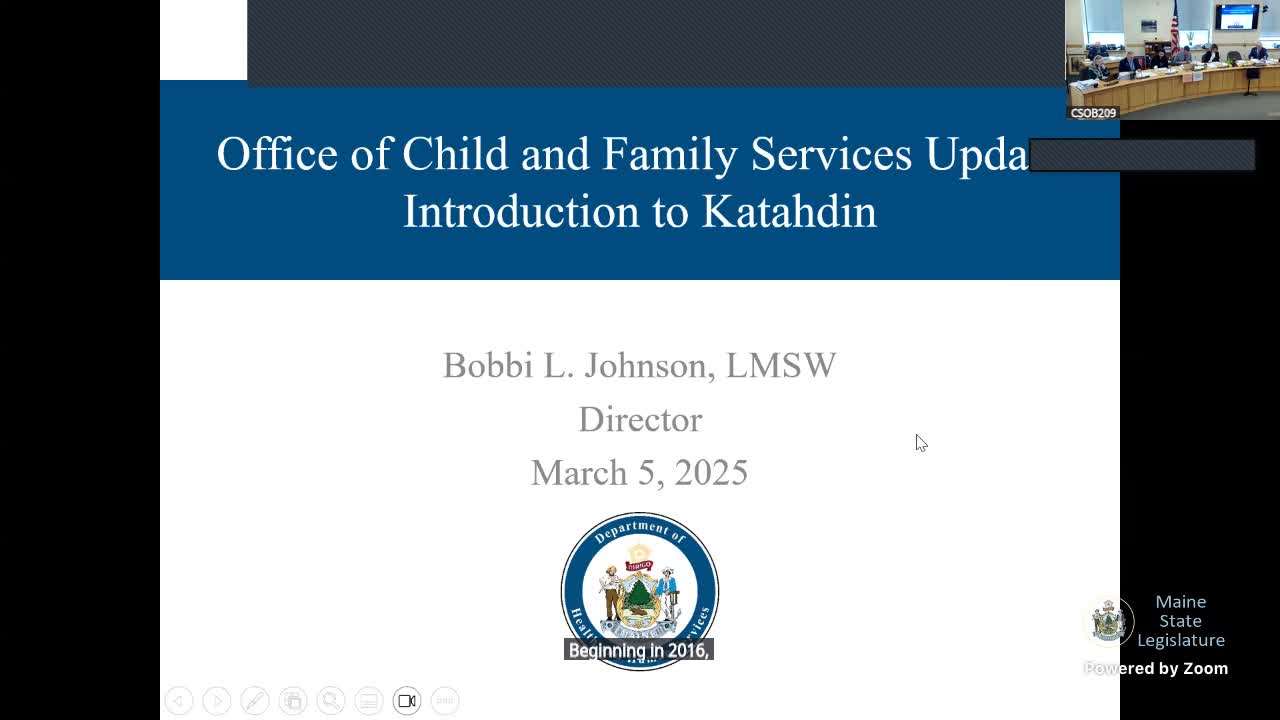
Senator Henry Ingwersen, chair of the committee, introduced the presentation. "Good morning again, everybody. ... I'm pleased to be the chair of this committee," Ingwersen said before the briefing. Bobby Johnson, director of the Office of Child and Family Services (OCFS), presented the report alongside Bob Blanchard, OCFS associate director of technology and support.
The presentation traced Katahdin’s origins to 2016 federal guidance from the Administration for Children and Families directing states to build a comprehensive child-welfare information system. "Beginning in 2016, the federal government, through the Administration for Children and Families, implemented regulations and guidance that directed states to develop what they called a comprehensive child welfare information system," Johnson said.
Johnson said the state chose a modular, data-focused design rather than the narrative-based approach used in the prior system, MACWIS. He told the committee the state issued an RFP in February (year not specified in the record) and awarded contracts to Deloitte and Salesforce. According to Johnson, the replacement was developed and implemented over a 20-month period beginning in April 2020 and going live in January 2022. He said the base software came from Delaware and that significant configuration was required to meet Maine’s requirements.
The presenters listed key goals for Katahdin: a web-based interface, structured supports for business workflows, tools to support continuous improvement of child-welfare practice, reduced duplicate data entry, and improved access to data and reporting. Johnson said the project assigned a program business lead drawn from district child-welfare staff to help align system design with practice needs.
The committee received the report; no formal vote or other committee action was recorded on the briefing during the session.
Less central details mentioned in the presentation—such as the exact month and year the RFP was issued and the specific scope of configuration work required—were not specified in the transcript.