Get Full Government Meeting Transcripts, Videos, & Alerts Forever!
Get email alerts on the Annual Performance Report topic
No spam. Unsubscribe anytime.
Canyon ISD holds public hearing on Texas Academic Performance Report; administrators say data in report lags current measures
Summary
At a public hearing, Canyon ISD staff presented the TAPR and annual performance report, noted much of the state-provided data is historic, and discussed discipline trends, vaping, attendance and a small drop in graduation rate since 2020.
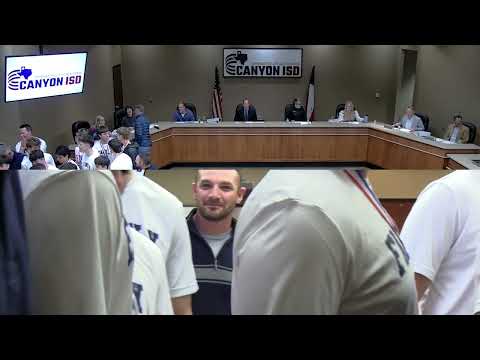
The Canyon ISD board held a public hearing Monday to present the district’s annual performance report and the Texas Academic Performance Report (TAPR). Administrators told trustees the report contains largely historical data the state requires for publication and that district staff use more up-to-date measures in their day-to-day decision-making.
Robin, the district’s safety and accountability presenter, told the board the TAPR binder includes the state-mandated sections — assessment performance, graduation and attendance, finance through PEIMS, campus performance objectives and special-education determinations — but much of the content covers earlier school years. She said the district will post the binder electronically and make it available at the front desk for review.
On discipline, staff reviewed three-year trends and flagged vaping as an ongoing concern, though administrators said recent counts suggested the vaping trend may be easing. A reporting error in the printed form was identified during the hearing: the district had recorded two violent/criminal incidents for the year and a board member pointed out the percentage printed on the state form should be about 0.001 percent rather than the larger 0.1 percent that the binder displayed; staff said they would correct the report.
Board members asked about attendance and graduation trends. Administrators said Canyon ISD’s graduation rate fell from about 97.6% in 2020 to about 95.6% in 2023 and acknowledged the district — like many across the state — has struggled with attendance since the COVID pandemic. Staff described ongoing outreach, home visits and targeted programming, and said the district tracks students who leave for GED pathways or alternative programs.
Administrators also discussed postsecondary and college-career military readiness measures, dual-credit completion, and the district’s House Bill 3 goals focused on third- and fourth-grade reading and math. A trustee asked whether campus differences in how some interventions are scheduled explain variation in interim CCMR (college, career and military readiness) numbers; administrators said scheduling choices, not necessarily weaker programming, largely account for short-term differences and they expected campuses to align over the full year.
There were no public comments during the hearing; the board closed the hearing after the presentation and questions.