Get Full Government Meeting Transcripts, Videos, & Alerts Forever!
Get email alerts on the University Raffles topic
No spam. Unsubscribe anytime.
Committee approves bill allowing university raffles under Amendment 84 with caveats on oversight
Summary
Lawmakers advanced House Bill 16‑34 to let Arkansas public universities run raffles under Amendment 84; sponsors and supporters said the bill provides a quicker path for fundraising but warned it lacks specific identity- and auditing-standards that rulemaking must address.
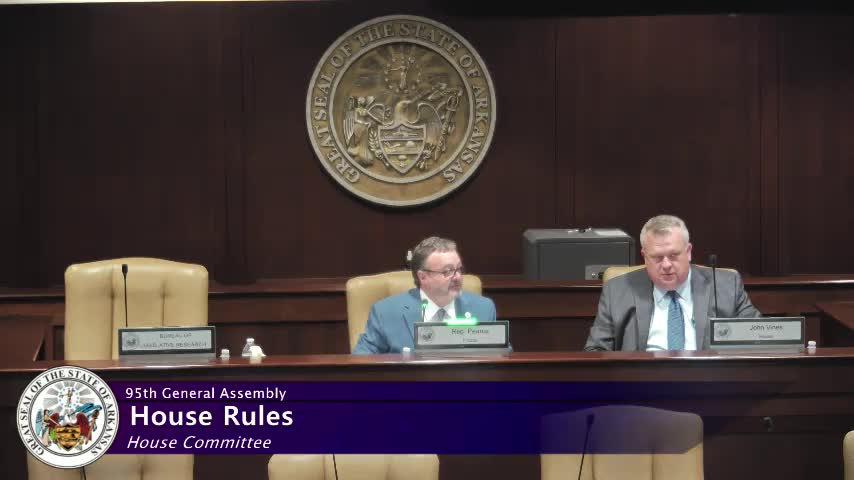
House lawmakers advanced House Bill 16‑34 on a voice vote after supporters argued the measure will let Arkansas public universities hold fundraising raffles under the constraints of Amendment 84 of the state constitution.
The bill, presented by Representative R. J. Hogg (District 81), would authorize universities to conduct raffles at sporting events and use proceeds for NIL scholarships, general athletic revenue, or facility construction and maintenance. Representative Matthew Shepard (District 97) and a representative of Saracen Casino Resort, Carlton Saffa, spoke in favor during the committee hearing.
Supporters said the new draft replaces earlier language and aims to be a clearer, single-text vehicle for in‑house raffles. Representative Hogg told the committee the bill “is going to allow for our universities in the state of Arkansas to have raffles, to use them at their sporting events, for NIL scholarships, general athletic revenue, or even for construction of facilities or maintenance.”
Why it matters: The bill moves quickly because sponsors included an emergency effective date; that means, as several speakers warned, the statute’s text will control until state rulemaking is completed. Carlton Saffa, speaking for Saracen Casino Resort, listed several technical and enforcement concerns that are not spelled out in the bill, including identity verification, the mechanics of a certified random-number generator, geolocation and intrastate limits, and audit authority for the state agency.
Saffa urged caution, saying the bill contains only a requirement that a university “shall conduct reasonable age verification” and ‘‘notably does not require identity verification.’’ He told the committee: “There is no identity verification and nothing more than reasonable efforts for age verification.” He also recommended involving Gaming Laboratories International (GLI) in rule development to certify random‑number generators and other technical controls.
Representative Shepard, who closed for the bill, said sponsors consulted with the attorney general’s office and the governor’s office and concluded Amendment 84 is the constitutional provision most likely to apply. Shepard said the bill includes rulemaking authority for DFNA and that “we included the age verification because the committee brought that up.” He added that more detailed technical and compliance standards could be established through rulemaking.
Committee members pressed sponsors on specifics. Concerns raised during discussion included: whether “reasonable” age verification is sufficient without identity checks; how winners will be selected in digital raffles; whether geolocation will be required to prevent interstate sales; and whether the state’s agency should have audit access to raffle accounts. Saffa warned a lack of auditing language would create “a can of worms” and cited litigation risk if university-related foundations resist disclosure.
Formal action: The committee called for the question, and a voice vote followed. The chair announced the result in the hearing that the bill had passed out of the committee. The transcript records vocal “aye” responses and the chair’s statement: “Congratulations. Your bill is passed.” Exact roll-call counts were not recorded in the transcript.
What remains: Sponsors and supporters repeatedly said more technical detail — identity verification, certified RNGs, geolocation, auditing and segregation of raffle funds — should be clarified in rules issued by DFNA. Several speakers said they expect the attorney general’s opinion and DFNA rulemaking to guide implementation.
Outlook: With committee approval, the bill moves to the next House stage. Supporters said the measure is intended to provide a legal option for university fundraising while staying inside the limits of Amendment 84; they cautioned it is not a comprehensive solution for NIL-related compensation problems.