Get Full Government Meeting Transcripts, Videos, & Alerts Forever!
Get email alerts on the Financial Regulation topic
No spam. Unsubscribe anytime.
Committee hears overhaul to Alaska money-transmission law to include virtual currency; regulators cite consumer losses
Summary
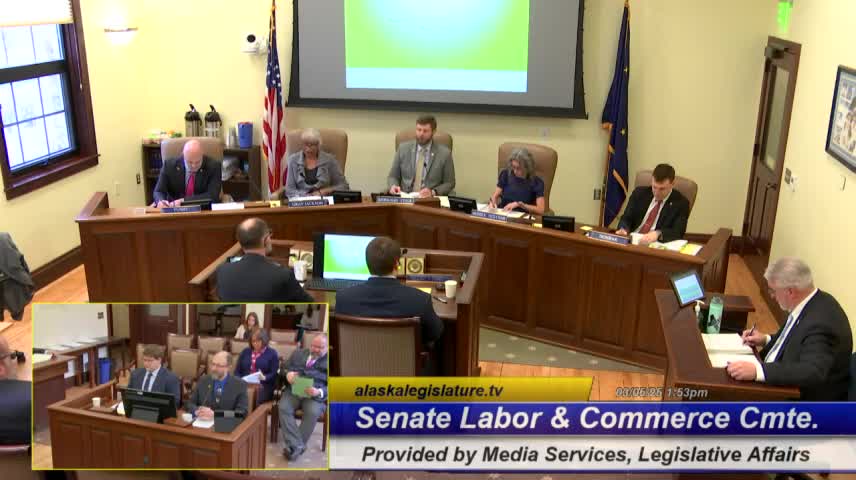
Senate Labor and Commerce heard first public testimony March 5 on Senate Bill 86, a comprehensive update to Alaska's money transmission statutes to incorporate virtual currency, adopt a model law, use the NMLS registry, tier fees by volume, and tighten safeguards including net-worth and recordkeeping requirements. Regulators told the committee Al
Senate Labor and Commerce took testimony March 5 on Senate Bill 86, a comprehensive modernization of Alaska’s money-transmission law that would explicitly include virtual-currency business activity, adopt a model framework used by other jurisdictions, and require use of the Nationwide Multistate Licensing System (NMLS) for licensing and background checks.
Senator Jesse Kiel, sponsor of SB 86, said the bill updates Alaska’s Uniform Money Services Act to better fit modern payment technologies and cryptocurrency. Kiel described the rubric as “fundamental, rudimentary safety and soundness” and said the goal is to ensure companies holding customer funds have the assets and controls to safeguard them.
Robert Schmidt, director of the Alaska Division of Banking and Securities, told the committee that money transmission is now a sizeable part of Alaskans’ finance flows. “Between the 4 types of money transmission, Alaskan sent or received $6,300,000,000 in 2024,” Schmidt said, and he reported more than 28 million money-transmission transactions occurred in 2024 (an average of about 53.6 transactions per minute across the year). He said Alaska now has roughly 73 licensed money transmitters, 30 of which transmit cryptocurrency, and that cryptocurrency transmission volume in Alaska increased about sixteenfold from 2020 to 2024.
Key bill provisions summarized by staff and the division include: use of NMLS for licensing and background checks; creation of a new article defining virtual-currency business activity and stating virtual currency held by licensees is not the licensee’s property; tiered renewal fees based on volume; expanded examination and recordkeeping powers (records retention from three to five years); authority to accept multi-state or independent exam reports; changes to net-worth and permissible investment rules; lowering the control threshold from 25% to 10% for certain definitions; and transitional provisions. The bill text also makes section 37 (cost recovery for investigations/prosecutions) effective only if a related indirect court-rule amendment is adopted by a two-thirds vote.
Regulatory rationale and examples: both the sponsor and the division cited recent collapses and bankruptcies in the cryptocurrency sector as reasons for modernization. Kiel and Schmidt referenced failures such as FTX, Voyager and Celsius as instances where customer assets were treated as corporate or bankruptcy estate assets rather than held for customers. Schmidt said the proposed changes “would have saved Alaskans millions of dollars had it been the law in 2022.”
Questions from senators covered scope and consumer protections: Senator Dunbar asked whether the division differentiates between widely used currencies (e.g., Bitcoin) and highly speculative “meme coins”; Director Schmidt replied the division regulates the exchanges (the dealers), not the intrinsic characteristics of a particular token, and noted that speculative investments are legal but that the division focuses on the licensee’s conduct and custody of customer assets. Committee members also asked about stored-value (reloadable) cards, unclaimed property, and where customer funds are held; Schmidt explained that stored-value balances are managed by issuers and sometimes by partner banks and that unclaimed property laws apply to dormant balances.
Committee action and next steps: the committee took testimony, heard questions, and set SB 86 aside for further consideration at a future meeting; no committee vote was recorded. Staff and the division remain available to provide sectional analysis and drafting as the committee considers amendments.
Background and scale: testimony described money transmission as an industry that now reaches most Alaskans through mobile apps, stored-value products, and cryptocurrency exchanges. The division provided aggregated self-reported industry figures; the bill would align Alaska with a model adopted by roughly 27 other jurisdictions and use the NMLS to increase licensing efficiency and multi-state coordination.
The committee will take additional action on SB 86 at a later date after receiving drafting updates and potential amendments.