Get Full Government Meeting Transcripts, Videos, & Alerts Forever!
Get email alerts on the Statehood Defense topic
No spam. Unsubscribe anytime.
Attorney general outlines statehood-defense program, cites 80-plus active cases and multiple federal challenges
Summary
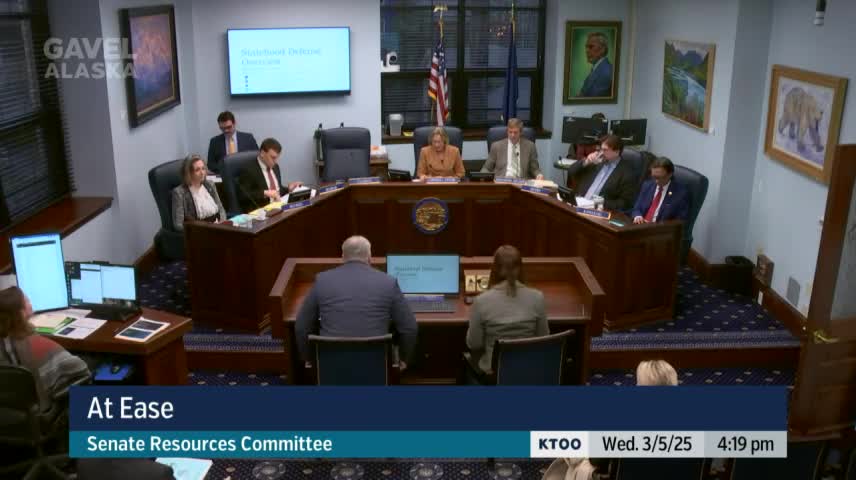
Attorney General Tregg Taylor told the Senate Resources Committee on March 5 that statehood defense is about "holding the federal government to the promises made to the state of Alaska statehood," and that the Department of Law coordinates weekly with DEC, DNR and ADF&G on litigation and technical work to protect state authority over lands, waters and resources.
Attorney General Tregg Taylor told the Senate Resources Committee on March 5 that Alaska’s statehood‑defense work aims to "hold the federal government to the promises made to the state of Alaska statehood," protecting the state’s ability to use its lands, waters and natural resources as intended at statehood.
Taylor said the Department of Law coordinates weekly with the Departments of Environmental Conservation, Natural Resources and Fish and Game on litigation and administrative matters. Corey Mills, deputy in the Department of Law’s civil division, told the committee the litigation load has risen from an average of 30–40 matters to "an active 80 plus cases in this arena," which the office is managing with a multiyear appropriation and a temporary increment added to the base budget.
What the committee heard: agencies described how statehood‑defense appropriations (first allocated beginning fiscal year 2021 and continued through fiscal 2024) support litigation, permitting engagement and technical work across multiple fronts.
- Department of Environmental Conservation (DEC): Acting Commissioner Christina Carpenter said DEC holds primacy for several federal programs in Alaska — programs under the Safe Drinking Water Act, the Clean Air Act, FIFRA (pesticide regulation), portions of RCRA (waste) and the Clean Water Act section 402 permitting program (APDES). DEC noted work on Waters of the United States (WOTUS) guidance, the Fairbanks PM2.5 State Implementation Plan (SIP) and a previous February 2021 action in which DEC issued 548 notices of intent to sue the federal government over contaminant cleanup responsibilities tied to lands conveyed to Alaska Native corporations under ANCSA; Congress subsequently appropriated $40 million and DEC received a $7 million appropriation to inventory and track those cleanups.
- Department of Natural Resources (DNR): Commissioner John Boyle emphasized navigability and submerged‑lands determinations as a core statehood defense priority. Boyle said Alaska estimates roughly "800,000 miles of navigable rivers and over 30,000,000 acres of navigable lakes," and that the federal government has formally acknowledged state title for a small share of that acreage. DNR’s public access assertion and defense (PAD) team collects navigability evidence and pursues determinations that affect selection by Alaska Native corporations and state resource management.
- Department of Fish and Game (ADF&G): Commissioner Doug Vincent‑Lang described three priorities: protecting the state’s authority to manage fish and wildlife, ensuring federal permitting uses the best available science, and challenging unwarranted endangered‑species listings and critical habitat designations. ADF&G said targeted scientific work has in some cases prevented listings or narrowed critical habitat designations (the department cited Pacific walrus work as an example) and flagged ongoing litigation such as petitions and appeals over Arctic ringed seals and bearded seals, incidental‑take rules for polar bears and Cook Inlet salmon management disputes.
Major litigation and issues identified by presenters:
- Pebble Mine/404(c): The state challenges EPA’s 404(c) determination, which covered roughly 300 square miles, arguing the agency’s action preempted state permitting and resource decisions; the state also has a Court of Claims action seeking compensation if the federal veto is upheld. Presenters said the 404(c) determination would block activity across a wide area and has prompted concurrent litigation.
- Lands into trust and native‑allotment jurisdiction: The state has litigation over the Bureau of Indian Affairs’ authority to take land into trust in Alaska and contested legal developments about tribal jurisdiction over native allotments, an issue tied to a recent administrative memorandum and to a separate Eklutna allotment/gaming dispute.
- Federal executive actions and regulatory primacy: Officials described executive orders and agency actions over recent administrations that change federal priorities or permitting practice and said state resources are being used to preserve fiscal stability and the state’s ability to manage resources. DEC emphasized the value of primacy for making locally informed regulatory decisions.
Why it matters: presenters argued that uncertain federal priorities, expansive administrative actions, and differing agency interpretations can restrict the state’s ability to permit and develop resources and that litigation and administrative engagement are necessary to secure legal certainty for resource development, community access and Alaska Native corporation selections.
Ending: Agency leaders told the committee they will continue coordination and litigation where necessary, and they noted the legislature’s multiyear appropriation and the temporary increment that together support the current case load through fiscal 2026. Committee members asked follow‑up questions on particular items — including the Fairbanks SIP, wood‑stove regulations, and funds tied to certain federal programs — and agencies said they would follow up with additional detail as needed.