Get Full Government Meeting Transcripts, Videos, & Alerts Forever!
Get email alerts on the Tax Policy Small Business Exemption topic
No spam. Unsubscribe anytime.
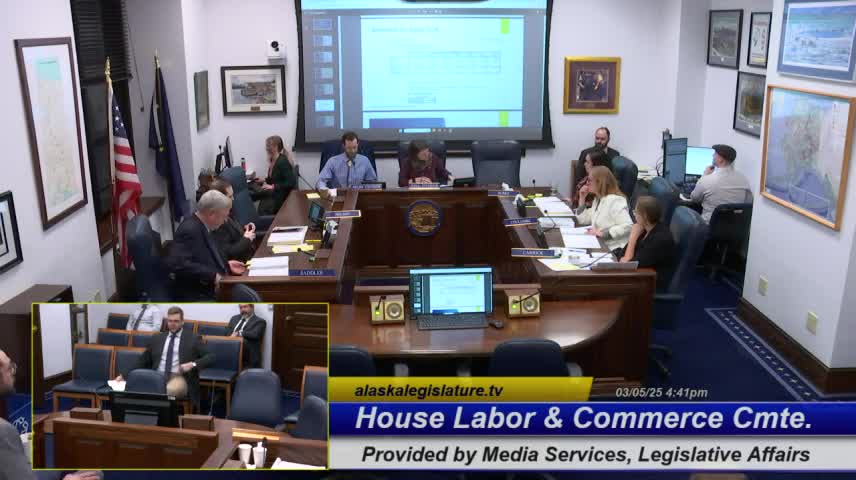
Committee amends and reports out small‑business tax exemption bill after three amendments
Summary
House Bill 113, the small business tax exemption bill, was amended three times in committee — including a sunset/notification amendment, a resurrected film tax credit amendment, and a cap on foregone revenue — and was reported out of committee as amended.
The House Labor and Commerce Committee considered and amended House Bill 113, a measure to reinstate a small‑business tax exemption. Committee members adopted three amendments and then voted to report the bill out of committee as amended with individual recommendations and accompanying fiscal notes.
Nut graf: The committee adopted (1) Amendment 1 (Representative Sadler) requiring Department of Revenue notification to previously participating businesses and a 10‑year sunset on the exemption; (2) Amendment 3 (Representative Fields), with a conceptual modification to expand the rural population threshold from 4,500 to 7,500, to add a film production tax credit modeled on a prior program; and (3) Amendment 4 (Representative Kerrick) capping total foregone revenue from the exemption at $2,700,000. After adopting the amendments the committee approved reporting the bill out of committee as amended.
Amendment actions and roll calls: Representative Sadler moved amendment 1 (134LS064\Alpha.1); the committee adopted it by unanimous consent. Representative Fields moved amendment 3 (conceptual amendment adopted to change the rural population threshold from 4,500 to 7,500); the roll call recorded 4 yeas and 3 nays with the yeas from Representatives Burke, Kerrick, Fields and Hall and nays from Representatives Nelson, Colom and Sadler. Representative Kerrick moved amendment 4 to cap the amount of foregone revenue at $2,700,000; a roll call also passed 4 yeas and 3 nays (Kerrick, Burke, Fields, Hall in favor; Colom, Nelson, Sadler opposed).
Final committee action: After amendment votes the committee accepted the motion to report HB 113 out of committee as amended with individual recommendations and accompanying fiscal notes; no roll call was recorded on the final motion and co‑chairs declared the bill reported with no objections.
Questions and debate: Members debated the efficacy and cost of resurrecting the film tax credit, whether film credits were transferable and could be purchased (a point members asked to have the administration confirm after the hearing), and the business impacts of a renewed exemption. Representative Sadler objected to the film tax credit amendment on fiscal and policy grounds, while Representative Fields and others said prior beneficiaries reported work and jobs when a film credit existed previously.
Ending: Committee members were asked to stay to sign the committee report for HB 113; the committee concluded business for the day.