Get Full Government Meeting Transcripts, Videos, & Alerts Forever!
Get email alerts on the Plastic Pollution Foodware Ban topic
No spam. Unsubscribe anytime.
Sponsor urges statewide ban on polystyrene food service ware; committee sets amendment deadline
Summary
Representative Andy Josephson introduced HB 25, which would ban disposable polystyrene food service containers statewide; sponsor and environmental advocates cited human health and marine pollution concerns. The committee set an amendment deadline for March 13 at 10 a.m.
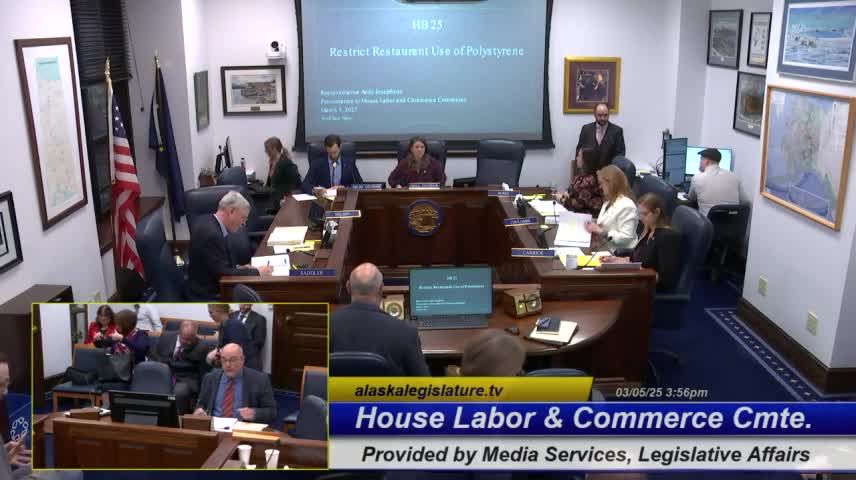
Representative Andy Josephson presented House Bill 25 on March 5, a first hearing to prohibit disposable expanded and extruded polystyrene (commonly called Styrofoam) food service ware in restaurants, food wagons and on the state ferry system. Josephson and invited experts told the House Labor and Commerce Committee that the product is a persistent pollutant and that styrene, the monomer in polystyrene, has documented health risks.
Nut graf: The bill would prohibit polystyrene food service packaging statewide, allow exemptions for packaged food prepared out of state and for businesses demonstrating that affordable alternatives are unavailable or that compliance would create undue hardship, and direct DEC (the Department of Environmental Conservation) to enforce violations under existing sanitary code procedures and fines.
Sponsor testimony: Josephson said many jurisdictions have banned polystyrene and that alternatives (paper, wood, bamboo, compostable plant‑fiber containers) are available. "It is known to be a human carcinogen that can contribute to leukemia and lymphoma," Josephson said during his presentation, describing studies on styrene and listing organ systems that research has associated with exposure. He also cited local testing that found microplastics in multiple water sources in Southcentral Alaska.
Invited testimony: Pamela Miller, executive director and senior scientist with Alaska Community Action on Toxics (ACAT), testified in support, saying polystyrene is hazardous, leaches styrene into hot, acidic or fatty foods, and fragments into microplastics that persist and travel long distances. Miller said plant‑based compostable alternatives are available in Alaska and cited Green Alaska Solutions as a local supplier.
Committee questions and concerns: Committee members focused on enforcement, definitions of affordability and undue hardship for small vendors and street vendors, and potential cost impacts to small businesses, especially in rural areas and among food‑wagon vendors. Representative Sadler asked how the department would define affordability or undue hardship; Josephson said the department would need to develop regulations and definitions in the Alaska Administrative Code if the statute passes. Representative Colom and others pressed about which products the bill would cover; ACAT and the sponsor clarified the bill targets polystyrene food packaging (cups, clamshells, trays).
Process: The committee set an amendment deadline for HB 25 at 10 a.m. on March 13. No vote to report the bill out of committee was taken at the hearing; the bill was set aside for future consideration.
Ending: The committee heard multiple perspectives on small business impacts and rural enforcement, and the sponsor and invited experts offered to provide additional product and cost information to the committee before the amendment deadline.