Get Full Government Meeting Transcripts, Videos, & Alerts Forever!
Get email alerts on the Education Funding topic
No spam. Unsubscribe anytime.
Sponsor outlines overhaul to school funding formula; bill would shift to single statewide appropriation
Summary
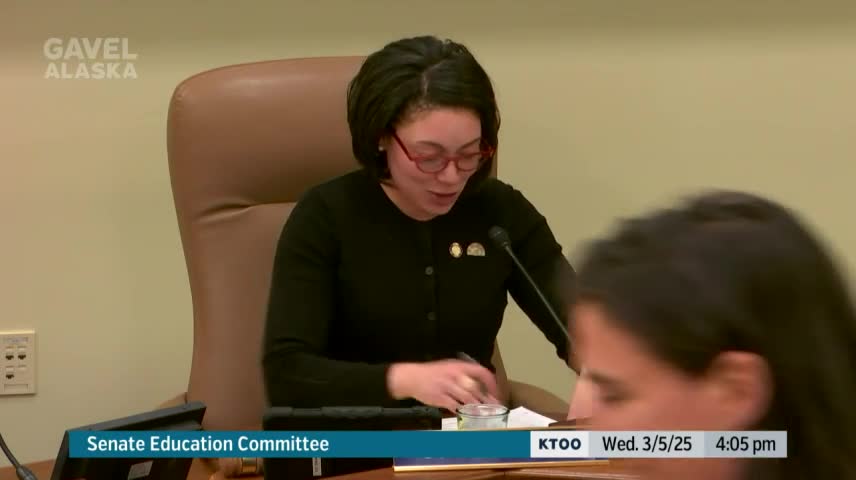
Senate Bill 46 would replace the base student allocation with a single statewide appropriation for public education and change how district state aid is calculated, sponsor Matt Klayman told the Senate Education Committee.
Senate Bill 46, presented to the Senate Education Committee on March 5 by sponsor Senator Matt Klayman of West Anchorage, would replace the statutory base student allocation process with a single, direct statewide appropriation for public education and change how district aid is calculated.
Klayman said the change is intended to simplify a two-step process he described as confusing to school districts and the public. “Instead of using a 2 step BSA approach, this bill proposes a single direct appropriation for public education,” he told the committee, and said the bill would keep existing programmatic adjustments (special education weights, career and technical education, cost-of-living factors) while shifting the starting point for budgeting to the total state appropriation.
Under the bill’s proposed calculations, the legislature’s total state aid appropriation would be combined with required local contributions and federal impact aid to determine a statewide basic need figure; districts would then receive shares of that total based on each district’s percentage of adjusted average daily membership. Sections in the draft also remove references to the “public education fund,” require the governor to publish two annual reports showing prior- and current-year education expenditures adjusted for inflation, and set an effective date of July 1, 2025.
Committee members asked technical and policy questions. Senator Kiel and others pressed whether the bill simply changes the starting point for political budgeting or whether it meaningfully constrains future appropriations; Klayman said the proposal is intended to create a more transparent baseline so the public and districts can see the effect of increases or cuts. Senator Kiel and other members also probed how required local contributions and federal impact aid are treated in the new calculation; Klayman and his staff said the language subtracts each district’s required local contribution and federal impact aid after calculating district basic need.
Public testimony on the bill included a two-minute comment from Rebecca Emerson, a parent from Palmer, who urged the committee to ensure special education funding follows students and to increase transparency and resources for students with disabilities.
The committee did not finalize SB 46 during the March 5 meeting. Chair Tobin paused the bill’s fiscal-note review and moved to public testimony and the day’s scheduled presentation so the sponsor could return for further questions at a later meeting.
Ending: Committee members asked the sponsor to return with clarifications about drafting intent and identified a need for follow-up on fiscal implications before the bill advances further.