Get Full Government Meeting Transcripts, Videos, & Alerts Forever!
Get email alerts on the Financial Regulation Money Transmission topic
No spam. Unsubscribe anytime.
Committee adopts substitute for money‑transmission bill, raises maximum civil penalty and sets amendment deadline
Summary
The Labor and Commerce Committee adopted a committee substitute to House Bill 99, increasing a proposed civil penalty from $1,000 to $10,000 to align with mortgage civil penalties and authorizing transition regulations; the committee set an amendment deadline of March 10.
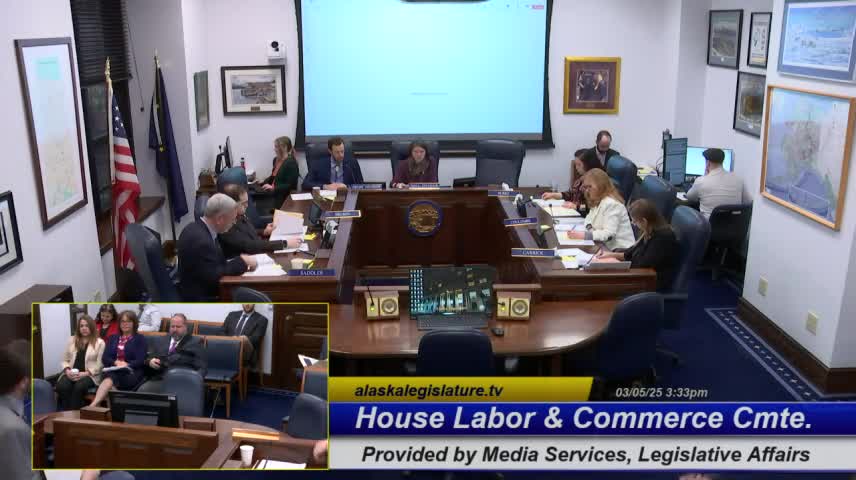
The House Labor and Commerce Committee adopted a committee substitute for House Bill 99, a measure that would regulate money transmission and virtual currency, and set an amendment deadline for Monday, March 10 at 10 a.m., co‑chair Fields said. The committee substitute includes changes that raise a civil penalty to $10,000 and gives the department authority to adopt transition regulations and to delay the bill's effective date by six months.
Nut graf: The substitute aligns civil penalties for money service businesses with penalties used in the mortgage statute and moves the effective date to July to allow rulemaking, public comment and a renewal period; the division director said the change will make the division self‑sustaining by enabling volume‑based fees tied to business size.
Summary of key changes: Evan Anderson, staff to co‑chair Fields, summarized the committee substitute. "On section 37, page 38, we are removing a fine, for, that says a thousand dollars and adding in a fine for $10,000," Anderson said. Section 68 allows the department to adopt transition regulations after the bill's effective date. Section 71 pushes the effective date back from January to July to give the department more time for rulemaking, public comment, and licensing renewals.
Administration testimony and fiscal note: Director Robert Schmidt of the Division of Banking and Securities told the committee the bill is intended to make the division self‑sufficient by permitting volume‑based licensing fees ("volume equals risk") and to expand examination and enforcement capacity. Schmidt said the division's examiners have been understaffed given industry growth and proposed five new positions (PCNs) over two years. Dawn Hanish, division operations manager, said the fiscal note requested five new PCNs (three in year one, two in year two) and one‑time equipment costs for onboarding and telework needs.
Penalty rationale and enforcement: When asked what conduct could trigger civil penalties up to the maximum, Schmidt said the mortgage statute allows civil penalties of up to $10,000 and that the maximum would attach to the "most egregious conduct" such as criminal activity or other large‑scale misconduct. "You heard me right when I said that there are bad people that do bad things," Schmidt added, noting monthly reports of elder scams involving cryptocurrency that often move funds offshore.
Committee process: The committee adopted the substitute as the working document after Representative Fields moved to adopt it and there being "no objection." The committee set an amendment deadline for Monday, March 10 at 10 a.m.; co‑chair Fields said the deadline could be extended if members needed LegisLegal's assistance to draft changes.
Ending: Committee members said they would review the fiscal note and proposed fee schedule; the committee did not vote to report the bill out at this meeting and left the bill for future consideration.