Get Full Government Meeting Transcripts, Videos, & Alerts Forever!
Get email alerts on the Workforce Cdl Implementation topic
No spam. Unsubscribe anytime.
DMV to begin issuing non‑domiciled commercial driver licenses after statutory updates
Summary
The House Labor and Commerce Committee heard an update that the Alaska Division of Motor Vehicles will begin issuing non‑domiciled commercial driver permits and licenses in April, implementing 2023–2024 statutory changes that removed residency barriers for UHP and TPS holders.
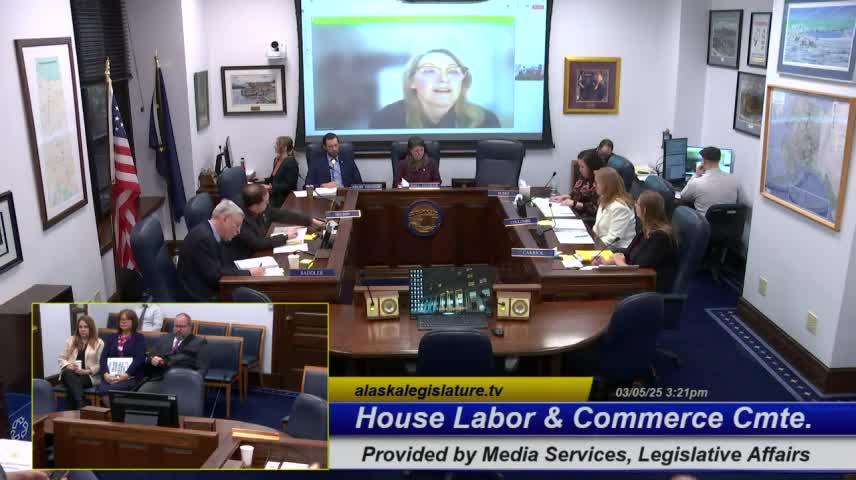
The Alaska Division of Motor Vehicles will begin issuing official non‑domiciled commercial learner permits (CLPs) and commercial driver licenses (CDLs) in April, DMV Director Kathleen Wallace told the House Labor and Commerce Committee on March 5. Tatiana Robbins, executive director of Project Alaska Inc., and labor representatives said the change should allow refugees and other newcomers with prior CDL experience to enter Alaska's truck driver workforce sooner.
The update came after Representative Julie Colom described a barrier that prevented Ukrainian refugees and other newcomers from getting CDLs because Alaska law previously required a one‑year wait after obtaining an Alaska driver's license. "In 2023, which removed the amount of years residency requirement," Representative Colom said, and Representative Colom and others then pursued further statutory alignment so non‑domiciled statuses would be eligible for CDLs.
Nut graf: The change implements statutes passed in 2023 and 2024 (including a 2024 law that Representative Robbins said was signed on 08/30/2024) that removed residency-year requirements and allowed non‑domiciled CLP/CDL issuance for people with Uniting for Ukraine (U4U) and Temporary Protected Status (TPS). Committee testimony said Alaska faces a shortage of roughly 500 truck drivers; committee members and workforce trainers said earlier DMV practices were slowing placement of trained drivers into jobs.
Committee testimony: Tatiana Robbins, executive director of Project Alaska Inc., told the committee that Project Alaska had served more than 2,000 Ukrainians and other newcomers since 2022 and that many have heavy‑equipment and truck experience but were unable to obtain CDLs under prior DMV practice. "We were waiting since August for that joyful news, which we received yesterday that we finally will be able to help our clients to apply for CDL license," Robbins said.
Patrick Fitzgerald of Teamsters Local 959 explained how apprenticeship and third‑party testing interact with DMV licensing, noting apprentices typically must hold a personal driver's license for one year under the Teamsters' program before entering apprenticeship steps that lead to CDL road testing. Fitzgerald described the union and its training trust as a third‑party testing provider that submits results to the DMV so trainees can receive a physical CDL at DMV offices.
DMV implementation: DMV director Kathleen Wallace told the committee the division currently has a workaround allowing issuance of a CDL or CLP now, and that beginning in April the division will issue the official non‑domiciled CLP or CDL. "Currently, we have a workaround where these folks could be issued, a CDL or CLP right now. In April, beginning in April, they will be able to be issued the official non domiciled CLP or CDL," Wallace said. The committee was told staff training and processing work remains and that full implementation timelines are being finalized.
Impact and next steps: Committee members asked for clarification about the immediate availability for people who already hold CDLs from other states and are returning to Alaska; Robbins and others said people who hold an out‑of‑state CDL may be able to obtain an Alaska CDL now via the workaround and that full training and permit issuance should be in place within roughly two weeks to a month. Committee members did not take formal action on this update; staff and administration officials said they will continue coordinating implementation and training.
Ending: Committee staff noted administration contacts are available for follow‑up and no committee vote was required for this informational update. The committee moved on to the next agenda item after setting no new deadlines related to this presentation.