Get Full Government Meeting Transcripts, Videos, & Alerts Forever!
Evanston amends landlord-tenant rules: new fee caps, enhanced tenant protections, and disclosure requirements
Summary
Evanston’s amended residential landlord-tenant ordinance, effective Jan. 1, tightens limits on late and move-in fees, expands tenant protections against lockouts and retaliation, updates notice and repair timelines, and requires new disclosures and a model lease option for landlords.
The City of Evanston updated its residential landlord-tenant ordinance effective Jan. 1 of this year, adding new caps on late fees and move-in charges, clarifying landlord entry and repair timelines, and expanding tenant protections against lockouts and retaliation.
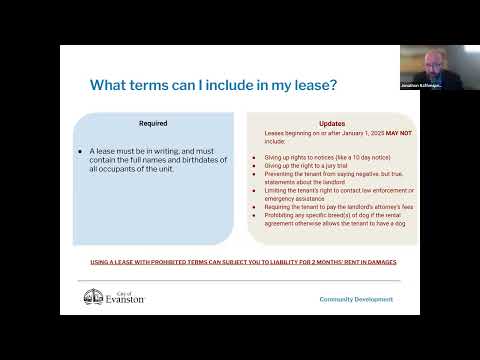
The changes, presented in a city webinar by Anna Elizarga, Housing and Economic Development Analyst for the City of Evanston, and John Raffensperger, supervising attorney for the Law Center for Better Housing, apply to most traditional rental units and were described as aligning Evanston’s rules with those in Chicago and Cook County. Raffensperger said, “the new ordinance became effective on January first of this year, so it is presently in effect.”
Why it matters: The ordinance alters financial and operational practices for landlords and gives tenants clearer remedies and notice rights. Landlords who do not update leases and procedures risk civil liability under the ordinance, including possible damages noted by presenters.
Key changes and requirements
Late fees and application/move-in charges: Landlords may not charge late fees greater than $25 when monthly rent is $1,600 or less. For rent above $1,600, the maximum late fee is $25 plus 5% of the portion of rent above $1,600 (example given in the webinar: $1,700 rent yields a $30 maximum late fee). Application, credit-check and move-in fees must reflect the landlord’s reasonable cost for those specific services and, where charged as an administrative or move-in fee, must be itemized to tenants. Presenters warned that unlawful fee provisions in new leases can expose landlords to damages (as discussed during the webinar).
Security deposits and related rules: Security deposits remain…
Already have an account? Log in
Subscribe to keep reading
Unlock the rest of this article — and every article on Citizen Portal.
- Unlimited articles
- AI-powered breakdowns of topics, speakers, decisions, and budgets
- Instant alerts when your location has a new meeting
- Follow topics and more locations
- 1,000 AI Insights / month, plus AI Chat