Get Full Government Meeting Transcripts, Videos, & Alerts Forever!
Get email alerts on the Residential Landlord Tenant topic
No spam. Unsubscribe anytime.
Evanston amends landlord-tenant rules: new fee caps, enhanced tenant protections, and disclosure requirements
Summary
Evanston’s amended residential landlord-tenant ordinance, effective Jan. 1, tightens limits on late and move-in fees, expands tenant protections against lockouts and retaliation, updates notice and repair timelines, and requires new disclosures and a model lease option for landlords.
The City of Evanston updated its residential landlord-tenant ordinance effective Jan. 1 of this year, adding new caps on late fees and move-in charges, clarifying landlord entry and repair timelines, and expanding tenant protections against lockouts and retaliation.
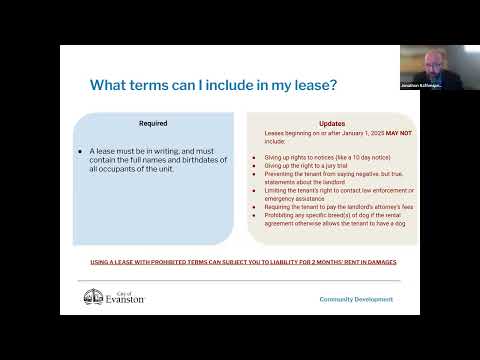
The changes, presented in a city webinar by Anna Elizarga, Housing and Economic Development Analyst for the City of Evanston, and John Raffensperger, supervising attorney for the Law Center for Better Housing, apply to most traditional rental units and were described as aligning Evanston’s rules with those in Chicago and Cook County. Raffensperger said, “the new ordinance became effective on January first of this year, so it is presently in effect.”
Why it matters: The ordinance alters financial and operational practices for landlords and gives tenants clearer remedies and notice rights. Landlords who do not update leases and procedures risk civil liability under the ordinance, including possible damages noted by presenters.
Key changes and requirements
Late fees and application/move-in charges: Landlords may not charge late fees greater than $25 when monthly rent is $1,600 or less. For rent above $1,600, the maximum late fee is $25 plus 5% of the portion of rent above $1,600 (example given in the webinar: $1,700 rent yields a $30 maximum late fee). Application, credit-check and move-in fees must reflect the landlord’s reasonable cost for those specific services and, where charged as an administrative or move-in fee, must be itemized to tenants. Presenters warned that unlawful fee provisions in new leases can expose landlords to damages (as discussed during the webinar).
Security deposits and related rules: Security deposits remain limited to 1.5 times one month’s rent. Landlords must hold deposits in a federally insured bank account located in Illinois and keep them separate from operating funds. Deposits must be returned within 21 days of move‑out or, if withheld, accompanied by an itemized statement of deductions within the same 21-day period. The ordinance removes the prior requirement that landlords pay interest on security deposits. The ordinance also prevents landlords from evading deposit rules by relabeling deposits as nonrefundable fees.
Required disclosures at lease start or renewal: Landlords must disclose, in writing, the owner/manager contact information, which party pays utilities and the last 12 months’ utility costs, any building-code violations within the prior year, whether the city or utilities have threatened to terminate service, any foreclosure in process or threatened, lead-hazard disclosures, and information on detecting, reporting and remediating bed bugs. Presenters noted the city will post a model lease and FAQ on the City of Evanston website.
Repairs, tenant remedies and timelines: Landlords must maintain units in compliance with building code and applicable laws and cannot shift maintenance obligations to tenants unless a separate written agreement provides compensation. The ordinance expands the definition of “essential services” to include air conditioning and Internet where the lease provides those services. If a tenant follows the ordinance’s written-notice procedures and the city cites the condition as a code violation, the landlord generally must address the condition within 10 days (the ordinance reduced the landlord response period from 14 days to 10). Tenants who comply with the repair-and-deduct procedure may spend up to $500 or one-half of the monthly rent (whichever is greater) to fix conditions and deduct the cost from rent, provided they follow the ordinance notice and contracting rules.
Withholding rent and pay-and-stay: Tenants may withhold rent only under limited conditions: the landlord receives written notice, the city cites the condition as a code violation, and the landlord does not remedy it within the 10-day period. The withheld amount must reasonably reflect the reduced rental value. Separately, a tenant may exercise a one-time right per tenancy to pay owed rent plus legal costs (but not attorney fees) after a nonpayment notice has expired and require the landlord to accept payment, which would terminate a pending eviction related to that missed payment unless a court issues an eviction order.
Notices, entry and renewals: Nonpayment notices remain 10 days. For lease violations other than nonpayment, landlords must give 30 days written notice and an opportunity to cure; accepting rent for a period after receiving such a notice can be treated as reinstating the tenancy. The prior owner-occupied two-flat exception to shorter notices was removed: all tenants under the ordinance now receive the same notice protections. Landlords must give at least two days’ notice before entering a unit for nonemergencies; reasonable visiting hours are presumed to be 8 a.m. to 8 p.m. A landlord may show a unit to prospective renters within 90 days before a lease ends.
Retaliation, assembly and lockouts: The ordinance expands protected tenant conduct to include complaining to community organizations or the media, organizing tenants, testifying in court or administrative proceedings, and exercising rights under the Illinois Safe Homes Act. Rules and regulations may not be used to bar tenant assembly or communication about building issues. Lockouts and other unlawful interruptions of tenancy are explicitly prohibited and include changing or removing locks, blocking entrances, removing fixtures or appliances (except when temporarily removed to make repairs), interfering with essential services including Internet service, and removing tenant property from the unit. Presenters warned such acts can lead to fines and civil liability.
Practical notes for landlords and tenants
The city has posted a model lease and a promised FAQ document to help landlords comply; webinar presenters recommended updating lease forms and fee practices promptly. Landlords were advised to document written notices (email plus mailed letter or certified mail) to ensure proof of service if disputes arise. Presenters also encouraged itemizing any move-in or administrative fees so they reflect actual costs.
What the webinar did not decide
The webinar provided interpretation and illustrations of the ordinance but did not include formal legal rulings or court decisions. Presenters referred to the Illinois Eviction Act when explaining service of notices and to federal lead-disclosure requirements for lead hazards but did not announce further local legislation during the session.
Resources and follow-up
City staff said the webinar recording, model lease and an FAQ will be posted on the City of Evanston website and that unanswered questions would be addressed via the published FAQ or Evanston 311. Presenters encouraged landlords to consult the posted materials and, when needed, legal counsel for complex disputes.