Get Full Government Meeting Transcripts, Videos, & Alerts Forever!
Get email alerts on the K 12 Funding topic
No spam. Unsubscribe anytime.
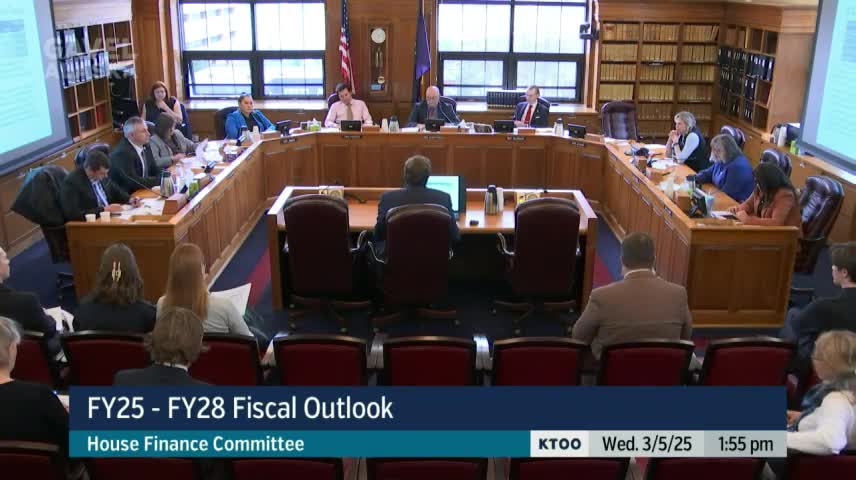
Committee hears how enrollment shifts and multipliers are reshaping K‑12 costs
Summary
Legislative Finance told the House Finance Committee that declining brick‑and‑mortar enrollment, growing correspondence counts and rising counts of intensive special‑education students have changed how increases to the base student allocation (BSA) flow to school districts.
Legislative Finance presented a focused accounting of K‑12 cost drivers to the House Finance Committee, showing that demographic shifts and the formula’s multipliers have amplified the fiscal impact of changes to the base student allocation (BSA).
Lehi Painter, legislative fiscal analyst, told the committee the FY2026 baseline projects fewer students and that the mix of correspondence versus brick‑and‑mortar students has shifted significantly over the last decade. He said that correspondence Average Daily Membership (ADM) rose from about 12,000 to roughly 22,000 while non‑correspondence (in‑person) ADM fell by roughly 16,000 students over the same period.
Why it matters: the K‑12 formula uses the base student allocation plus several multipliers and adjustments (school size, cost factors, special needs factor and special education intensives). Painter showed that a dollar added to the BSA in FY2011 now has a greater effect on district funding because of those multipliers—what was $1 became about $2.28 in impact under current multipliers. He also emphasized a growth in students qualifying for the special education intensives: those students are counted at 13 times the BSA, so increases in that count drive funding materially higher.
Supporting detail: the FY2025 enacted budget included roughly $175 million in one‑time outside‑the‑formula K‑12 additions; the governor’s education omnibus (House Bill 76 / SB 82) carries fiscal notes totaling roughly $116 million for FY2026 (and larger in FY2027), and a tribal compacting proposal carries additional fiscal notes (discussed in committee). The House rules committee version of a BSA‑increasing bill under consideration would add $1,000 to the BSA in FY2026 and was estimated in staff scenarios to add hundreds of millions in FY2026 costs when combined with additional targeted grants (for example, reading proficiency incentives).
Committee members asked whether formula dollars earmarked for special education and other factors are tracked to individual students. Painter said the system currently provides a special needs factor as a block grant and separate intensives funding; he offered to follow up with the Department of Education and Early Development on reporting and whether districts must account for the specific use of block‑grant dollars.
Ending: Members noted potential cliffs when hold‑harmless provisions (which phase out over several years) end, and cautioned districts may face consolidation decisions and facility costs even if statewide totals decline. Legislative Finance proposed to provide additional analytic follow‑up for per‑student total spending and reporting of special education flows.